Helping design and engineering professionals discover, evaluate and specify technologies and processes that shorten the design cycle and enable success.



Digital Engineering April 2026
In the latest issue of Digital Engineering, we take a look at the latest innovations in design for additive manufacturing, including the use of natural language inputs, social media cosplayers, and AI integration. The issue also includes a feature…

January Special Focus Issue: Design for Additive
In this Special Focus Issue of Digital Engineering, learn about the latest advancements in design for additive manufacturing, including new software tools, additive in automotive, custom medical devices, and more.
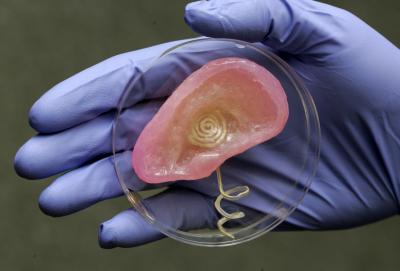
Where Cornell researchers were focused on creating a prosthetic for children who suffer from a congenital deformity, Princeton’s team has put its efforts toward battling hearing loss. Princeton’s ear was built using AM to combine biology and electronics. The result is a prosthetic that could not only boost a user’s hearing, but also allow him to pick up radio signals.
"In general, there are mechanical and thermal challenges with interfacing electronic materials with biological materials," said Michael McAlpine, an assistant professor of mechanical and aerospace engineering at Princeton and the lead researcher. "Previously, researchers have suggested some strategies to tailor the electronics so that this merger is less awkward. That typically happens between a 2D sheet of electronics and a surface of the tissue. However, our work suggests a new approach — to build and grow the biology up with the electronics synergistically and in a 3D interwoven format."
The researchers used an ordinary 3D printer to mix hydrogel and calf cells with silver nanoparticles. The calf cells eventually develop into cartilage, and the silver nanoparticles form an antenna. This combination essentially forms a biological/technological body part that sci-fi fans might name a cybernetic ear.
While this is a cool development, don’t expect to be replacing hearing aids with cyber ears just yet. Although the theory is sound, the researchers have yet to figure out how to connect the ear with nerve endings that would allow for hearing. Once that hurdle is crossed, the prosthetic will have to go through the standard rounds of medical testing before it becomes available to the general public.
Below you’ll find a video about Princeton’s achievement.
Source: EurekaAlert


John Newman is a Digital Engineering contributor who focuses on 3D printing. Contact him via [email protected] and read his posts on Rapid Ready Technology.
Follow DE
Join over 90,000 engineering professionals who get fresh engineering news as soon as it is published.






About Us · Contact Us · Editorial Team · Advertising · Privacy Policy · Subscriber Services · © 2026 Digital Engineering 24/7 · Peerless Media