Helping design and engineering professionals discover, evaluate and specify technologies and processes that shorten the design cycle and enable success.


Alert!
Digital Engineering ceased publication on July 1, 2026. This website remains available as an archive of engineering content.
For inquiries or information, please email [email protected].

Digital Engineering April 2026
In the latest issue of Digital Engineering, we take a look at the latest innovations in design for additive manufacturing, including the use of natural language inputs, social media cosplayers, and AI integration. The issue also includes a feature…

January Special Focus Issue: Design for Additive
In this Special Focus Issue of Digital Engineering, learn about the latest advancements in design for additive manufacturing, including new software tools, additive in automotive, custom medical devices, and more.
The newest application for AM in aerospace is the creation of in situ printed electronics to help monitor aerospace components. Research performed at the Welsh Centre for Printing and Coating (WCPC), part of Swansea University, used Optomec’s aerosol jet process to print strain and optical creep sensors directly onto jet engine compressor blades.
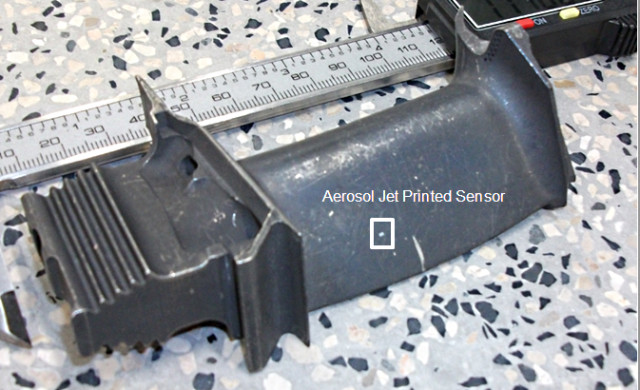 3D printed sensors are nearly invisible on the jet engine part. Courtesy of WCPC.
The printed sensors monitor the condition of the blades in real time, offering the potential for higher running speeds and increased fuel efficiency. Additionally, the sensors could reduce maintenance time by automatically generating hard data about the blades that would otherwise require additional time in the maintenance crews.
Optomec’s aerosol jet process operates by spraying a layer of conductive nano-silver ink that is directed by a flow guidance deposition head. While it may sound as accurate as spraying water out of a plant mister, the nozzle that directs the material flow is able to focus the stream to within 10 µm. Following deposition, a thermal post-treatment sets the material in place.
Along with being nearly invisible to the naked eye, the nano-silver ink is also heat resistant up to 482°F. WCPC researcher are currently at work to improve that number by developing a new nano-platinum ink capable of operating at up to 2192°F. The ability to continue sensor duties at higher temperatures is critical if the sensors are to have practical applications.
Previous experiments with Optomec’s process have printed electronics directly into UAV parts, and this is unlikely to be the last time researchers find new ways to use 3D printed sensors. Below you’ll find a video that discusses the value of printed sensors.
Source: WCPC


John Newman is a Digital Engineering contributor who focuses on 3D printing. Contact him via [email protected] and read his posts on Rapid Ready Technology.
Follow DE






About Us · Contact Us · Editorial Team · Advertising · Privacy Policy · Subscriber Services · © 2026 Digital Engineering 24/7 · Peerless Media