Helping design and engineering professionals discover, evaluate and specify technologies and processes that shorten the design cycle and enable success.


Alert!
Digital Engineering ceased publication on July 1, 2026. This website remains available as an archive of engineering content.
For inquiries or information, please email [email protected].

May 2026 Special Focus: Artificial Intelligence in Design and Simulation
In this Special Focus Issue, learn about the latest developments in the integration of artificial intelligence into engineering workflows.

April 2026 Special Focus Issue: Generative Design
In this Special Focus Issue, Digital Engineering takes a look at how generative design solutions can be used across different types of design problems and with a variety of manufacturing approaches to accelerate design space exploration, and…
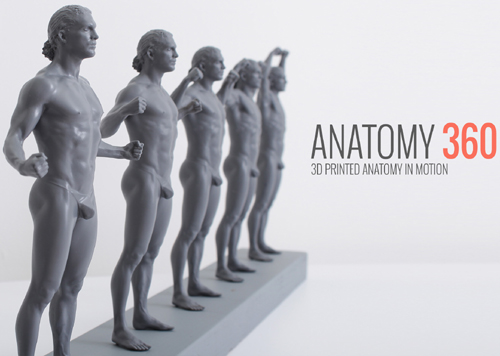
Art is another area where AM has made an impact. Many artists have been inspired by the freedom of design offered by 3D printing and have made new creations that could only come to life through AM. In most cases, AM is the vehicle for inspiration, but a new series of models being tested by Anatomy 360 may turn that on its head, with 3D printing becoming the inspiration for art.
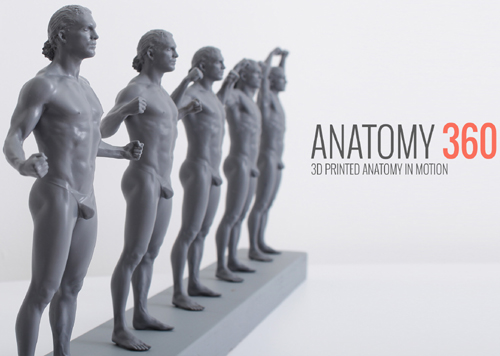 3D printed models from Anatomy 360 could be used as reference by artists. Courtesy of Anatomy 360.
Anatomy 360 is using scanning equipment and 3D imaging software to produce 3D printed human models to act as reference for artists. From the website:
Our 3D scanning research and development has resulted in a system capable of capturing humans in motion, in any pose, in a fraction of a second. Combine this with 3D printing and we have something very special. These are not the result of hand sculpting. There is no estimation, measurements or guess work involved in their production. They are perfect representations, capturing true likeness in a moment in time.
While some artists are capable of pulling images directly from their imagination, others require a reference to draw from. Artists generally use living models or existing pictures and illustrations as reference, but this idea offers a new alternative.
Rather than having to deal with a living model who gets tired and isn’t likely to be excited about you turning them over to get the best angle for a specific detail, the models produced by Anatomy 360 are three dimensional references that can fit in your bag.
The company is putting out feelers to the artistic community to see what the demand for this sort of product might be like. It certainly seems like a good idea, particularly for student artists as part of an introductory class. Below you’ll find Anatomy 360’s video about the models.
Source: Anatomy 360


John Newman is a Digital Engineering contributor who focuses on 3D printing. Contact him via [email protected] and read his posts on Rapid Ready Technology.
Follow DE
Join over 90,000 engineering professionals who get fresh engineering news as soon as it is published.






About Us · Contact Us · Editorial Team · Advertising · Privacy Policy · Subscriber Services · © 2026 Digital Engineering 24/7 · Peerless Media