Helping design and engineering professionals discover, evaluate and specify technologies and processes that shorten the design cycle and enable success.



Digital Engineering April 2026
In the latest issue of Digital Engineering, we take a look at the latest innovations in design for additive manufacturing, including the use of natural language inputs, social media cosplayers, and AI integration. The issue also includes a feature…

January Special Focus Issue: Design for Additive
In this Special Focus Issue of Digital Engineering, learn about the latest advancements in design for additive manufacturing, including new software tools, additive in automotive, custom medical devices, and more.
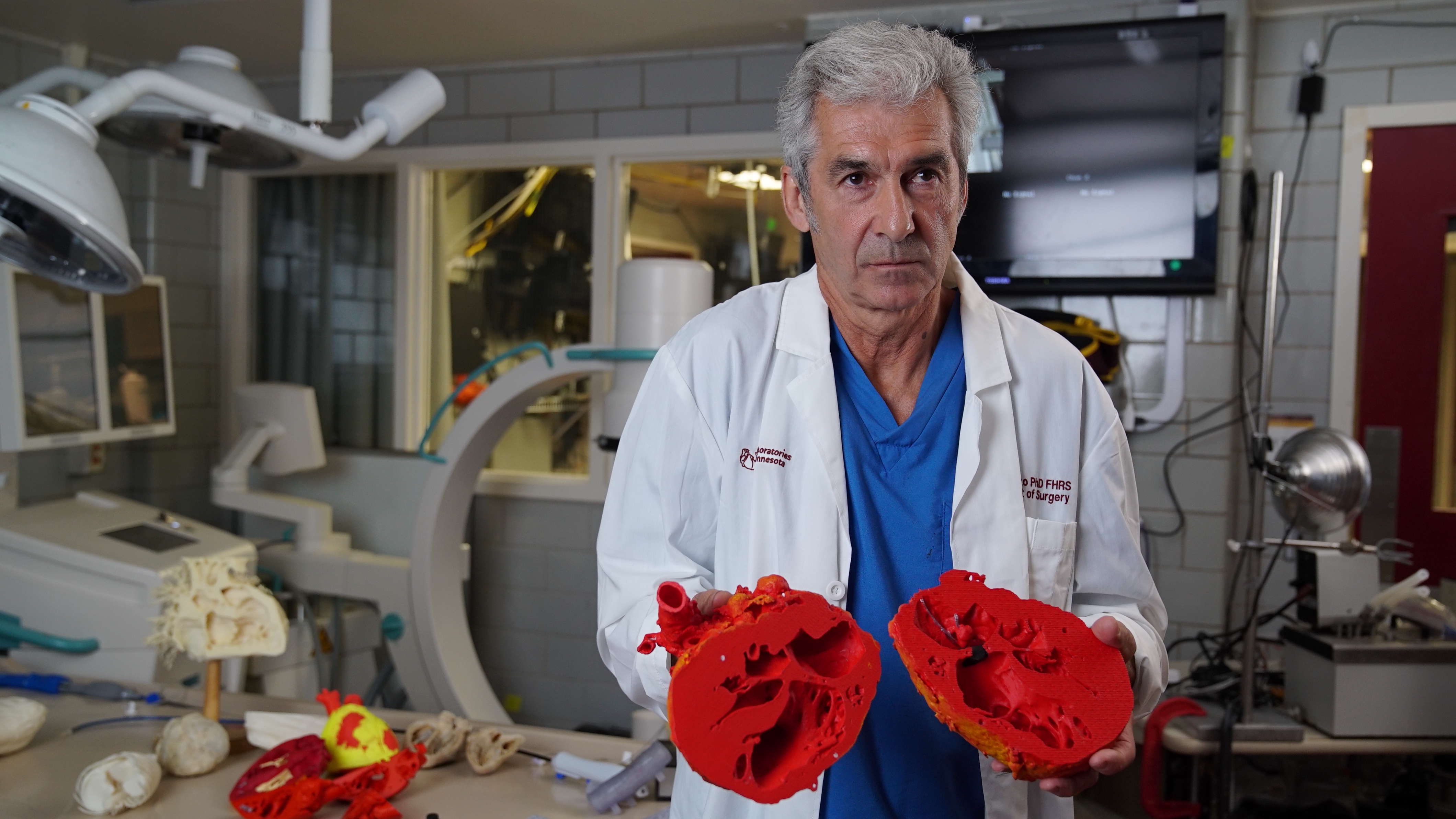
The heartbeat of any good university medical school program is its physicians-in-training and laboratory research. At the University of Minnesota Medical School’s Visible Heart Labs, students and practicing physicians are being enriched with 3D printing technology donated by Stratasys, aimed at advancing cardiac anatomy and heart-related research.
Stratasys J750 Digital Anatomy 3D printers, along with MakerBot METHOD X and MakerBot Sketch offerings, are being used to produce anatomic models that mimic the feel, responsiveness, and biomechanics of the human heart. Because of the nature of the 3D-printed output, the heart models can be punctured, sutured, cut, and physically manipulated like actual human tissue, which greatly aids in training for up and coming physicians as well as for the next-generation of medical device developers, according to Dr. Paul Iaizzo, professor Visible Heart Laboratories at the university.
The Visible Heart Lab is also home to the university’s Atlas of Human Cardiac Anatomy collection of 800 human hearts that are available for hands-on study. The 3D-printed anatomically-correct heart models provide another layer of immersion for students as well as other populations affiliated with the medical school, Iaizzo says. Iaizzo’s team is steadily building out a portfolio of 3D-printed models of the collection’s physical human hearts.
“Once the hearts are 3D printed, we can perform virtual device prototyping and virtual device placement and slice it on any plane,” Iaizzo explains. “It’s a great way to train engineers and a great way to understand the potential for varied anatomy and how a wide range of devices can fit inside of different anatomies.”
3D printed anatomical models are an essential element of mixed reality instruction in addition to video or even virtual reality (VR) training, Iaizzo contends. As part of the curriculum, Iaizzo has gone as far as to assemble students in the lab to paint 3D-printed heart models in a team-building exercise that includes pizza and snacks. “There’s nothing like it to understand these anatomies and to visualize it and hold it in your hand,” he explains. “By painting each valve and space on the heart, it puts it in the brain in a really novel way.”
In addition to student education, practicing physicians at the medical center are also leveraging the 3D-printed heart model to educate patients and explain complex procedures. The models can be customized to an individual patient’s anatomy and pathology or designed to reflect the patient’s demographics, comorbidities, and even details like where plaque has accumulated in a particular blood vessel or a presence of tumors. In total, these capabilities make for more personalized care as well as help medical teams better describe treatments and surgical options with patients.
Iaizzo says the center’s partnership with Stratasys is key to advancing 3D printing technology for research applications. He’s so convinced of the benefits of 3D printing applications for medical applications, he encourages all of his graduate students to spend time in the lab learning the technology and how it can be applied to advance medical research. “3D printing is an important skill to put in the toolbox,” he says.
To hear more about how the Visible Heart lab is using 3D printing technology, watch this video.


Every day, our customers find simpler, smarter approaches to stubborn design problemsand greater confidence to confront towering human and technological challenges. Less hindered by the usual constraints, they can imagine, design, iterate and…
Rapid Prototyping in The Automotive Industry
Henry Ford may not have invented the automobile, but his pioneering spirit did transform the way cars were made. His assembly line process drastically reduced costs with standardized parts and greater efficiency which led to lower cost, higher quality and greater reliability.

Beth Stackpole is a contributing editor to Digital Engineering. Send e-mail about this article to [email protected].
Follow DE
Join over 90,000 engineering professionals who get fresh engineering news as soon as it is published.






About Us · Contact Us · Editorial Team · Advertising · Privacy Policy · Subscriber Services · © 2026 Digital Engineering 24/7 · Peerless Media