Helping design and engineering professionals discover, evaluate and specify technologies and processes that shorten the design cycle and enable success.




Digital Engineering April 2026
In the latest issue of Digital Engineering, we take a look at the latest innovations in design for additive manufacturing, including the use of natural language inputs, social media cosplayers, and AI integration. The issue also includes a feature…

January Special Focus Issue: Design for Additive
In this Special Focus Issue of Digital Engineering, learn about the latest advancements in design for additive manufacturing, including new software tools, additive in automotive, custom medical devices, and more.
NASA is looking at using AM from a number of angles. First, as an additive technology, 3D printing requires far less space to be useful than, say, a CNC machine. It wouldn’t be all that difficult to find room in a spacefaring craft for a Mojo and enough materials to run it. Creating useful objects without associated fumes and debris is also a plus. Another plus, from a conservation of materials viewpoint, is that broken parts could be recycled to produce raw materials.
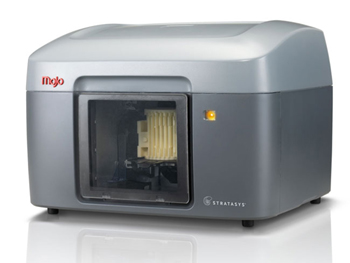
How often have you seen a character on Star Trek save the day or come up with a crucial part using replicators? 3D printers aren’t quite as all-powerful as a replicator, but they are useful for creating new parts on the fly. Karen Taminger of NASA's Langley Research Center has been quoted saying that if AM had been available in the 1970s, the astronauts on Apollo 13 could have more easily repaired the damaged oxygen tank on the Service Module that endangered its mission.
Using AM to replace worn or broken parts would also save on cargo space. In place of carrying tools and spare parts that might be necessary, the crew could print out what they happen to need. Less extraneous gear also means less money spent. Even if the crew needed a specific design mid-flight, CAD specs could be uploaded from experts still on the ground, without requiring the crew to become experts in CAD design.
Using AM as part of the design and building process for future spacecraft is also a good reason for adopting the technology. I’m not just talking about rapid prototyping, either.
"I could take a structural bulkhead and a heat exchanger with internal cooling passages and integrate the two into a single component, with big reductions in system weight and volume. This type of thing is critical to the space program," said Taminger
Below you’ll find a video about potential designs for future Mars exploration rovers. That might seem somewhat tangentially related, but looking at the proposals made me think they could be produced with 3D printing, probably with a lower cost to boot. Comments in the video about smaller electronics also made me think that AM-related PCBs and the like might be at least a partial solution to other problems as well.
Source: AL.com


John Newman is a Digital Engineering contributor who focuses on 3D printing. Contact him via [email protected] and read his posts on Rapid Ready Technology.
Follow DE
Join over 90,000 engineering professionals who get fresh engineering news as soon as it is published.






About Us · Contact Us · Editorial Team · Advertising · Privacy Policy · Subscriber Services · © 2026 Digital Engineering 24/7 · Peerless Media