Helping design and engineering professionals discover, evaluate and specify technologies and processes that shorten the design cycle and enable success.


Alert!
Digital Engineering ceased publication on July 1, 2026. This website remains available as an archive of engineering content.
For inquiries or information, please email [email protected].

Digital Engineering April 2026
In the latest issue of Digital Engineering, we take a look at the latest innovations in design for additive manufacturing, including the use of natural language inputs, social media cosplayers, and AI integration. The issue also includes a feature…

January Special Focus Issue: Design for Additive
In this Special Focus Issue of Digital Engineering, learn about the latest advancements in design for additive manufacturing, including new software tools, additive in automotive, custom medical devices, and more.
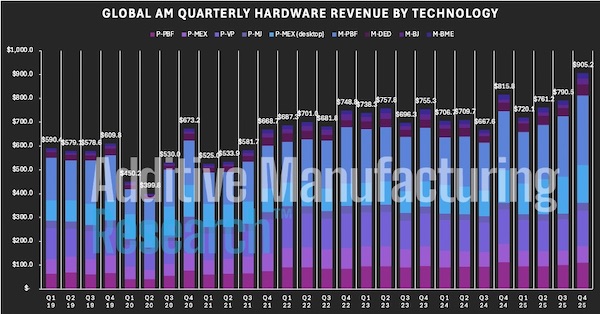
Additive Manufacturing Research (AM Research) says the 3D printing market reached $16 billion in 2025, and is on track to grow to $57 billion by 2034. That’s according to the research firm’s Q4 2025 3DP/AM Market Data and Forecast for the metal AM and polymer AM markets.
The total market grew 10.2% in 2025 compared to 8.3% in 2024. Metals totaled $6.27 billion, while polymers reached $9.79 billion in 2025. The combined AM services market was valued at $8.53 billion.
Growth in metal AM in 2025 came from the medical, space, and defense/maritime sectors. The AM print services market, which will be the largest segment over the next decade, is undergoing continual evolution, the report says. According to the company: “The integrated provider approach is seeing a resurgence with companies such as Fabric8Labs, Seurat, and even Velo3D all capitalizing on an environment that highly values AM but often struggles to leverage it effectively.”
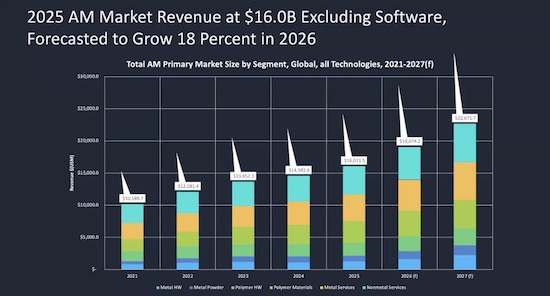
Metal additive print services overtook polymer services worldwide for the first time in 2025, driven by contract manufacturers and integrated production service models, in which printer manufacturers offer printing services as well as hardware.
"2025 was a story of two markets, with the first half of the year largely in line with the tougher times of the last two years, but in the second half of 2025 we saw what we believe is the start of a significant turnaround for AM,” said AM Research executive vice president Scott Dunham. “The industry is still carrying too much weight competitively and a number of companies exited in 2025 – this won't stop in 2026. But it's become clear we're at a point where growth is flowing back into the market."
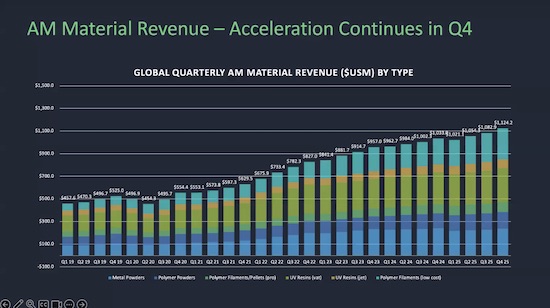
On the polymers side, the consumer goods market is printing tens of millions of parts using low-cost extrusion methods, and the announcement that Lego is now 3D printing could have a huge impact. “The implications of Lego even doing some of its output in 3D printing instead of injection molding has big implications for the industry,” Dunham said in a briefing.
Materials saw softer sales in 2025 because of slower hardware sales, Dunham said, but there will likely be a more than doubling in metal AM powder shipments by 2028. Hardware shipments are also expected to grow moving forward.
Sources: Press materials received from the company and additional information gleaned from the company’s website.


Brian Albright is the editorial director of Digital Engineering.
Contact him at [email protected].






About Us · Contact Us · Editorial Team · Advertising · Privacy Policy · Subscriber Services · © 2026 Digital Engineering 24/7 · Peerless Media