Helping design and engineering professionals discover, evaluate and specify technologies and processes that shorten the design cycle and enable success.


Alert!
Digital Engineering ceased publication on July 1, 2026. This website remains available as an archive of engineering content.
For inquiries or information, please email [email protected].

Digital Engineering April 2026
In the latest issue of Digital Engineering, we take a look at the latest innovations in design for additive manufacturing, including the use of natural language inputs, social media cosplayers, and AI integration. The issue also includes a feature…

January Special Focus Issue: Design for Additive
In this Special Focus Issue of Digital Engineering, learn about the latest advancements in design for additive manufacturing, including new software tools, additive in automotive, custom medical devices, and more.
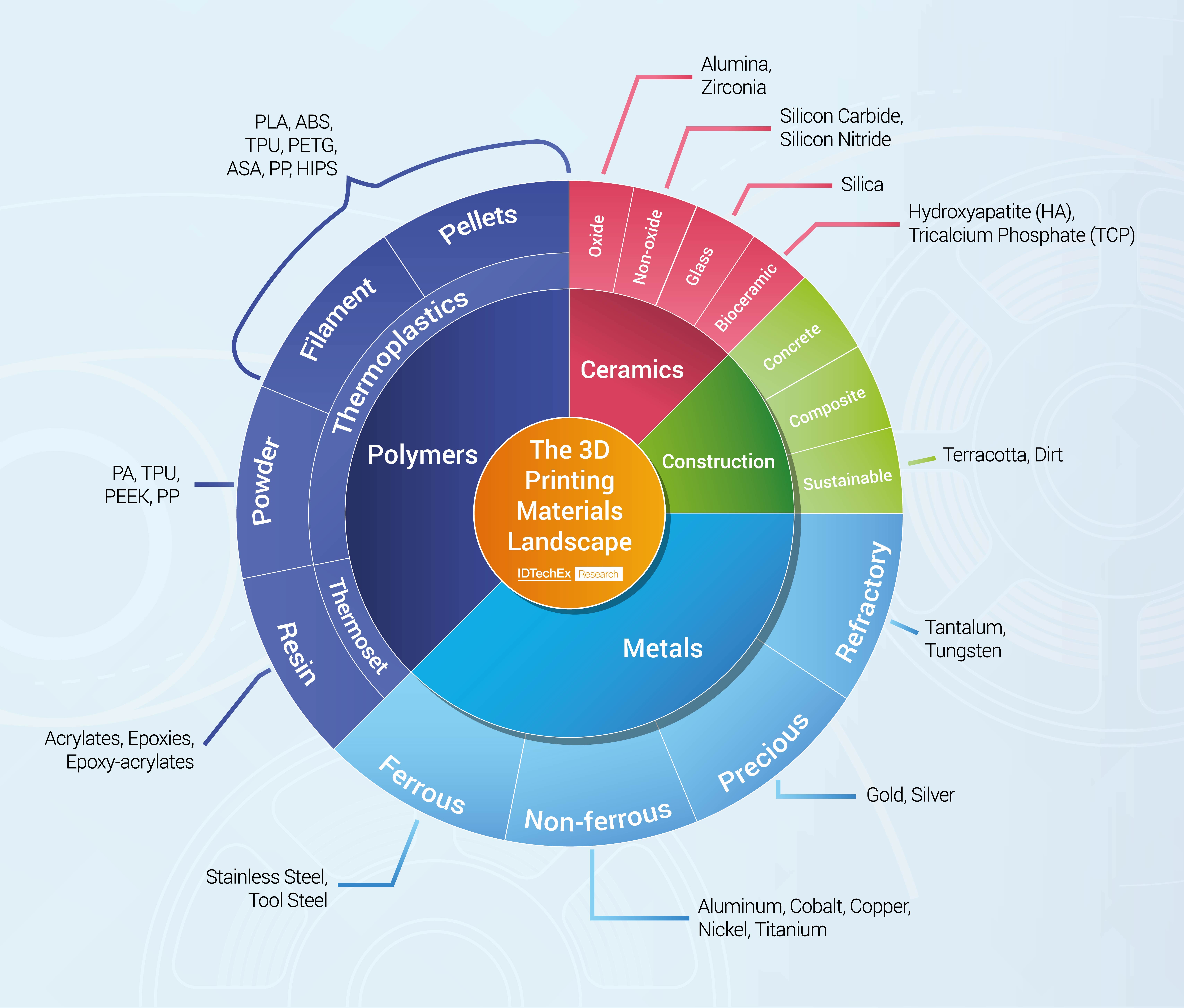
Gone are the days when 3D printing was primarily associated with a singular class of materials—mainly low-cost thermoplastics—which limited potential use cases. Today, an expanding palette of new materials is delivering greater choice and flexibility, driving more widespread of adoption of 3D printing and opening doors to new applications across an array of non-traditional industries.
IDTechEx is now forecasting that the global market for 3D printing materials will hit $29.5 billion in 2032, broadening out to include new polymers, metals, waxes, sands, even concrete materials that are classified as higher-performing. New metal-matrix composites, recycled plastics, and bio-ceramics are hitting the market, allowing enterprises to move beyond simple prototyping to producing higher quality products along with the ability to test drive concepts with materials that accurately mimic the final product’s appearance and behavior, IDTechEx officials said.
Here's IDTechEx’s take on what’s happening in the key 3D printing materials segments:
Polymers. Polymers have long been the public face of AM materials and are still most in demand, yet they are changing. Most engineers are familiar with low-cost filaments like PLA and PETG, yet that familiarity limits the perception that 3D printing is only suitable for basic prototyping applications. With the advent of more functional and higher-performance polymers now available—for example, fiber-reinforced polymer matrix composites—enterprises can benefit from additional strength and stiffness benefits for more sophisticated applications. High-temperature thermoplastics, foams, recycled plastics, and bio-based polymers are also gaining steam.
Metals. While powders have been the dominant feedstock, metal 3D printer OEMs are starting to consider alternative materials to support the delivery of lower-cost printer models that are also easier to operate while ensuring high-quality prints. Lower-cost metal wire and metal injection molding pellets are gaining traction. Another option is metal paste, which is viewed by some as a safer alternative to powder, which has handling concerns and can be highly combustible. The IDTechEx report doesn’t see these new feedstocks replacing metal powders as the dominant source; however, analysts there believe the introduction of new materials sources will only serve to expand the metals 3D printing market.
In addition to new materials advances, the advent of multiscale material modeling and simulation is also helping to expand the role of additive manufacturing. This new class of software delivers insights that help engineers better understand the connections between materials, 3D printing processes, and part performance, with the goal of producing higher quality printed parts.
Watch this video to see IDTechEx explore current and future 3D printing materials possibilities with Brightlands Materials Center.


Beth Stackpole is a contributing editor to Digital Engineering. Send e-mail about this article to [email protected].
Follow DE
Join over 90,000 engineering professionals who get fresh engineering news as soon as it is published.






About Us · Contact Us · Editorial Team · Advertising · Privacy Policy · Subscriber Services · © 2026 Digital Engineering 24/7 · Peerless Media