Helping design and engineering professionals discover, evaluate and specify technologies and processes that shorten the design cycle and enable success.


Alert!
Digital Engineering ceased publication on July 1, 2026. This website remains available as an archive of engineering content.
For inquiries or information, please email [email protected].
Sponsored
 Dear DE Reader:
Additive manufacturing is a critical technology for speeding the design process. But there are issues. Systems that fabricate high-quality, functional 3D prints tend to be pricey and often require trained staff to operate. Service bureaus can give you fabulous results relatively quickly, but not in a few hours. Today's Check it Out has two links. Both offer what you need to know about making high-quality 3D prints quickly at your desk.
Your first link takes you to a paper called “3D Printing with Desktop Stereolithography” that's all about Formlabs' new Form 2 desktop 3D printer. The second takes you to a sign-up to get a complimentary Form 2-built sample part sent to you so that you can scope out and judge the quality of its work and the material yourself.
Now, “desktop” in the Form 2's description means user-friendly like a PC as well as right-sized and quiet enough to hang out next to you like a laser printer. This is a professional-use system, although you could swing it as a home unit. A complete starter set-up with the main unit, software, build platform, some print photopolymer, finish kit, etc. runs 3500 bucks.
What’s key here is that the Form 2 is a desktop 3D printer leveraging SLA (stereolithography) technology. That's pretty cool. SLA, a time-proven technology, produces high-quality, fine-detailed parts fast. The Form 2's build volume is a good-sized 5.7×5.7×6.9 in., and its average layer thickness is a nice 0.001-0.004 in. Depending on your design's complexity and size, you can be eyeballing a functional part in a few hours.
The Form 2 has a bunch of cool features and capabilities like a front-panel touchscreen interface and Wi-Fi. It calculates print times, and you can monitor and communicate with it from your smartphone. There's an automated resin system, and the Form 2 handles a variety of shaded and transparent prototyping and functional photopolymers ranging from flexible to tough and from castable to biocompatible.
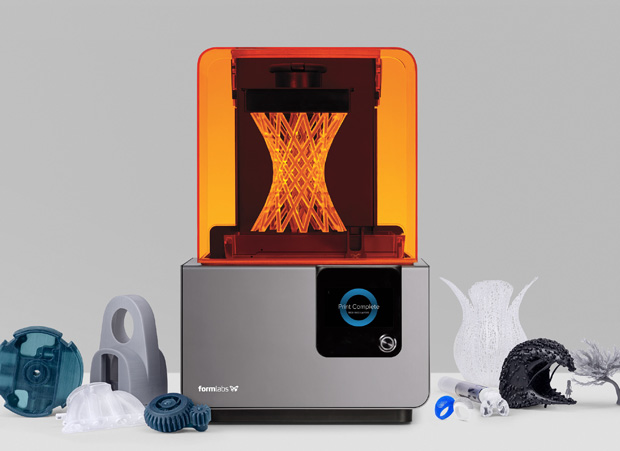 The Form 2 desktop 3D printer from Formlabs offers designers and engineers the ability to 3D print concepts, designs and functional prototypes using advanced photopolymer materials from their desktops. Image courtesy of Formlabs Inc.
“3D Printing with Desktop Stereolithography” has all the details on desktop SLA, how the Form 2 operates, materials, costs, applications where you can best deploy a Form 2 and so on. At the tail end of this 13-page document is a live link for requesting that sample part if you want to read first. Either way, hit today's Check it Out link to go for the paper, the complimentary sample part or both. Good stuff.
Thanks, Pal. – Lockwood
Anthony J. Lockwood
Editor at Large, DE


Anthony J. Lockwood is Digital Engineering's founding editor. He is now retired. Contact him via [email protected].
Follow DE






About Us · Contact Us · Editorial Team · Advertising · Privacy Policy · Subscriber Services · © 2026 Digital Engineering 24/7 · Peerless Media