Helping design and engineering professionals discover, evaluate and specify technologies and processes that shorten the design cycle and enable success.


Alert!
Digital Engineering ceased publication on July 1, 2026. This website remains available as an archive of engineering content.
For inquiries or information, please email [email protected].

Digital Engineering April 2026
In the latest issue of Digital Engineering, we take a look at the latest innovations in design for additive manufacturing, including the use of natural language inputs, social media cosplayers, and AI integration. The issue also includes a feature…

January Special Focus Issue: Design for Additive
In this Special Focus Issue of Digital Engineering, learn about the latest advancements in design for additive manufacturing, including new software tools, additive in automotive, custom medical devices, and more.
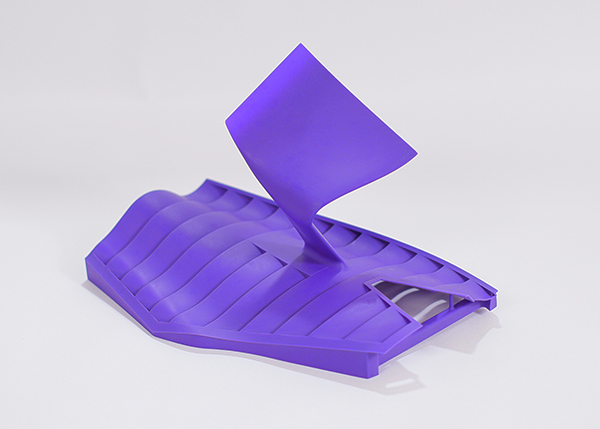
3D Systems makes available Accura Composite PIV—a new material specifically designed to address PIV testing applications used primarily in motorsports wind tunnel testing. Developed in collaboration with Alpine F1 Team (formerly Renault F1 Team), Accura Composite PIV is capable of producing rigid parts in a high-contrast color optimized for PIV testing.
Parts produced using this material take less time to prepare—from CAD to wind tunnel—and deliver accurate, high-resolution data. When used as part of a 3D Systems additive manufacturing solution—comprising Accura Composite PIV, the company’s stereolithography (SLA) technology, software and advanced application services—Alpine F1 Team has been able to maximize its wind tunnel investment and improve its understanding of the airflow over the car.
3D printing wind tunnel parts for aerodynamic testing is virtually a 24/7 operation as the racing team constantly works to unlock new levels of performance in the car. 3D Systems’ SLA technology has allowed Formula 1 companies to build rigid aerodynamic parts with high productivity and leverage innovations like integrated pressure tappings.
These parts are used in testing that relies on a laser-based technology known as "particle image velocimetry" or PIV. One challenge with taking reliable PIV measurements is the reflections of laser light from background surfaces other than the airborne particles, which reduces the image quality resulting in a loss of useful information.
3D Systems developed Accura Composite PIV—a new reflection mitigating SLA material—that Alpine F1 Team is using to print its wind tunnel model parts. Alpine F1 Team has demonstrated that the new SLA material is effective in reducing the laser reflection effect. The use of this system is opening up the ability to gain a greater insight into the aerodynamic characteristics of the wind tunnel model.
The workflow to produce wind tunnel parts in other currently available materials often requires a multi-step process to achieve a suitable finish required for wind tunnel testing. The color of Accura Composite PIV helps eliminate some of these steps and compress the workflow for efficiency and throughput gains.
“We’ve proudly collaborated with 3D Systems for many years,” says Pat Warner, advanced digital manufacturing manager, Alpine F1 Team. “The deep expertise of their application engineers and their industry-leading solutions have been an invaluable part of our innovation team. It’s been exciting to co-develop Accura Composite PIV and see the benefits it’s bringing to our process. We produce nearly 500 parts per week for wind tunnel testing. Due to the material’s unique optical characteristics, we are now collecting more reliable data from our PIV system in the wind tunnel.”
In addition to Accura Composite PIV’s color, the material has a high tensile and flex modulus, with a heat deflection temperature of 100° C, which makes it ideal to withstand the rigors of wind tunnel testing. This material is formulated for use with 3D Systems’ stereolithography 3D printing technology—including the company’s 3D Sprint software—that is designed for rapid production of large (up to 1,500 mm in length), high-resolution parts.
“Customer-centric innovation is a guiding force within 3D Systems,” says Kevin Baughey, segment leader, transportation and motorsports, 3D Systems. “Working with Alpine F1 Team to develop our newest material is another example of how we’re leveraging our F1 application expertise to develop advanced solutions that give our customers a competitive edge.”
Sources: Press materials received from the company and additional information gleaned from the company’s website.

From digitization, design and simulation through manufacturing, inspection and management, our comprehensive portfolio of technologies provides a seamless, customizable workflow designed to optimize products and processes while accelerating…
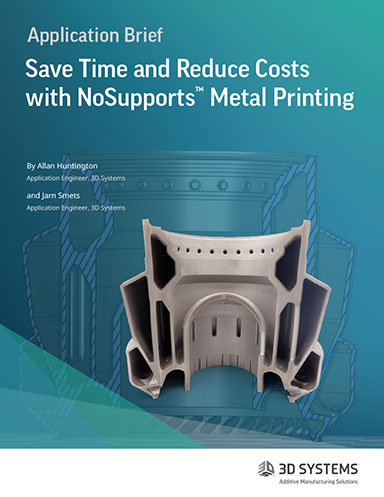
Save Time and Reduce Costs with NoSupports™ Metal Printing
Metal 3D printing is a high energy process in which it is possible for unmanaged heat and stress to build up and impact part quality, this guide presents a step-by-step methodology for how to apply NoSupports to a hot end section of a larger turbomachinery part.

DE's editors contribute news and new product announcements to Digital Engineering. Press releases may be sent to them via [email protected].
Follow DE






About Us · Contact Us · Editorial Team · Advertising · Privacy Policy · Subscriber Services · © 2026 Digital Engineering 24/7 · Peerless Media