Helping design and engineering professionals discover, evaluate and specify technologies and processes that shorten the design cycle and enable success.



Digital Engineering April 2026
In the latest issue of Digital Engineering, we take a look at the latest innovations in design for additive manufacturing, including the use of natural language inputs, social media cosplayers, and AI integration. The issue also includes a feature…

January Special Focus Issue: Design for Additive
In this Special Focus Issue of Digital Engineering, learn about the latest advancements in design for additive manufacturing, including new software tools, additive in automotive, custom medical devices, and more.
Digital Engineering recently spoke to Radhika Krishnan, executive vice president and general manager, software, at 3D Systems, about the company’s software business. She also discussed how 3D Systems has responded to the current pandemic and the need for more flexible manufacturing of healthcare supplies.
Digital Engineering: Please describe 3D Systems’ software business.

Radhika Krishnan: When people think of 3D Systems, they think of hardware; they think materials. Software is not the first asset that comes to mind. I came on board 15 months ago, and was very surprised to see the team that we had and the assets we had complied in the software area over time. The portfolio is very strong.
It’s logical to assume that our software assets are geared toward AM. The interesting thing to note is that we have an interesting combination of both additive and subtractive technology in our software portfolio that can help ease the adoption of additive. Customers are on a journey. Some of them are happy doing subtractive. Some would like to kick the tires on some level of prototyping and others have ventured into production. Our software enables them to ease their way into that journey and get from Point A to Point B faster.
We have quite a few products in the scan-to-CAD category for reverse engineering. We have products that allow you to do inspections like Geomagic Control X. We have an offering called 3D Connect to remotely manage printers and provide support services. That is over and above our additive manufacturing offerings.
DE: How are you partnering with design software companies to enable better integration and adoption of 3D printing?
Krishnan: It’s a very interesting dynamic. With some of our software partners, we have good synergy because we have 3D capabilities that are not in their wheelhouse. The software providers are starting to build up their own competencies, but without a doubt we do have larger partners that continue to look to us for those 3D-oriented competencies.
One thing I’ve tried to do in a structured and rigorous way is build up the partnership ecosystem at large. For example, Hexagon and Artec can benefit from the kinds of scan-to-CAD offerings we bring to the table. We are building up partnerships with machine tool builders. We’re being proactive in how we engage with those companies as well.
DE: Can you talk about the state of CAD-to-print functionality, which we’ve seen a lot of design software providers focusing on?
Krishnan: That’s utopia. That's a thing most customers would appreciate and a lot of vendors are pushing. Our position is that there is no one-size-fits-all solution. We are providing more of a platform-oriented approach as customers look to go from CAD to production.
We’re definitely looking to converge all that that we have in our portfolio today to create a platform-oriented approach.
We have a very deep appreciation and intrinsic view of how the products need to come together to simplify processes. One epiphany we've had is we recognize that the way that you architect a platform is contingent on the use case and on the vertical. [Take health care, for instance; because it is so regulated, there are a variety of requirements.
Sometimes customers have preference for a specific tool in one part of the production cycle. There is a high bar for learning some of these tools, so it is not a case where you can force them to move on to something else. So we’re very sensitive to individual needs that customers have. Even as we are architecting a platform, we are trying to get them a level of flexibility and focus on things that are missing.
DE: 3D Systems has been active in responding to the current COVID-19 pandemic by providing support in the production of medical supplies.
Krishnan: Needless to say there is enormous potential and value that the additive industry can provide at this time of crisis. We have been inundated with hundreds of cries for help. We have printers and software and materials, and we have deep expertise in health care.
I have people on my team that have deep regulatory expertise. Even as we venture into this and evaluate some inquiries, we have to keep in mind that this won’t be solved by somebody making up their one design for an N95 mask or PPE in their garage. There is a lot of press on people doing that, but it is critically important that you are following regulatory guidelines and doing this the right way.
We are being very careful about what commitment we step up to and the boundaries of what we can and cannot do. The FDA has come up with an emergency use authorization, which is a shortened process for obtaining the necessary regulatory approvals to manufacture PPE. We are working with hospitals and educating them in certain instances.
It doesn't look like the AM industry at large is completely clued into the nuances of what it takes to build parts for health care, so that is one thing we’ve tried to be very mindful about. While all of these companies mean well, that doesn’t mean those efforts are going to end well.
The good news is that there are a lot of tools that can get the job done. We can reuse designs for PPE that other costumes may need. That is one of the easiest things to do today in terms of our ability to transfer files back and forth.
There is more work that can happen around standards in particular. I think the industry could use more standardization and more focus around that. This notion of using more centralized repositories, cloud-centric models and so on can just make situations like this a lot easier to deal with.

From digitization, design and simulation through manufacturing, inspection and management, our comprehensive portfolio of technologies provides a seamless, customizable workflow designed to optimize products and processes while accelerating…
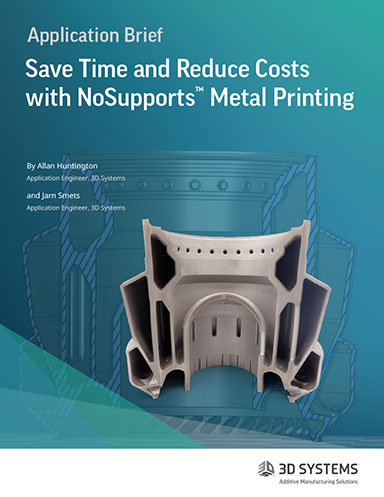
Save Time and Reduce Costs with NoSupports™ Metal Printing
Metal 3D printing is a high energy process in which it is possible for unmanaged heat and stress to build up and impact part quality, this guide presents a step-by-step methodology for how to apply NoSupports to a hot end section of a larger turbomachinery part.

Brian Albright is the editorial director of Digital Engineering.
Contact him at [email protected].

Join over 90,000 engineering professionals who get fresh engineering news as soon as it is published.






About Us · Contact Us · Editorial Team · Advertising · Privacy Policy · Subscriber Services · © 2026 Digital Engineering 24/7 · Peerless Media