Helping design and engineering professionals discover, evaluate and specify technologies and processes that shorten the design cycle and enable success.


Alert!
Digital Engineering ceased publication on July 1, 2026. This website remains available as an archive of engineering content.
For inquiries or information, please email [email protected].

Digital Engineering April 2026
In the latest issue of Digital Engineering, we take a look at the latest innovations in design for additive manufacturing, including the use of natural language inputs, social media cosplayers, and AI integration. The issue also includes a feature…

January Special Focus Issue: Design for Additive
In this Special Focus Issue of Digital Engineering, learn about the latest advancements in design for additive manufacturing, including new software tools, additive in automotive, custom medical devices, and more.
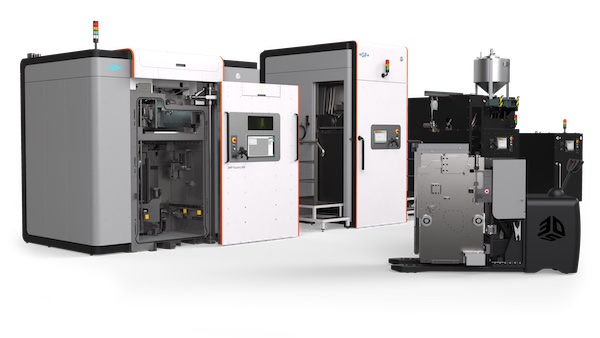
When the Airbus Defence and Space OneSat satellite enters orbit, it will do so with the help of large antenna arrays produced by an end-to-end AM solution built with 3D Systems’ DMP Factory 500.
The multi-year contract will draw on 3D Systems’ Application Innovation Group’s (AIG) materials, 3D printing technology, software and applications expertise to produce the large antenna arrays on the OneSat family of satellites. AM was chosen as the production method for the passive RF components as it enables weight reduction, part performance optimization, and faster time to market, Airbus officials said. 3D Systems’ ability to deliver a complete solution lets Airbus engineers focus on their core competencies in areas like functional design rather than taxing resources by having to integrate elements from multiple vendors, according to 3D System officials.
“Using our solution helps limit cost and mitigates risk by eliminating challenges that can be presented with systems integration,” explains Dr. Michael Shepard, vice president, Aerospace & Defense Segment, at 3D Systems. “For an application such as RF passive hardware components, which have extremely complex functional design requirements and exacting requirements for quality, using 3D Systems’ integrated ecosystem helps achieve the best possible results with minimal time and cost.”
Each OneSat satellite features two large antenna arrays—one to transmit signals and one to receive—and the parts in question are large and complicated, with tough dimensional and surface finish requirements. The DMP Factory 500 incorporates a number of features that lend itself to such challenging applications, Shepard says, including its low oxygen architecture that keeps O2 below ~ 25 ppm during operation. This significantly improves build quality and helps keeps powder chemistry in-spec so it can be re-used more readily, Shepard claims—an advantage for an industry that maintains high requirements for quality and precision.
The DMP Factory 500’s three laser architecture improves productivity as one of the lasers can address the entire build volume, which allows for faster printing and a seamless outer mold line. The printer’s size is also a factor: The DMP Factory 500 has a 500mm X 500mm X 500mm build volume that accommodates large builds.
In addition to the hardware and materials advantages, Shepard calls out the 3DXpert software and 3D Systems’ application engineering expertise as an important part of the mix. The 3DXpert software facilitates build preparation for metals 3D printing, but also features topology optimization and build simulation tools. “In the case of the RF components for Airbus, we used the build simulation tools to re-target geometries to account for thermally-induced displacements so we could minimize material waste and post-AM machining,” Shepard says.
3D Systems AIG has also developed printing parameters for its LaserForm materials that help customers like Airbus achieve their desired goals, including minimizing or eliminating supports, he adds.
3D Systems’ application engineering expertise completes the end-to-end AM solution. The team will act in the capacity of project manager and will lead the technology transfer process, enabling another tier 1 supplier to quickly ramp up production of fully-qualified components.
“Our engineers have supported customers on many different AM projects to help them achieve the best possible results,” Shepard says. “When we engage with a customer, it might be their first additive project, but it’s our engineer’s one hundred and first.”
For a look at the DMP Factory 500 in action, check out this video.


Beth Stackpole is a contributing editor to Digital Engineering. Send e-mail about this article to [email protected].
Follow DE






About Us · Contact Us · Editorial Team · Advertising · Privacy Policy · Subscriber Services · © 2026 Digital Engineering 24/7 · Peerless Media