Helping design and engineering professionals discover, evaluate and specify technologies and processes that shorten the design cycle and enable success.




Digital Engineering April 2026
In the latest issue of Digital Engineering, we take a look at the latest innovations in design for additive manufacturing, including the use of natural language inputs, social media cosplayers, and AI integration. The issue also includes a feature…

January Special Focus Issue: Design for Additive
In this Special Focus Issue of Digital Engineering, learn about the latest advancements in design for additive manufacturing, including new software tools, additive in automotive, custom medical devices, and more.
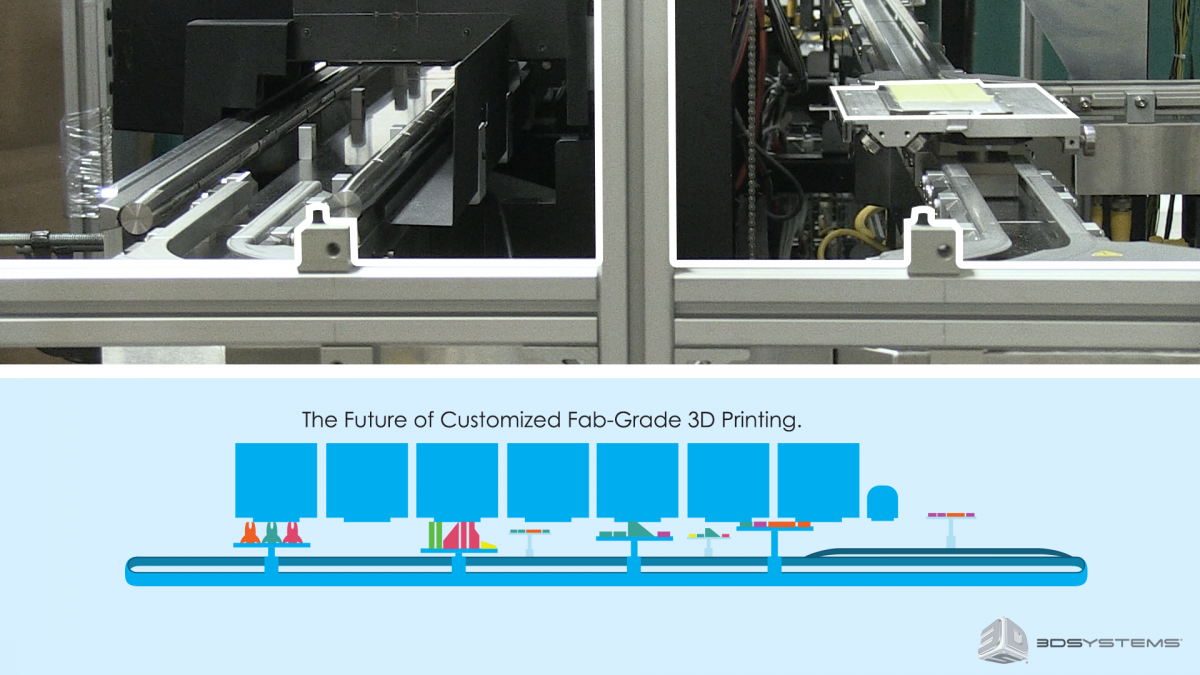 3D Systems' new high-speed solution uses a moving print bed with fixed-position printheads. Image: 3D Systems
3D printing has always been seen as a way to revolutionize manufacturing, but up until now it has suffered from a significant limitation: mass production. Making large quantities of anything via 3D printing can be a slow, expensive process.
3D Systems, as part of its efforts to enable the Google Project Ara customized, mass-produced phone, has developed a continuous, high-speed fab-grade printer system that turns the typical print model on its head. The company unveiled more details about the new system a few days ago. 3D Systems provided some hints about how the solution would work back in May.
Project Ara aims to create interchangeable, custom modules that can be used to make a phone unique to each user. The modules can be upgraded one at a time.
The new 3D printing system creates an assembly line by making the printhead stationary and turning the print bed into a mobile, racetrack style conveyor. The production line is a circle with print nozzles layering on different types and colors of material during each individual pass. According to the company, it can print 50 times faster than a standard system. It also makes it possible to produce lots of completely customized items at the same time.
The assembly line approach also makes it possible to manufacture thousands of parts at speeds comparable to injection molding operations. According to the company:
This breakthrough opens up the possibility of just-in-time, high volume, flexible additive manufacturing using the company’s precision stereolithography (SLA) and selective laser sintering (SLS) advanced manufacturing printers, enabling manufacturers to produce functional, precision parts in seconds, without the need for tooling or a lengthy supply chain.
You can learn more about the new concept in the video below.
Source: Tech Crunch


Brian Albright is the editorial director of Digital Engineering.
Contact him at [email protected].

Join over 90,000 engineering professionals who get fresh engineering news as soon as it is published.






About Us · Contact Us · Editorial Team · Advertising · Privacy Policy · Subscriber Services · © 2026 Digital Engineering 24/7 · Peerless Media