Helping design and engineering professionals discover, evaluate and specify technologies and processes that shorten the design cycle and enable success.



Digital Engineering April 2026
In the latest issue of Digital Engineering, we take a look at the latest innovations in design for additive manufacturing, including the use of natural language inputs, social media cosplayers, and AI integration. The issue also includes a feature…

January Special Focus Issue: Design for Additive
In this Special Focus Issue of Digital Engineering, learn about the latest advancements in design for additive manufacturing, including new software tools, additive in automotive, custom medical devices, and more.
Enhancing AM production and quality control in this way promises to open the door to greater flexibility for design teams and improved efficiencies for manufacturers. Traditional manufacturing often must combine smaller components to make subsystems because fabrication facilities are limited by the shapes that they can mold or mill. Using metal AM, manufacturers can build subsystems in layers, reducing the part count to a few components. This in turn will reduce the materials, fabrication processes and labor required to produce the subsystems.
What manufacturers need is a quick and inexpensive way of determining how the interactions between the laser or electron beam and the metal powder used in the AM process affect the part’s final state. Manufacturers must also be able to determine if microstructure variations can occur from one part to another. Because the metal melting process is so fast, designers and manufacturers find it difficult to quantitatively measure the thermal profile of the alloys. The heating process also affects the microstructure’s evolution, including internal stress of the materials.
The challenge here is the complexity of the AM processes.
“There are so many variables with uncertainties in materials processing, especially in the metals 3D printing process,” says Professor Wei Xiong, one of the leading members of the university’s research team. “Without predictive simulation, it is hard to control the material’s quality. High-temperature materials used for jet engines are usually critical components, requiring ultra-high mechanical performance. Therefore, it is important to perform reliable simulation to optimize processing parameters for the best quality of the 3D-printed components.”
Thus, before AM can take on more demanding applications — such as broader reliance on short runs of certified parts — designers and manufacturers need to better understand the impact that AM has on the quality of parts.
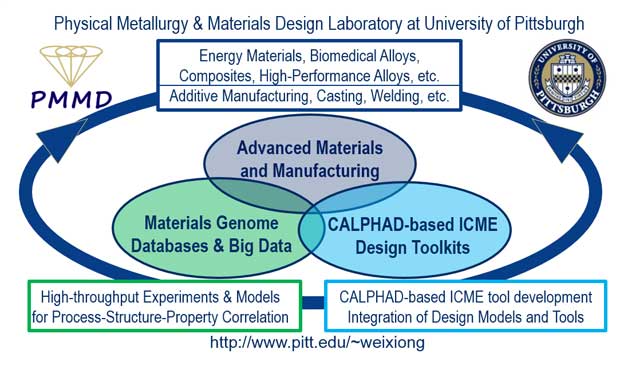
To build this model, the researchers opted to base the simulations on Integrated Computational Materials Engineering (ICME), which allows engineers to design products by linking materials models at multiple length scales (Figure 1). This approach aims to provide greater insight into how various fabrication processes produce material structures, how the structures generate material properties, and how engineers should choose materials and tailor processing parameters for a given application.
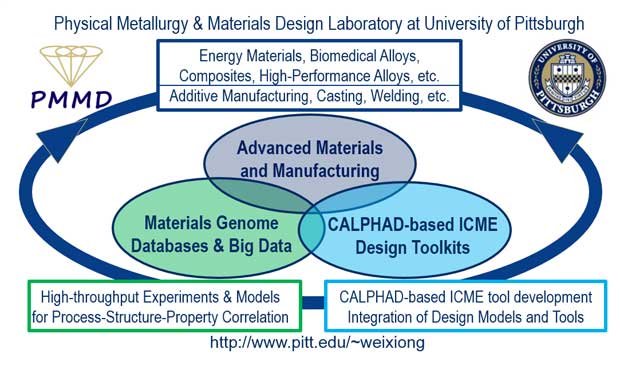 Figure 1. Researchers at the University of Pittsburgh have combined CALPHAD-based ICME design and simulation tools with materials genome databases to enable engineers to simulate the entire additive manufacturing process. This simulation provides new insight into the impact of AM processes on the microstructure and material properties of parts produced for high-temperature applications. Armed with this new capability, engineers and manufacturers will be able to certify the quality of AM-produced parts. (Image courtesy of Professor Wei Xiong, Physical Metallurgy & Materials Design Laboratory, University of Pittsburgh.)
“ICME is a landmark method for advancing computational materials modeling in practical engineering applications,” says Xiong. “The ICME tools will enable us to predict alloy microstructure [produced] by different processing, and thus further control material properties.”
Success of these simulation techniques and tools will translate into a broader role for AM in the industrial sector, sweetening the deal by shortening development cycles. Without simulation tools such as these, high-temperature metal AM could remain a costly specialty technology beyond the reach of most design teams and manufacturers.


Tom Kevan is a freelance writer/editor specializing in engineering and communications technology. Contact him via [email protected].
Follow DE
Join over 90,000 engineering professionals who get fresh engineering news as soon as it is published.






About Us · Contact Us · Editorial Team · Advertising · Privacy Policy · Subscriber Services · © 2026 Digital Engineering 24/7 · Peerless Media