Helping design and engineering professionals discover, evaluate and specify technologies and processes that shorten the design cycle and enable success.



Digital Engineering April 2026
In the latest issue of Digital Engineering, we take a look at the latest innovations in design for additive manufacturing, including the use of natural language inputs, social media cosplayers, and AI integration. The issue also includes a feature…

January Special Focus Issue: Design for Additive
In this Special Focus Issue of Digital Engineering, learn about the latest advancements in design for additive manufacturing, including new software tools, additive in automotive, custom medical devices, and more.
When it comes to prototypes, there is a void between traditional materials and what is required for true functional and mechanical tests. Although it is common for research and development (R & D) and engineering teams to evaluate and validate part designs from stereo lithography (SLA) and cast urethane parts, HK Plastics Engineering (Oceanside, CA) customers wanted more. "Our clients need more upfront validation on part designs before they invest a significant amount in production tooling,” said Ron Krippner, vice president of Sales and Marketing. “SLA and cast urethane parts do not offer necessary information about chemical compatibility, mechanics, functionality, aesthetics and weatherability."
HK Plastics Engineering, Inc., located in Oceanside, CA, produces parts for the medical device industry.
“One of the highlights of my job is working with some of the most talented people in the plastics industry,” said Krippner. “They love a challenge, and when we presented the needs of our clients, they wanted to dive right in and find a better way.”
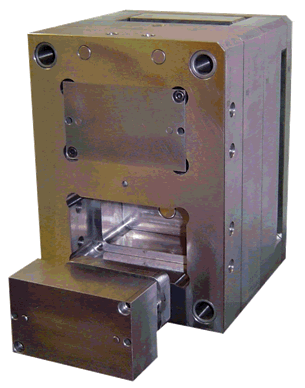 Figure 1, "B" Half of HKRP |
The challenge was simple—create a low cost, quick turnaround molding system that can run thermoplastic resin.
Inexpensive Prototype Tooling
The HK team developed a quick change insert system called HK Rapid Prototype (HKRP). The system comprises a mold base and 3 x 5 in. inserts (see Figure 1). Because the inserts are not expensive, HK can inventory several sets on the shelf to be ready for a rush order.
HK division manager Dean Gaffney said, “The response to the HKRP system has been remarkable. The fact that HK can produce injection molded parts within two weeks from order fills a necessary gap at the product development stage.”
There are other advantages to the HKRP system. Once the customer decides it is time for production tooling, the engineering and mold design is often 80 percent complete because many considerations for the production tool have been addressed in the HKRP insert. With an investment in HKRP, HK can significantly discount the design portion of the production mold.
Bridge Tooling and Insurance
HK has used the HKRP system to provide “more-than-prototype” volumes needed in an emergency. “It’s a great system to make production-worthy parts and bridge the gap of an 8–10 week lead-time for a production tool.” A client recently called HK to get 100,000 parts produced in a two-week window. HK made a P20 (semi-hard steel) cavity HKRP insert in three days and begin production immediately thereafter (see Figure 2). In the meantime, HK began to work on an 8-cavity hardened tool steel production mold. HK met the deadline and gained a new believer in the benefits of the HKRP program.
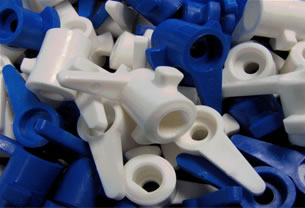 Figure 2, HKRP sample parts |
Customers realize if a production mold goes down for any reason, they risk losing a significant amount of revenue, so a benefit of the HKRP system is the inherent insurance a company will have by always having a backup mold worthy of production in an emergency.
HKRP Specifications
The HKRP system does have size limitations. Parts must be within a 3 x 5 footprint and no deeper than 3 in. HKRP inserts cost anywhere from $1,999 to $4,999 with a typical lead time of two weeks. Undercuts can be addressed with hand-loaded inserts. Because of HKRP’s popularity, a larger footprint may be offered in the future.
A Fortune 500 company project manager said, “It is advantageous to get inexpensive prototype parts in thermoplastic using the HKRP process. We by-pass the limitations of traditional prototype parts, get parts faster than production tooling and have a backup mold in case the production tool ever goes down.”
For more details, visit www.hkplasticseng.com.
Sources: Press materials received from the company and additional information gleaned from the company's website


DE's editors contribute news and new product announcements to Digital Engineering. Press releases may be sent to them via [email protected].
Follow DE
Join over 90,000 engineering professionals who get fresh engineering news as soon as it is published.






About Us · Contact Us · Editorial Team · Advertising · Privacy Policy · Subscriber Services · © 2026 Digital Engineering 24/7 · Peerless Media