Helping design and engineering professionals discover, evaluate and specify technologies and processes that shorten the design cycle and enable success.


Alert!
Digital Engineering ceased publication on July 1, 2026. This website remains available as an archive of engineering content.
For inquiries or information, please email [email protected].

Digital Engineering April 2026
In the latest issue of Digital Engineering, we take a look at the latest innovations in design for additive manufacturing, including the use of natural language inputs, social media cosplayers, and AI integration. The issue also includes a feature…

January Special Focus Issue: Design for Additive
In this Special Focus Issue of Digital Engineering, learn about the latest advancements in design for additive manufacturing, including new software tools, additive in automotive, custom medical devices, and more.
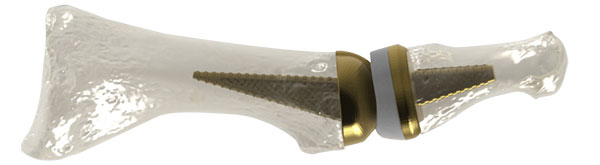
AddUp, metal additive manufacturing original equipment manufaturer, and Anatomic Implants are working together to submit a 510(k) to the U.S. Food and Drug Administration for a 3D printed toe joint replacement.
Anatomic Implants, a medical device startup out of Washington, DC, is a medical device startup company to patent and develop a metatarsophalangeal (MTP) joint replacement that nearly replicates the human anatomy by leveraging titanium 3D printing technology. The MTP toe joint is located at the base of the big toe and is one of the three main points used for balance. It is often the first joint in the foot to develop osteoarthritis.
With the global market for 1st MTP joint reconstruction being $500 million-plus annually, the market is underserved. Through the use of additive manufacturing a porous structure can be integrated into the design to promote osseointegration. Osseointegration gives implants a much higher chance of bonding to the bone, which can reduce the chances of the implant being rejected by the body, according to the companies, which usually leads to better patient outcomes after surgery.
To bring their product to market, the company has chosen AddUp’s FormUp 350 Powder Bed Fusion (PBF) machine to qualify the implant for submission to the FDA. The FormUp 350 can produce varying complex geometries with fine detailed lattice structures, made for implantable medical devices. The FDA’s Center for Devices and Radiological Health (CDRH) and the Center for Drug Evaluation and Research (CDER) has approved many 3D printed class II medical devices through the 510(k) pathway since the mid-2000s.
“With 1st MTP joint replacement being a largely underserved market, and medical device companies building lattice structures into implantables since the mid-2000s, Dr. Nutter and I sought out to make a more anatomic design by leveraging the latest technologies adopted by the industry and FDA,” explains Anatomic Implants President David Nutter. “We were excited to partner with AddUp to achieve 510(k) clearance after learning about their proprietary 3D printing technology and seeing how it could benefit the development of the Anatomic Great Toe Joint.”
The 510(k) clearance process involves a comprehensive review of safety and performance data for the implant to determine if it is substantially equivalent to an implant that is already on the market. Anatomic Implants has been hard at work on the Anatomic Great Toe Joint since its inception late 2016 and has already secured design patents in the U.S., Canada, and throughout Europe, which represents the majority of the global 1st MTP joint reconstruction market.
AddUp has vast experience in the medical industry with global OEMs relying on the FormUp 350 for serial production of their medical implants. The company’s North American subsidiary, The AddUp Solution Center, is located in Cincinnati, OH and is ISO13485 certified. They have experience partnering with a variety of medical customers and supporting their path to FDA clearance.
“AddUp is committed to supporting the development of cutting-edge solutions for the medical market” says AddUp Inc. Deputy CEO Nick Estock. “Our team at the AddUp Solution Center has the expertise on FDA regulations and qualification protocols to provide a proactive approach to regulatory compliance essential for a successful 510(k) submission.”
The Anatomic Great Toe Joint will be on display in the AddUp booth at the American Academy of Orthopaedic Surgeons (AAOS) Annual Conference in San Fransciso, CA from February 13 – 15, 2024.
Sources: Press materials received from the company and additional information gleaned from the company’s website.


DE's editors contribute news and new product announcements to Digital Engineering. Press releases may be sent to them via [email protected].
Follow DE






About Us · Contact Us · Editorial Team · Advertising · Privacy Policy · Subscriber Services · © 2026 Digital Engineering 24/7 · Peerless Media