Helping design and engineering professionals discover, evaluate and specify technologies and processes that shorten the design cycle and enable success.



May 2026 Special Focus: Artificial Intelligence in Design and Simulation
In this Special Focus Issue, learn about the latest developments in the integration of artificial intelligence into engineering workflows.

Design & Simulation Software Guide 2025
In this Special Issue, Digital Engineering presents its second annual guide to design and simulation software vendors.
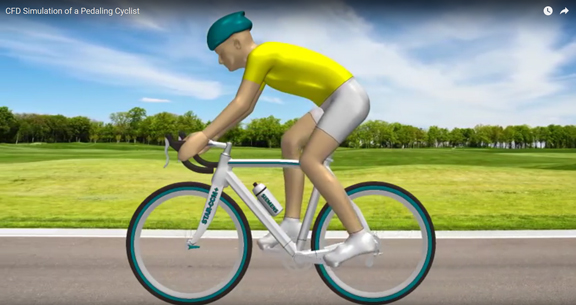 Modeling a cyclist's posture and aerodynamics in CD-adapco's STAR-CCM+ software (image from CD-adapco's YouTube clip).
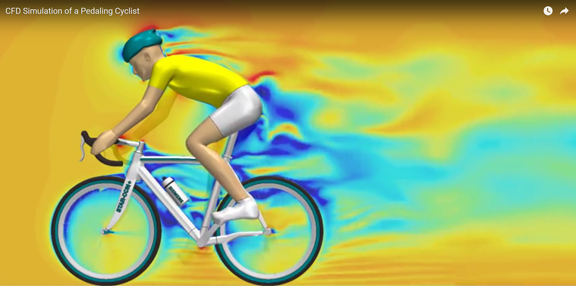 Visualizing a cyclist's aerodynamics in CD-adapco's STAR-CCM+ (image from CD-adapco's YouTube video).
With the Olympic opening ceremonies airing tonight, we scoured our news fodders for relevant technologies we could highlight. It turns out CAD, CAE (computer-aided engineering), and even artificial intelligence (AI) could give the Olympians a performance boost.
Kitman Labs, based on Menlo Park, California, has been collecting data -- lots of data -- on athletes. The company's goal is to predict injuries, using AI.
Stephen Smith, founder and CEO of Kitman Labs, said, "We predict everything from the weather to the stock market these days. So why not injuries?"
Kitman recruits athletes to wear a device equipped with its cloud-connected mobile app, dubbed Kitman Athlete, to collect data. The customizable app gathers information on athletes' wellness, workload, and performance, among others. For prediction, the software uses a combination of real-time data, computer science, sports science, and data analytics. It identifies patterns and correlations within the participants' training, sleep, fatigue, stress, perceived performance, and actual performance. This is where the company apply machine learning -- AI-like algorithms that study and analyze the collected data. The injury alerts it issues are specific to the individual athlete, according to the company.
Those who rely on the Kitman Labs Athlete Optimisation System include the Irish Rugby Football Union (IRFU), Miami Dolphins, Detroit Pistons, and Bath Rugby. The latest partner to come onboard is the South African Rugby Union (SARU).
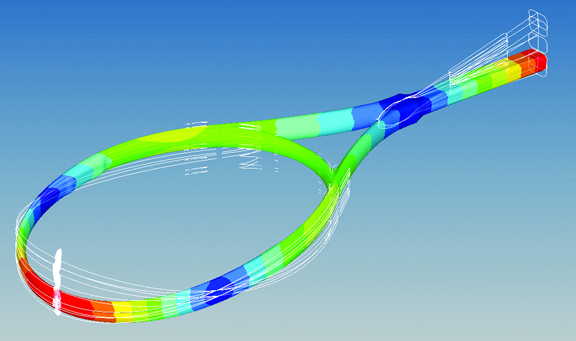
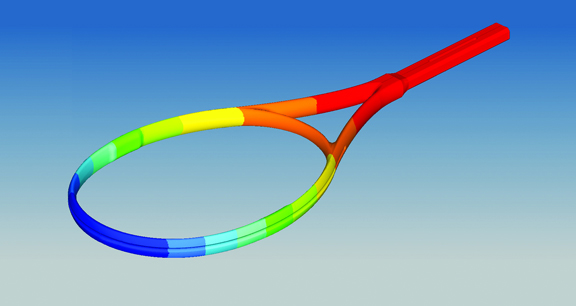 Wilson Sporting Goods uses Altair's OptiStruct solver to simulate and study the performance of composite rackets. Image here shows displacements in the simulation results. (Image courtesy of Altair.)
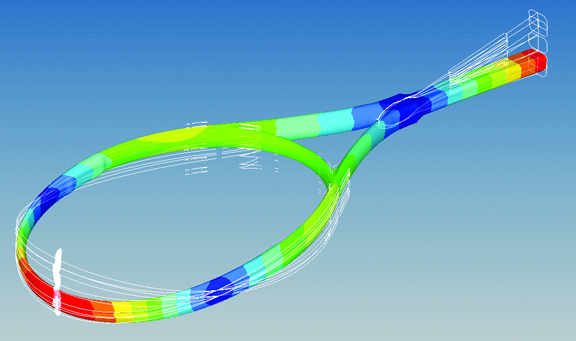 Wilson Sporting Goods uses Altair's OptiStruct solver to simulate and study the performance of composite rackets. (Image courtesy of Altair.)
Tennis players might not pay too much attention to finite element analysis (FEA), but tennis racket maker Wilson Sporting Goods does. Wilson works with Altair Engineering, a simulation software developer, to digitally model and test the performance of composite rackets. Altair's HyperMesh software played a key role in the project.
Bob Kapheim, the design engineer at Wilson, said, “I worked with Altair ProductDesign for roughly one year attempting to correlate a composite lay-up finite element model of a tennis racquet, built in HyperWorks, to its real world counterpart. I was very impressed with Altair’s knowledge, hard work, quick response, and attention to detail. At the conclusion of the study, we were able to predict and verify within 4% error at least four important performance characteristics of the tennis racquet. We believe this will give us an advantage of speed to market in future product designs."
The performance studies were done using OptiStruct, Altair's structural analysis solver. The software's simulation results were compared to data from real-world tests to ensure they were accurate and reliable.
The world of competitive cycling, too, has recently discovered software-based simulation. Since cyclists combat the wind in uphill rides and can take advantage of gravity in downhill rides, studying their aerodynamics could offer certain advantages. In a blog post, simulation software maker CD-adapco claims, "90% of the energy loss is related to aerodynamic drag."
This is where the company believes it's product STAR-CCM+ could be put to effective use to develop "a complete transient model with prescribed rider motion," suggested CD-adapco's blogger Chris Beves. To prove his point he "set up a transient kω-SST model with 70 million cells (4mm sizing in the wake around and downstream of the rider) of a rider morphing the legs at 1.5-degree pedal crank angle intervals with full rotation of the pedals and wheels."
The results of his virtual cycle ride can be viewed in this video. Beves concluded, "Whilst there is more data to analyze from this simulation, at least the first step towards a revolution in analyzing cycling aerodynamics within STAR-CCM+ is afoot."
For more examples of CAE at the Olympics, CD-adapco has chronicled a few additional applications for sports such as sailing, table tennis and sports equipment.


Kenneth Wong is Digital Engineering's resident blogger and senior editor. Email him at [email protected] or share your thoughts or suggestions at digitaleng.news/facebook.
Follow DE
Join over 90,000 engineering professionals who get fresh engineering news as soon as it is published.






About Us · Contact Us · Editorial Team · Advertising · Privacy Policy · Subscriber Services · © 2026 Digital Engineering 24/7 · Peerless Media