Helping design and engineering professionals discover, evaluate and specify technologies and processes that shorten the design cycle and enable success.


Alert!
Digital Engineering ceased publication on July 1, 2026. This website remains available as an archive of engineering content.
For inquiries or information, please email [email protected].
Sponsored

Digital Engineering April 2026
In the latest issue of Digital Engineering, we take a look at the latest innovations in design for additive manufacturing, including the use of natural language inputs, social media cosplayers, and AI integration. The issue also includes a feature…

January Special Focus Issue: Design for Additive
In this Special Focus Issue of Digital Engineering, learn about the latest advancements in design for additive manufacturing, including new software tools, additive in automotive, custom medical devices, and more.
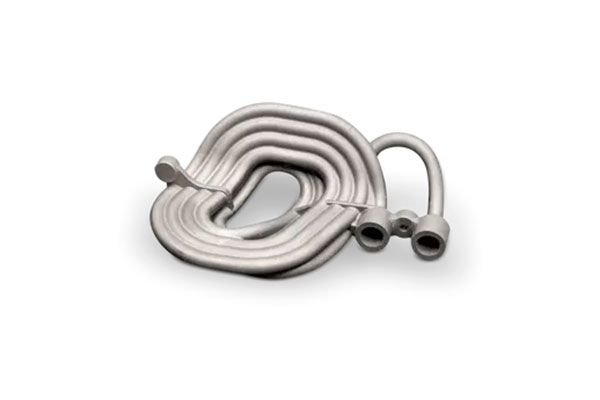
Alpine F1 Team turned to metal additive manufacturing (AM) to push the performance of its car by producing a titanium hydraulic accumulator with complete functionality in a minimized footprint. With years of collaborative supply and development with 3D Systems, Alpine F1 Team selected 3D Systems’ direct metal printing (DMP) technology to produce the complex part, and relied on 3D Systems’ expertise and proprietary cleaning processes to ensure optimal quality.
Pat Warner, Advanced Digital Manufacturing Manager, Alpine F1 Team:
“Beyond the necessary accuracy of the part itself, we had very strict fluid cleanliness requirements for the inverter coil that could only be achieved by partnering with 3D Systems. Their proprietary cleaning process has a proven track record in high performance applications for delivering particle-free components, even on challenging internal channels.”
Alpine F1 Team is continually improving its car, working in very short iteration cycles to advance and refine performance as much as possible. Constant challenges include working within the limited space available, keeping part weights as low as possible, and adhering to evolving regulation constraints.
Experts within 3D Systems’ Application Innovation Group (AIG) provided Alpine F1 Team with the know-how to make titanium production possible for a complex coiled component with a challenging, function-driven internal geometry. Additive manufacturing offers a unique opportunity to overcome the challenges of fast-paced innovation by supplying highly complex parts with short lead times. For parts like Alpine F1 Team’s hydraulic accumulator, additional AM expertise was required for a successful part due to the level of design complexity and strict requirements for cleanliness.
For the accumulator, specifically a rear heave fluid inerter coil, Alpine F1 Team designed a hard-line damper, which is part of a rear heave damper in the rear suspension system inside the gearbox main case. A long, rigid piece of tubing, the accumulator stores and releases energy in order to average out pressure fluctuations. As such, the performance of the line damper is correlated to its internal volume, and thus the length of the component.
Additive manufacturing enabled the Alpine F1 Team to maximize the length of the dampening coil while packaging complete functionality within a restricted space. According to Pat Warner, Advanced Digital Manufacturing Manager at Alpine F1 Team, the final design would be impossible to produce using any other method: “We designed this part to be as volumetrically efficient as possible, and to share wall thickness between adjacent tubes. Achieving this volume is only possible with AM.”
The final titanium dampening coil was produced using 3D Systems’ DMP Flex 350, a high-performance metal AM system featuring best-in-class oxygen levels (<25 ppm) and an inert printing atmosphere. The unique system architecture of 3D Systems’ DMP machines ensures exceptionally strong and accurate parts with high chemical purity, and the repeatability needed for production parts.
During operation the dampening coil is filled with fluid and averages out pressure fluctuations within the system by absorbing and releasing energy. In order to function properly, the fluid has a specification for cleanliness to avoid contamination. Using metal AM to design and produce this component offered considerable benefits in terms of functionality, integration into the larger system, and weight reduction, yet the team faced a challenge when it came to complete powder removal from the internal channels.
To achieve thorough material evacuation on these complex metal prints 3D Systems’ AIG contributed its vast process knowledge to apply a proprietary cleaning protocol that has been successfully used on to tens of thousands of parts, and ensures particle-free titanium components. For customers who plan to adopt metal AM and require the highest degree of part cleanliness for internal channels, 3D Systems has an established protocol to transfer this know-how to new facilities.
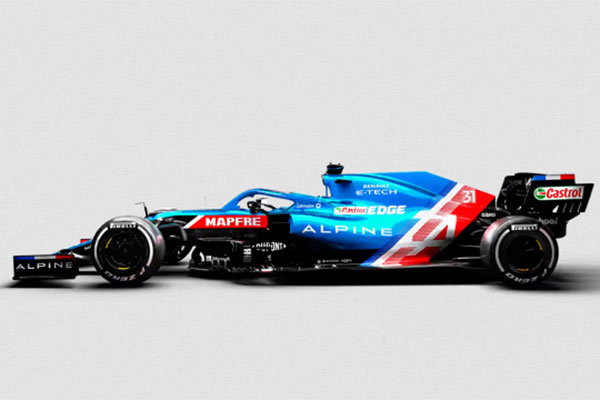
Alpine F1 Team works in very short iteration cycles to advance and refine the performance of its car as much as possible.
3D Systems’ complete metal AM solution goes beyond its leading expertise and metal printing platform to include carefully developed and optimized materials and 3DXpert software. 3DXpert is an all-in-one software for preparing, optimizing, and managing the metal printing workflow.
Alpine F1 Team selected LaserForm Ti Gr23 (A) material for its accumulator, citing high strength and the ability to accurately produce thin wall sections as the reasons for its choice. All LaserForm materials have specific, extensively developed print parameters within 3DXpert that package the expertise of 3D Systems’ engineers within the workflow for the highest quality results.
3D Systems is partner to hundreds of critical applications across industries where quality and performance are paramount. 3D Systems’ systematized approach to scaling from prototyping to production ensures a streamlined path to qualified AM parts, and the AM leader also offers technology transfer to help customers successfully adopt additive manufacturing within their own facilities.
Following the success of Alpine F1 Team’s titanium printed accumulator, Warner says the team was encouraged to pursue more complex suspension components the following year.

From digitization, design and simulation through manufacturing, inspection and management, our comprehensive portfolio of technologies provides a seamless, customizable workflow designed to optimize products and processes while accelerating…
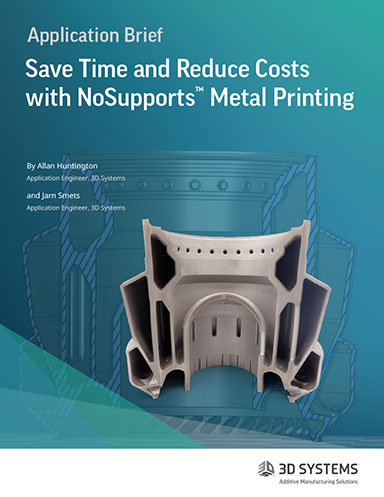
Save Time and Reduce Costs with NoSupports™ Metal Printing
Metal 3D printing is a high energy process in which it is possible for unmanaged heat and stress to build up and impact part quality, this guide presents a step-by-step methodology for how to apply NoSupports to a hot end section of a larger turbomachinery part.






About Us · Contact Us · Editorial Team · Advertising · Privacy Policy · Subscriber Services · © 2026 Digital Engineering 24/7 · Peerless Media