Helping design and engineering professionals discover, evaluate and specify technologies and processes that shorten the design cycle and enable success.


Alert!
Digital Engineering ceased publication on July 1, 2026. This website remains available as an archive of engineering content.
For inquiries or information, please email [email protected].

May 2026 Special Focus: Artificial Intelligence in Design and Simulation
In this Special Focus Issue, learn about the latest developments in the integration of artificial intelligence into engineering workflows.

April 2026 Special Focus Issue: Generative Design
In this Special Focus Issue, Digital Engineering takes a look at how generative design solutions can be used across different types of design problems and with a variety of manufacturing approaches to accelerate design space exploration, and…
Altair, which did its part to promote more widespread use of simulation and modeling with a novel approach to software licensing for its HyperWorks portfolio, is now extending the model to its solidThinking suite.
The company’s patented units-based licensing model is now being offered as solidThinking Units (sTUs) designed to help small- and mid-sized organizations tap into simulation more readily as a critical asset for facilitating product innovation and efficient design. Under the sTU licensing scheme, customers gain access to all software titles in the solidThinking suite in addition to the ability to run those capabilities on-demand on local platforms or in the cloud, depending on their preferred deployment model.
Altair sees the units-based licensing model as a way to promote greater use of simulation, particularly for smaller firms that have limited simulation resources or that have been shut out of widespread use of simulation because that don’t have access to a solution that cost effectively scales with growth. “We are bringing the design community closer to simulation, bridging the gap between design and analysis in a form that is easy to utilize, procure and experience,” says Ravi Kunju, Altair’s senior vice president of Business Development and Strategy.
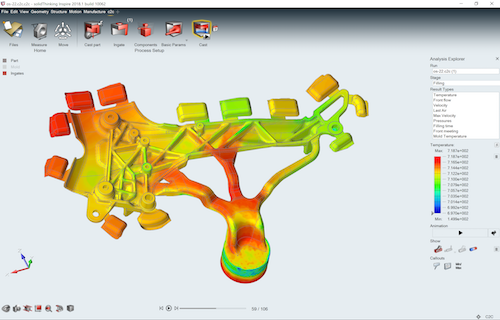
The solidThking suite, which encompasses nine applications, including the Inspire generative design and topology optimization simulation tool and Evolve 3D hybrid modeling and rendering environment, has traditionally been licensed as individual products. With the new sTU licensing plan, customers with a single seat license for the product portfolio will be covered for the entire suite, greatly opening up access and reducing cost, officials say. Moreover, the sTU licensing model is less expensive than the traditional HyperWorks Units (HWU), increasing the suite’s attractiveness for smaller customers.
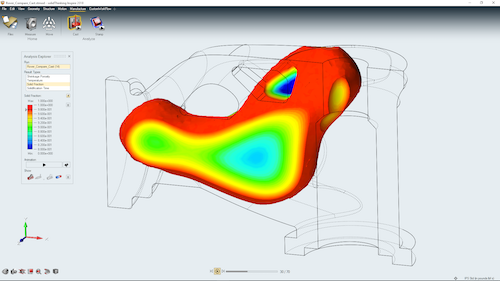
In addition, the sTU licensing is ushering in another key capability: Enabling customers to run solidThinking applications locally or in the cloud from anywhere, at any time, further lowering the cost of entry for organizations with limited IT and compute resources. For those organizations that have a higher simulation-maturity level, the on-demand flexibility allows them to easily scale compute resources to meet burst periods where there is ramped up simulation demand.
“SMBs can make an investment in a certain pool of units, which enables the entire organization to have access to those technologies, whether that’s a designer or a manufacturing engineer,” says Mike Kidder, senior vice president of Corporate Marketing for Altair. “This licensing model model lets them access the tools that are relevant to their job function and share the same pool of units for different purposes.”
Watch this video to see how solidThinking Inspire facilitates the design of a part from concept to production:


Altair transforms design and decision making by applying simulation, machine learning, and optimization throughout product lifecycles. Altair offers software in five categories related to Computer Aided Engineering (CAE) and High Performance…
Accelerating and Advancing CAE
GPUs are changing the nature of engineering simulation, according to a new ebook from Jon Peddie Research (JPR). It explains how GPU acceleration is improving CAE workflows.

Beth Stackpole is a contributing editor to Digital Engineering. Send e-mail about this article to [email protected].
Follow DE






About Us · Contact Us · Editorial Team · Advertising · Privacy Policy · Subscriber Services · © 2026 Digital Engineering 24/7 · Peerless Media