Helping design and engineering professionals discover, evaluate and specify technologies and processes that shorten the design cycle and enable success.



May 2026 Special Focus: Artificial Intelligence in Design and Simulation
In this Special Focus Issue, learn about the latest developments in the integration of artificial intelligence into engineering workflows.

Design & Simulation Software Guide 2025
In this Special Issue, Digital Engineering presents its second annual guide to design and simulation software vendors.
Altair reports that it has achieved up to 10x speedups with the Altair OptiStruct structural analysis solver on NVIDIA GPU-accelerated system architecture—with accuracy. This speed boost has the potential to impact several industries including automotive, aerospace, industrial equipment, and electronics that frequently need to run large, high-fidelity simulations.
“This breakthrough represents a significant opportunity for our customers to increase productivity and improve ROI with a high level of accuracy, much faster than was previously possible,” says Uwe Schramm, Altair’s chief technology officer for solvers and optimization. “By running our solvers on NVIDIA GPUs, we achieved formidable results that will give users a big advantage.”
The test suite included a variety of industry models including multiple solution types such as statics, frequency response, buckling and optimization. Support for GPU acceleration began with OptiStruct’s direct solver and with the large-scale NVH solver AMSES, a standard feature of OptiStruct. AMSES is said to cut the time required to compute eigenvalues for analysis in NVH simulations, and it can quickly calculate thousands of modes with millions of degrees of freedom. The same levels of acceleration were achieved with both solvers, Altair reports.
Most recently, the OptiStruct development team extended GPU support by porting OptiStruct’s PCGiterative solver on the same NVIDIA GPU-accelerated system, which resulted in high performance boosts. For some models—such as compact, block-like, solid structures—the PCG solver can be faster than the direct solver, especially when GPUs are in play. The upcoming OptiStruct 2019 release will include support for multiple GPUs.
OptiStruct speedup on GPU-accelerated systems enables scaling for large models, particularly NVH models, that may run poorly or not run at all on CPU-based systems. The greater memory capacity of GPUs, including the ability to use multiple GPUs, means they can handle much larger, more complex models.
NVIDIA Quadro GV100 GPU technology was used for the solver runs and was compared with dual Intel Xeon Sandy Bridge-EP 3.1GHz 16-core CPUs with 256GB of RAM. Run times compared were total elapsed times, or wall times, for the solution to complete.
Sources: Press materials received from the company and additional information gleaned from the company’s website.


Altair transforms design and decision making by applying simulation, machine learning, and optimization throughout product lifecycles. Altair offers software in five categories related to Computer Aided Engineering (CAE) and High Performance…
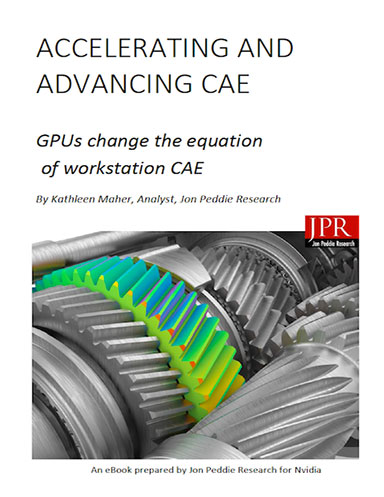
Accelerating and Advancing CAE
GPUs are changing the nature of engineering simulation, according to a new ebook from Jon Peddie Research (JPR). It explains how GPU acceleration is improving CAE workflows.

DE's editors contribute news and new product announcements to Digital Engineering. Press releases may be sent to them via [email protected].
Follow DE
Join over 90,000 engineering professionals who get fresh engineering news as soon as it is published.






About Us · Contact Us · Editorial Team · Advertising · Privacy Policy · Subscriber Services · © 2026 Digital Engineering 24/7 · Peerless Media