Helping design and engineering professionals discover, evaluate and specify technologies and processes that shorten the design cycle and enable success.


Alert!
Digital Engineering ceased publication on July 1, 2026. This website remains available as an archive of engineering content.
For inquiries or information, please email [email protected].

Digital Engineering April 2026
In the latest issue of Digital Engineering, we take a look at the latest innovations in design for additive manufacturing, including the use of natural language inputs, social media cosplayers, and AI integration. The issue also includes a feature…

January Special Focus Issue: Design for Additive
In this Special Focus Issue of Digital Engineering, learn about the latest advancements in design for additive manufacturing, including new software tools, additive in automotive, custom medical devices, and more.
With more than 5,000 small satellites already in-service and demand surging, there’s a race to come up with innovative launch vehicles to deliver these small satellites (SmallSat) into low-earth orbit—a market currently dominated by SpaceX and others.
Rocket start-up Launcher aims to get a jumpstart on the emerging market, leveraging metal additive manufacturing (AM) technology from Velo3D to improve engine design for its Orbiter satellite transfer vehicle and platform and get it launch-ready in an accelerated time frame. Launcher, which is developing its own launch service — Launcher Light, slated to take flight in 2024 — shifted focus to the top of rocket’s three-stage design so that the Orbiter vehicle would be ready in time to hitch a ride on SpaceX’s SmallSat Rideshare Program in October.
As part of its RideShare Program, SpaceX sells payload space on its Falcon 9 rocket. Launcher decided to fast-track design of its satellite deployment system by making it compatible with the SpaceX service and other launch platforms to get a jumpstart on its hosted payload business model. These satellite deployment systems are intended to make satellite deployment easier and affordable—what Launcher estimates will cost around $8,000 per kilogram.
“Seeing an opportunity to give our customers the best of both worlds, we brought Orbiter to the head of the line,” said Max Haot, founder and CEO of Launcher. “At the same time, we continue our work on the Launcher Light’s mechanical structures, the fairing, and most important, the engine, all in preparation for its first commercial flight in 2024.”
Launcher licensed a drawing for a space-proven turbopump then got to work improving and lightweighting the design using AM technology and consulting expertise from Velo3D and its network of contract manufacturers. Quickly, the Launcher team determined it needed in-house design and AM capabilities, settling on the Sapphire metal AM system. “Every time you buy a separation ring, propulsion system, or support structure from a third party, your costs and lead time easily rise by a factor of 10,” Haot said. “Instead of the week or so it takes us to design an engine, print, and test it, we would spend maybe two to three months with an outside provider. It's prohibitive.”
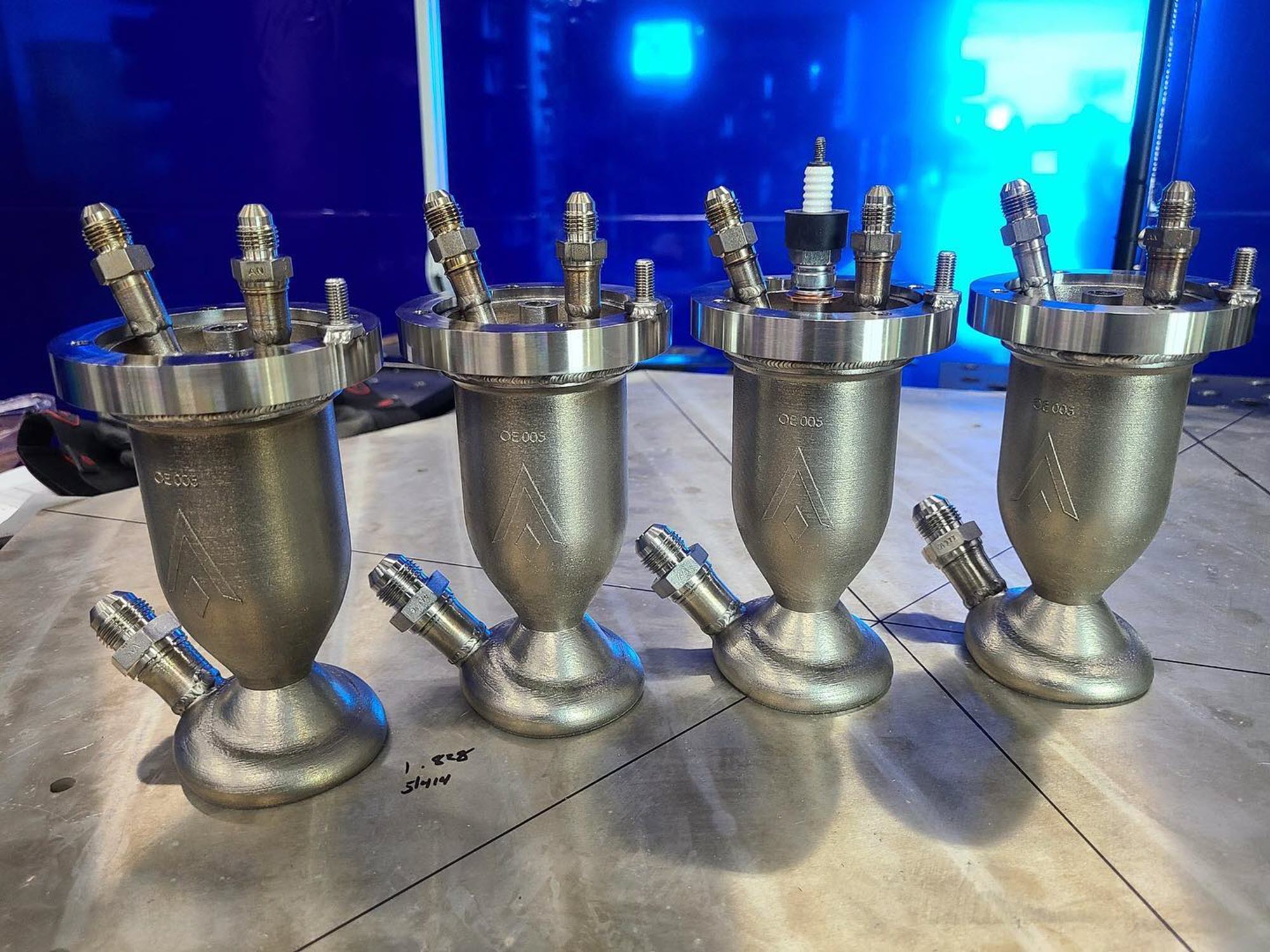
The Velo3D Sapphire metal AM system has been critical to building hard-to-produce parts, including the engine’s shrouded impeller, a complex Inconel part that spins at 30,000 rpm and must withstand more than 300 bar of outlet pressure. The Sapphire is also being used to produce the Orbiter’s 22-liter tanks, which exactly match its build volume. Initially, the build was created in Inconel, but was optimized for lighter-weight titanium materials. Over time, the team has leveraged the metal AM technologies to create brackets, combustion chambers, and injectors.
Having in-house AM capabilities is key to Launcher’s ability to push for more aggressive designs and higher-performing parts. “We don’t have to completely change our design to make it work with the Velo3D printer,” said Tim Berry, Launcher’s head of manufacturing. “Velo3D is practically a turn-key system that allows you to focus on design iteration and spend more time optimizing for a specific use case—all of which supports our primary mission of low-cost satellite deployment.”
To learn more about how Launcher is leveraging AM and simulation technologies as part of its rocket launch mission, watch this video session.

From software to hardware to complete product support, Velo3D is a fully integrated Metal AM manufacturing solution that gives designers and engineers unparalleled freedom to create what was previously considered "impossible".

Beth Stackpole is a contributing editor to Digital Engineering. Send e-mail about this article to [email protected].
Follow DE






About Us · Contact Us · Editorial Team · Advertising · Privacy Policy · Subscriber Services · © 2026 Digital Engineering 24/7 · Peerless Media