Helping design and engineering professionals discover, evaluate and specify technologies and processes that shorten the design cycle and enable success.


Alert!
Digital Engineering ceased publication on July 1, 2026. This website remains available as an archive of engineering content.
For inquiries or information, please email [email protected].

Digital Engineering April 2026
In the latest issue of Digital Engineering, we take a look at the latest innovations in design for additive manufacturing, including the use of natural language inputs, social media cosplayers, and AI integration. The issue also includes a feature…

January Special Focus Issue: Design for Additive
In this Special Focus Issue of Digital Engineering, learn about the latest advancements in design for additive manufacturing, including new software tools, additive in automotive, custom medical devices, and more.
Additive manufacturing (AM) for on-demand medical device production has been a value-added game-changer. Development of such devices is constantly being fine-tuned with enhanced automation capabilities, incorporating advances such as AI, while offering increased accessibility and affordability, according to companies vested in this space.
AM enables high levels of customization for medical devices including implants, prosthetics and surgical guides. This personalization leads to potentially better patient outcomes and reduced recovery times, while trimming costs through less waste, and on-demand production reducing or even eliminating the need to maintain large inventories.
And the business is fruitful in this space, with steady growth anticipated. In fact, the medical device market was valued at $176.7 billion in 2020 and is expected to grow at more than 5% annually through 2028, according to research cited by Protolabs.
3D Systems brings over 15 years of experience to the on-demand medical device sector, having planned more than 200,000 unique patient cases and manufactured over 1 million patient-matched devices, according to Ben Johnson, vice president, MedTech at 3D Systems.
“Patient-matched devices are a sweet spot for additive manufacturing where the product mix is high, and the volume is low. The use of patient-matched devices has shown to be beneficial in reducing OR time, improving surgical outcomes, and reducing surgical errors,” Johnson explains.
Materialise is equally established in this sector, according to Nora Toure, director of Medical Business & Sales, Materialise North America, who notes how the company has helped more than 10 million patients through various medical means. “On-demand manufacturing isn’t just something we do, it’s fundamental to our identity and mission,” says Toure. “For us, ‘on-demand’ means more than just fast manufacturing. It’s about enabling just-in-time, patient-specific device creation through digital workflows, cloud-based collaboration, and scalable regulatory-compliant processes.”
Materialise services healthcare with personalized implants and surgical planning services, offering hospitals and medical device companies software solutions to design, manufacture and scale their own on-demand devices. The company’s personalized acetabular cups, as one example, have reportedly achieved a 97% survival rate in complex hip defect cases.
At Protolabs, Alex Lothspeich, 3D printing applications engineer, cites the evolution of the medical industry and how Protolabs seized an opportunity. “The medical industry is constantly evolving. For Protolabs to be able to optimize our speed, our customization and our digital agility, that works hand in hand with the medical industry, especially medical devices.”
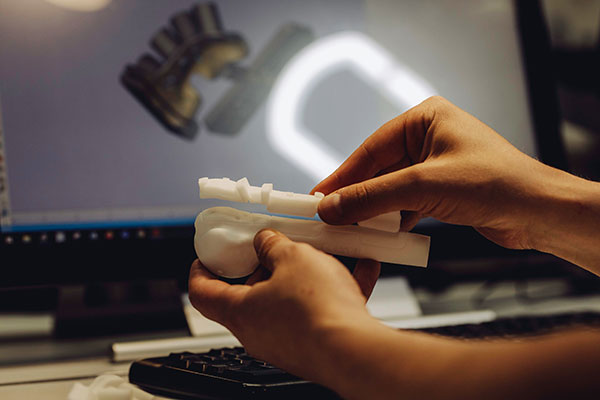
3D printed bone model and drilling osteotomy guides designed to match the patient’s unique anatomy and to guide the surgeon intra-operatively. Guides design and image ©Materialise
Lothspeich offers several case examples of Protolabs’ involvement with medical firms. He mentions Allison London Brown, CEO of NC-based UVision360, Inc., whose medical device startup has opened access for specific surgical procedures to move from hospital-only settings to doctors’ offices. The goal: allowing women simplified access to hysteroscopy and cystoscopy via the company’s Luminelle hysteroscopy system. Through collaboration with Protolabs, UVision360 can prototype quickly with tiny features via Protolabs’ stereolithography (SLA) approach using MicroFine green material.
Another example involves HemoSonics Quantra’s multiprocess manufacturing for point-of-care testing devices. Protolabs assisted using SLA, CNC and molding to build housings and internal manifolds across the product lifecycle.
Within the on-demand medical device space, benefits include customization, faster time to market, cost-effectiveness and design complexity. EOS’ Andrew Lijoy, applied solutions manager, APAC, adds to the list: “One of the other advantages is improved healing process. Devices can be designed with surface structures that promote better osseointegration, enhancing the healing process and the success of implants.” Sustainability also factors in: “Additive manufacturing supports sustainable production practices by reducing material waste and energy consumption.”
Lothspeich of Protolabs identifies additional advantages: “In terms of benefits, customization tends to be a top one. You have patient-specific implants, surgical guides, prosthetics, anything that allows us to use STL files from CT or MRI scans. Using those, we can produce one-off devices that are tailored to that unique anatomy.
“Another factor worth promoting is the speed for additive [manufacturing],” he says. ”We’re taking days instead of months and we’re able to support faster validation. Engineers can go from CAD to part in under 24 to 72 hours. It is a game changer for any sort of feasibility trials.”
Cost efficiency is also significant, Lothspeich adds: “As opposed to injection molding that involves tooling, additive manufacturing is ideal for those low-volume steps. You’d essentially be avoiding $50-150K in upfront tooling. Additive manufacturing is great for early-stage design validation in short-term market trials.”
At 3D Systems, Johnson notes that benefits are largely clinical: “We primarily see advantages in clinical metrics such as improved surgical outcomes, and reduced time in the OR for certain procedures with patient-matched devices. We are also able to serve the needs of unmet patient populations like in pediatrics or oncology that would not be able to take advantage of off-the-shelf devices due to unique requirements.”
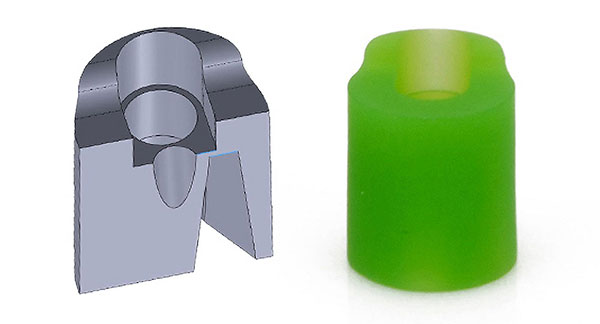
The LUMINELLE hysteroscopy system’s tiny, 3D-printed, MicroFine Green parts made by Protolabs. The manifold adapter part is shown in two views. Image courtesy Protolabs.
Materialise also views a great advantage with patient outcomes. “When you design solutions specifically for a patient’s anatomy, you’re not just improving precision, you’re dramatically increasing the likelihood of procedural success. Precision leads to better surgeries, fewer complications and, in many cases, faster recovery,” Toure explains.
Increased design capabilities also get a nod: “Additive manufacturing enables us to create geometries impossible with traditional methods, from lattice structures that promote bone in-growth, to surgical guides that provide surgeons with reference points they never had before,” Toure shares. “We’re creating entire ecosystems—preoperative planning, patient education, digital workflows—that improve the whole experience for everyone involved.”
Material challenges can negatively impact medical device manufacturing, according to Anna Sailor, EOS Additive Minds consultant, Metal. “One of the biggest challenges with titanium medical devices is heat accumulation that can lead to deformation, warping and even cracking in parts. EOS has robust monitoring tools to observe process characteristics during the build to help us better understand and predict these phenomena.”
Materialise’s Toure views challenges from an accessibility standpoint: “The real challenge isn’t proving that personalization works; we’ve done that. It’s making it accessible and scalable. That’s where our investments in AI, automation and cloud platforms come in. We’re not just building better devices; we’re building the digital backbone to deliver personalized care anywhere, at any time, safely, efficiently and at scale.”
Tackling the costs associated with personalization has led to increased accessibility, according to Toure: “Historically, personalization has been associated with high costs, but our automated processes have changed the economic equation. We’re making these solutions viable for broader patient populations, not just the most complex cases. Collaboration is key. There’s often a disconnect between engineers, clinicians and regulatory teams, which can slow progress.
“Another challenge is the complexity of manual processes,” Toure adds. “Personalization often involves manual segmentation and design, which can slow down production and increase costs. By automating steps like segmentation and leveraging AI to analyze patient data, we’ve been able to reduce lead times and make personalization more efficient.”
EOS’ Smart Fusion technology monitors manufacturing in real time, “allowing for layer-by-layer regulation of the laser power to control areas of overheating,” Sailor explains. “This advanced closed-loop control tool makes it possible to build robust parts without the risk of job crashes due to material deformation while building with even less supports, leading to less post-processing activities and reducing overall part costs. For the on-demand medical device industry, where speed and reliability are critical, Smart Fusion offers a scalable path to consistent, high-quality production.”
Johnson at 3D Systems explains how the company’s EXT 220 MED can produce high-performance polymer implants in PEEK or PEKK as well as instrumentation and accessories in Radel. Additionally, 3D Systems’ NextDent 5100 is used for various dental applications.
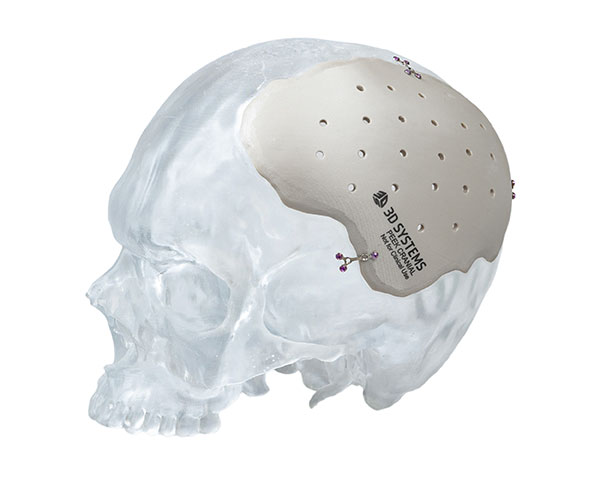
Johnson cited a case study highlighting Rainer Trummer, a 55-year-old computer scientist from Austria who faced a skull anomaly since birth. Cost and limited technology meant corrective surgery was previously impossible. Salzburg University Hospital used 3D Systems’ AM technologies to create a skull implant for Trummer using an EXT 220 MED 3D printer capable of printing PEEK implants under cleanroom conditions.
At Protolabs, medical device manufacturing incorporates several approaches: SLA for fine-detail precision plastics often used for surgical guides and housings; selective laser sintering (SLS) and MJF for functional strength in enclosures; and direct metal laser sintering (DMLS) for dense biocompatible metals like titanium or stainless steel in orthopedics and surgical tools. Lothspeich says Protolabs factors in biocompatibility and sterilization when considering material options.
Materialise’s approach begins with precise computed tomography scan segmentation and specific design processes. “This digital foundation determines the success of the final device,” Toure explains. The company uses SLS and DMLS for titanium implants in orthopedics, SLA for surgical guides requiring submillimeter accuracy, and Multi-jet Printing for multimaterial devices mixing rigid and flexible components.
Regulatory compliance often presents significant challenges, according to EOS’ Lijoy: “Medical manufacturers need to produce and test an incredible amount of data to achieve compliance, which takes a lot of time and resources.”
Sailor further explains one way in which EOS addresses this: “The EOS Medical Device Master File is designed to help expedite regulatory approval by offering a single, validated source of technical data, which medical device manufacturers can reference in their submission to regulation authorities. This reduces repetitive testing, lowers regulatory friction and minimizes delays in market entry.”
Lothspeich shares’ Protolabs’ approach: “Having to maintain regulatory requirements tends to be a key challenge in terms of traceability, process validation and material biocompatibility. We’re having to ensure repeatability across orders as well as risk controls and documented processes, especially under ISO 13485 and FDA.”
3D Systems’ Johnson also adds cost considerations to the mix: “The challenges with additively manufacturing patient-matched medical devices are primarily in cost and regulation. These devices are more commonly utilized in difficult surgical procedures or very complex patient disease. As cost continues to be addressed through hardware and digital workflow enhancements, I believe we will see increased adoption of patient-matched devices into more commonly performed surgical procedures.”
Johnson of 3D Systems expects patient-matched device manufacturing to be prominent in established clinical segments such as dentistry, craniofacial surgery, orthopedics, and oncology. “As we look to the newest frontiers that will require OEMs to continue R&D efforts to enhance 3D printing technologies, software and materials. With these innovations, I anticipate we will open new clinical opportunities in segments such as cardiovascular medicine and pharmaceuticals, further expanding treatment options.”
Lothspeich at Protolabs adds: “The devices I’ve looked forward to [include] any type of personalized device serving as standard of care. We see more implants, guides, prosthetics that are made more patient-specific, especially as reimbursement catches up. We have a dedicated team constantly keeping tabs on the market, seeing if there are upcoming technologies that align with what medical manufacturers are looking for.”
Toure concludes: “I believe we’re heading toward a world where personalization becomes the standard, not the exception. AI-driven automation will play a huge role in making this possible by streamlining workflows and reducing costs. We’ll see greater convergence of technologies like 3D printing, augmented reality and AI, plus expansion into new areas like cardiovascular and pulmonary applications. Ultimately, the goal is to make personalized care accessible, affordable and sustainable.”

From digitization, design and simulation through manufacturing, inspection and management, our comprehensive portfolio of technologies provides a seamless, customizable workflow designed to optimize products and processes while accelerating…
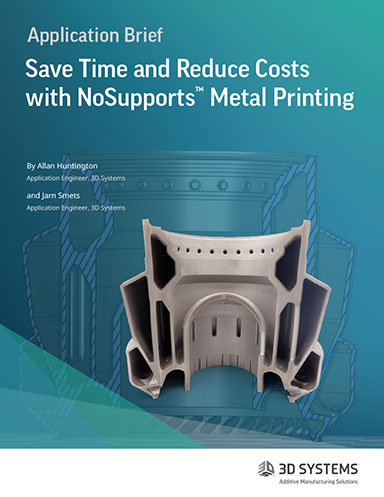
Save Time and Reduce Costs with NoSupports™ Metal Printing
Metal 3D printing is a high energy process in which it is possible for unmanaged heat and stress to build up and impact part quality, this guide presents a step-by-step methodology for how to apply NoSupports to a hot end section of a larger turbomachinery part.

Stephanie is the Associate Editor of Digital Engineering.
Follow DE






About Us · Contact Us · Editorial Team · Advertising · Privacy Policy · Subscriber Services · © 2026 Digital Engineering 24/7 · Peerless Media