Helping design and engineering professionals discover, evaluate and specify technologies and processes that shorten the design cycle and enable success.



Similar to past AMUG events, this year’s Additive Manufacturing Users Group (AMUG) 2025 conference, March 30-April 3, was fueled by the endless opportunities to network via AM-centered workshops and sessions, the expo, derby race, technical competition, evening receptions, and more. Overall, this year’s event though drew smaller numbers compared to the past: 1,100 people, including 300 first-timers. But AMUG didn’t hide the challenges. Instead it went full transparency as the first day shifted into gear.
But first, AMUG reminded the audience of its unique positioning as an additive show:
“The big thing here at AMUG is networking. Sometimes we're networking by teaching one another, coaching one another, learning about one another. We're providing a forum for that,” VanDeren said on opening day. The purpose behind the networking is all about additive: “AMUG leverages cross-industry knowledge for effective technology transfer,” VanDeren says. Expect to mingle with novice to expert users from universities, government, contract manufacturing, OEMs (equipment, software), associations and more.
VanDeren and Todd Grimm, the organization’s designated emcee, jointly shared the stage, noting highlights of the 5-day event.
Among the highlights was the event expo, where dozens of exhibitors demonstrated software, equipment and service capabilities to attendees. However, AMUG, which took place a little over a week ahead of RAPID + TCT, takes a different tack on its expo compared to other AM shows.
“Our Expo is not designed to be a commercial space. This expo is a training playground for you. Our exhibitors are here to give you coaching to be more knowledgeable users of their product or service,” VanDeren shared.
Later in the opening session, VanDeren’s speech was interrupted by the recorded jarring noise of an elephant stampeding across the projection screen. “We’re going to talk about a difficult reality—the elephants in the room. The floor for the expo is smaller. The amount of attendees is less. Our success at AMUG is not measured by the number of heads here or number of dollars funded for the event. Our success is measured by the relevance [of the event], your desire to come back, by your takeaways when you go home, and by what you bring to us.”
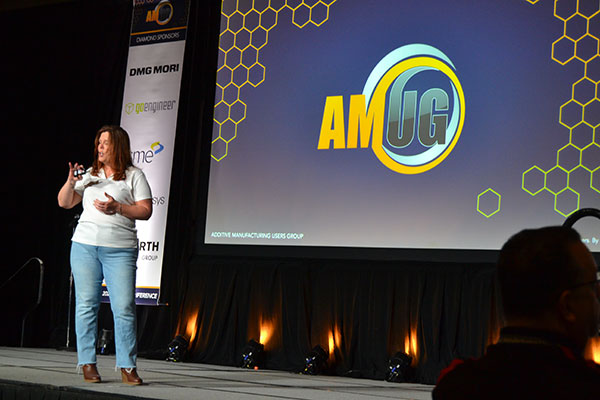
VanDeren identified the elephants from AMUG’s vantage point:
VanDeren said she’s been hearing: “There’s a chase now. there is less push to sell equipment, more push to chase an application and sell equipment to solve that application. As a result we’re hearing some talk of let’s focus on a more industry-specific show. But the collision of different industries can yield wonderful and happy surprises. Those can churn in to other developmental applications.”

Speaking to this year’s smaller expo, she reflected AMUG’s perspective: “One thing to know, we’re not focused on being a transactional show. We’re not focused on being a lead-gen show. We focus on building relationships. We’re seeing less machines on the floor, but look at this as a playground, a lab for those of us who are here that we can be learning from one another,” VanDeren adds.
A big acknowledgment at the event was to government changes:
“Not many federal government people are here due to an executive order commissioning that the DoD may not travel to conferences until further notice,” VanDeren pointed out. “That created some rattles here at AMUG – a lot of cancellations, some of whom were speakers, which meant we had to jingle and jangle to fill our spots.
“It’s important to acknowledge our triumphs, it’s also important to acknowledge the trials,” VanDeren noted post-event. “The ‘elephants’ are impacting all of us. While none of the [elephants] are a direct result of the efforts of a single entity, they have unique impacts on each. Rather than focus on the global distractions, I’d rather keep my eye on the rising of tides raising all ships. We all gain when we unite and build up the industry in its entirety, when we speak with humility that not every effort has been met with resounding success, when we champion the growth of varied pockets of AM industry.”
The first of the week’s keynotes was Ryan Watkins, research engineer of NASA JPL (Jet Propulsion Laboratory), NASA’s only federally funded research and development center with contractors that work on NASA missions. His session, “Built to Break, Designed to Protect,” focused on creation of 3D-printed crushable lattices for space exploration. Watkins shared how some of the NASA JPL work of late has been targeted to robotics spacecraft. He spoke about work related to a Mars mission, as well as using unitcellhub, an open source lattice design tool developed at JPL. “It automates geometry creation, meshing, finite element simulation and database management,” Watkins shares.

In a later Diamond Sponsor Insights and Highlights panel, moderated by Adam Penna of All Digital Additive Manufacturing, five experts addressed challenges and anticipated future directions for the industry: Stacey Eeman, director, industry strategy, SME; Foster Ferguson, vice president of industrial business at Stratasys; AJ Strandquist, CEO of Wurth Additive; Alex Richards, general manager at DMG Mori; and Tyler Reid, vice president of digital manufacturing of GoEngineer sales and service organization.
When asked what technologies GoEngineer’s Reid sees as grabbing hold of the AM industry, and shaping the future, he said, “What I’m most excited about is AI and smart implementation of AI into our products. We’re starting to see just glimpses of that. But it’s a type of technology that, as soon as it hits, it hits hard. And every person in this room, no matter what your role is, you need to figure out how to smartly implement AI into products and workflows.”
Reid later noted how aerospace and defense, for the last few years, has been the number one buyer of AM technology. “It’s one of the few industries that’s been able to overcome the higher cost because of the capabilities of the system. But what I’ve noticed on the metal side is a narrowing of the product design tailored more and more for aerospace and defense. That concerns me.
“We live and breathe additive,” Reid continues. “But additive is something like 0.2% of the total spend in manufacturing—a tiny, tiny sliver. We need to expand that market. How do we create lower cost, higher value goods and expand this market? We have to reach into tooling and jigs and fixtures and actual industries where production is accessible. Production is least accessible in aerospace and defense—It’s so regulated.”
At DMG Mori, which builds its own automation systems (including laser powder bed fusion machines) and subtractive manufacturing machines, Richards said “our general outlook is we’re looking 30 years into the future and saying, ‘what does the manufacturing industry look like?’ We also have the challenge of how to replace the existing equipment we’re using for additive parts in a way where we can be more efficient and more productive when we don’t have the same workforce 30 years from now. How do we increase our productivity to a point where we can increase by 5 times to make up for the lack of workforce?”
Strandquist of Wurth Additive also chimed in, addressing the “minor details,” by sharing how Wurth Additive has a digital inventory services software that covers commercial, operational and QA/QC, which was first announced at AMUG 2024. “Essentially the gap that we solve is in all the boring stuff. How do you keep track of paperwork? People talk about serial production in additive. They think: 50,000 pieces in one batch. Really, that’s not the party trick. The party trick is 50,000 prints in 50,000 locations. Then the question is ‘how do I collect paperwork at 50,000 locations easily without a huge overhead?’ The question is how do we take the process and build around it?”
Strandquist continued: “Additive has done a really good job of being in prototyping and being this far-out theoretical deep-thinking product. But the time for it to be a jackhammer and everyday tool is upon us. We can always look to the future, but the time is now to use what we have and implement it.”
Foster Ferguson sees the industry as having some challenges, including that of legacy platforms pushing 30-40 years old. “How do we supplement that market when there’s a single vendor log and we’re trying to address the supply chain issues?”
In speaking to the tooling aspect in automotive, a “significant” $11 billion market, Ferguson noted how Stratasys recently developed a Center of Excellence in Detroit for this reason. “There’s a Ford F150 being made every 57 seconds. [And] there’s all of this messy stuff that has to happen before you go on the line and start to deal with tooling. The purpose of that Center of Excellence was to bring additive into the hands of these users—small and medium sized suppliers—to build the tooling. That’s a major market.
“And going back to aerospace and defense … there’s a few areas we think additive is really well-positioned for,” Ferguson says. “UAV and UAS is significant. There’s a lot of opportunity in space. It’s [additive] inherently almost designed for that.”
While at breakfast, additive user Stephen Feldbauer, director of R&D at Abbott Furnace in PA, who also serves as an AMUG volunteer, acknowledged and agreed with AMUG’s opening remarks, noting specifically less exhibitors, one less salon, and the timing of RAPID and AMUG. “Companies can’t afford both; companies are sending less people and taking more targeted approach on who should be at events.” He said it’s likely that exhibitors are “not going to sell anything here but can have great networking to build relationships to sell.”
For other AMUG announcements, click on the following:
AMUG Shares Tech Competition Winners
AMUG Reveals President’s Award Winner
Mark your calendars now for next year’s AMUG, which will head west to Reno, NV, March 15-19, 2026.
Sources: Press materials received from the company and additional information gleaned from the company’s website.


Stephanie is the Associate Editor of Digital Engineering.
Follow DE
Join over 90,000 engineering professionals who get fresh engineering news as soon as it is published.






About Us · Contact Us · Editorial Team · Advertising · Privacy Policy · Subscriber Services · © 2026 Digital Engineering 24/7 · Peerless Media