Helping design and engineering professionals discover, evaluate and specify technologies and processes that shorten the design cycle and enable success.


Alert!
Digital Engineering ceased publication on July 1, 2026. This website remains available as an archive of engineering content.
For inquiries or information, please email [email protected].


Digital Engineering April 2026
In the latest issue of Digital Engineering, we take a look at the latest innovations in design for additive manufacturing, including the use of natural language inputs, social media cosplayers, and AI integration. The issue also includes a feature…

January Special Focus Issue: Design for Additive
In this Special Focus Issue of Digital Engineering, learn about the latest advancements in design for additive manufacturing, including new software tools, additive in automotive, custom medical devices, and more.
The Additive Manufacturing Users Group (AMUG) announced the winners of its annual Technical Competition, which recognizes achievements in additive manufacturing applications and finishing techniques. A panel of industry veterans selected entries from NASA Jet Propulsion Laboratory and Equispheres as Advanced Finishing and Advanced Concepts winners, respectively. AMUG members selected the entry by Ricoh 3D for Healthcare as the Members' Choice winner.
The Technical Competition took place at the annual AMUG Conference, March 30–April 3, 2025, in Chicago. Bonnie Meyer, co-chair of the Technical Competition Committee, said, "There was an impressive range of participation with entries from corporate partnerships to individuals showcasing how their hobbies and professional experiences blend into additive manufacturing opportunities. The competition also showcased a wide array of entry types, from engaging and creative variations on existing applications to unique and innovative uses of additive manufacturing."
Ten judges reviewed the competition entries to select Advanced Finishing and Advanced Concepts winners.
Ryan Watkins, research engineer with NASA Jet Propulsion Laboratory (JPL), submitted the winning entry in the Advanced Finishing category, "Mars Sample Return Crush Lattices." While additive manufacturing produced small unit-cell lattice structures, printing limitations yielded ligament thicknesses (and overall part mass) that were suboptimal for the mission.
To address the limitations, NASA JPL worked with REM Surface Engineering's chemical polishing process to controllably reduce ligament thickness and overall component mass by over 80% while ensuring that the parts would meet mission requirements. The mass after chemical polishing was within 0.5 percent of the target.
The judges said, "Ryan's use of finishing to modify the force required to crush the structure is ingenious, allowing him to create a finished structure that could not be printed. He is not just modifying the appearance of the part; he is also modifying the physical properties to meet the application's needs. This is very impressive."
Evan Butler-Jones, vice president of product & strategy at Equispheres Inc., submitted the winning entry for Advanced Concepts but quickly acknowledged that the project was a collaborative effort with Martinrea International, represented by Steve Geddes, senior technical specialist.
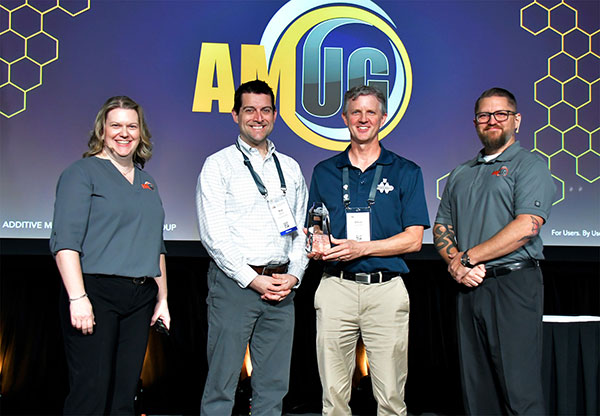
Butler-Jones' entry titled, "Applying Additive Manufacturing for Integrated Passive Cooling in an e-Motor Housing," leveraged Martinrea's design and engineering talent, which is focused on the automotive sector, and Equispheres' additive manufacturing process expertise to deliver an aluminum part. Doing so uncovered potential for use cases in electric vehicles (EVs) and other industries with thermal management challenges.
The design and printing process produced an integrated vapor chamber for two-phase passive and liquid cooling in a single structure, which eliminates the need for additional cooling components while improving heat transfer efficiency. Fundamentally, the laser powder bed fusion process combined partial and full melting to produce the passively cooled vapor chambers within the motor housing.
The judges commented, "Excellent in many aspects. More than 100% improvement in both energy use and heat control! The result is an additive manufacturing replacement for an existing component, forgoing the need for motor redesign. This could not have been done any other way."
Through voting by AMUG's Members, Luke Hileman, lead technician for Ricoh 3D for Healthcare, won the Members' Choice category. The "Neonatal Thoracentesis Trainer" entry will serve as a training tool for healthcare professionals, enhancing their skills in the life-saving procedure.
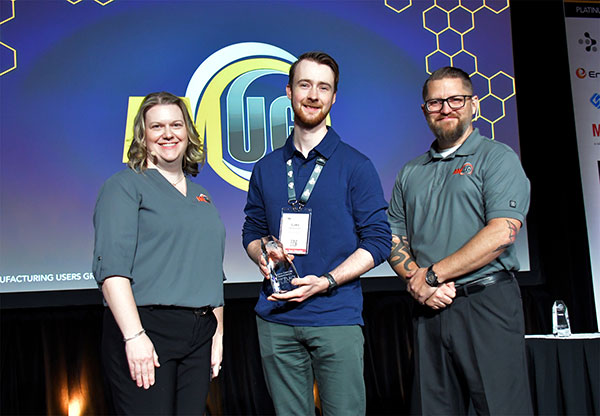
The high-fidelity simulation model used advanced printing techniques and technology to create the trainer with haptics that "feel like the real thing." Thoracentesis is a procedure to drain fluid from the space between the lungs and the chest wall, called the pleural space.
The judges' comments on Hileman's entry stated, "A wonderful use of additive manufacturing to address life-saving medical treatment for infants. These models provide a much-needed training aid for doctors to practice and plan this complicated procedure and to prevent future developmental issues that can occur if the slightest mistake is made."
Meyer stated, "Unlike the Advanced Concepts and Advanced Finishing categories, the Members' Choice award has no defined evaluation criteria. It is open to personal and subjective impressions. The Members' Choice results were very close, with only one vote separating first and second place."
For Advanced Finishing, Aaron Sherman of HellermanTyton took second place for "Miniature Tabletop Gaming Models by Pocket Dimension Studios." Third place was awarded to Brent Griffith of Labconco Corporation for "Nature's Grip Recreated: Advanced 3D Print Finishing Techniques on Rock Climbing."
In Advanced Concepts, second place was awarded to the Members' Choice winner, Luke Hileman. Jacob Kallivayakik of Eaton Corporation garnered third place for "AM for Electric Machines."
Meyer concluded, "The AMUG Technical Competition brings together an impressive range of industries and applications, offering participants a valuable platform to highlight their accomplishments. This year, the judges placed a greater emphasis on entries that demonstrated practical solutions with real-world impact–applications that are not only innovative but deliver tangible benefits."
Ryan Watkins, Evan Butler-Jones, and Luke Hileman, or their designated representatives, will receive complimentary admission to the 2026 AMUG Conference, where they will elaborate, from the stage, on the projects' details and the processes used.
The Technical Competition judging panel was comprised of ten AMUG DINOs, an award that recognizes tenure and contributions. These judges were Rey Chu, Joerg Griessbach, Tom Mueller, Bruce Okkema, Rick Pressley, Colton Rooney, Harold Sears, Ed Tackett, Sean Wise, and Mark Wynn.
Sources: Press materials received from the company and additional information gleaned from the company’s website.


DE's editors contribute news and new product announcements to Digital Engineering. Press releases may be sent to them via [email protected].
Follow DE






About Us · Contact Us · Editorial Team · Advertising · Privacy Policy · Subscriber Services · © 2026 Digital Engineering 24/7 · Peerless Media