Helping design and engineering professionals discover, evaluate and specify technologies and processes that shorten the design cycle and enable success.


Alert!
Digital Engineering ceased publication on July 1, 2026. This website remains available as an archive of engineering content.
For inquiries or information, please email [email protected].

Digital Engineering April 2026
In the latest issue of Digital Engineering, we take a look at the latest innovations in design for additive manufacturing, including the use of natural language inputs, social media cosplayers, and AI integration. The issue also includes a feature…

January Special Focus Issue: Design for Additive
In this Special Focus Issue of Digital Engineering, learn about the latest advancements in design for additive manufacturing, including new software tools, additive in automotive, custom medical devices, and more.
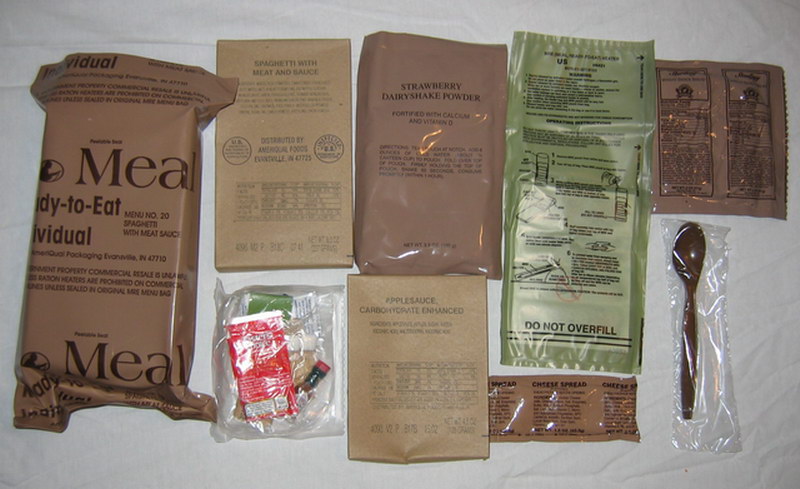 3D food printing could revolutionize the production of military rations (MREs). Image: MRE Info
I thought they were pretty cool souvenirs, and after we returned from vacation I decided to try one out for lunch. It was disgusting. Barbequed meat in a can? Blackberry jam the consistency of caulking? Yuck.
Meals, Ready-to-Eat (MREs) have come a long way since then, and by all accounts they are significantly more edible than in the past. Now, in a very "Star Trek"-like development, the U.S. Army is investigating how 3D printing could help generate custom food for deployed troops.
The 3D food printers could potentially be used to allow soldiers to generate rations on site, which would be much less costly than packaging and shipping food and eliminate waste, according to researchers at the Natick Soldier Research, Development, and Engineering Center (NSRDEC) in Massachusetts.
Using chemical substrates to print the food would allow the creation of food that could meet both the culinary tastes and nutritional needs of individual soldiers. The process is called ultrasonic agglomeration, and it uses high-frequency sound waves to cause clumps of particles to clump together. Modulating the sound controls how the food constituents bind.
That could make it easier for food researchers to create compact, stable and good tasting food.
"It could reduce costs because it could eventually be used to print food on demand," said Matt Scerra, NSRDEC food technologist. "For example, you would like a sandwich, where I would like ravioli. You would print what you want and eliminate wasted food."
"Printing of food is definitely a burgeoning science," said Lauren Oleksyk, and military food technologist. "It's currently being done with limited application. People are 3D printing food. In the confectionery industry, they are printing candies and chocolates. Some companies are actually considering 3D printing meat or meat alternatives based on plant products that contain the protein found in meat."
In the field, having the ability to create food on demand opens up even more possibilities.
"We are thinking as troops move forward, we could provide a process or a compact printer that would allow soldiers to print food on demand using ingredients that are provided to them, or even that they could forage for," Oleksyk said. "This is looking far into the future."
Source: The Fiscal Times


Brian Albright is the editorial director of Digital Engineering.
Contact him at [email protected].

Join over 90,000 engineering professionals who get fresh engineering news as soon as it is published.






About Us · Contact Us · Editorial Team · Advertising · Privacy Policy · Subscriber Services · © 2026 Digital Engineering 24/7 · Peerless Media