Helping design and engineering professionals discover, evaluate and specify technologies and processes that shorten the design cycle and enable success.


Alert!
Digital Engineering ceased publication on July 1, 2026. This website remains available as an archive of engineering content.
For inquiries or information, please email [email protected].

Digital Engineering April 2026
In the latest issue of Digital Engineering, we take a look at the latest innovations in design for additive manufacturing, including the use of natural language inputs, social media cosplayers, and AI integration. The issue also includes a feature…

January Special Focus Issue: Design for Additive
In this Special Focus Issue of Digital Engineering, learn about the latest advancements in design for additive manufacturing, including new software tools, additive in automotive, custom medical devices, and more.
Patient-specific devices are the next frontier in personalized medical care, with 3D printing at the forefront to allow hospitals and medical device makers to capitalize on the emerging trend.
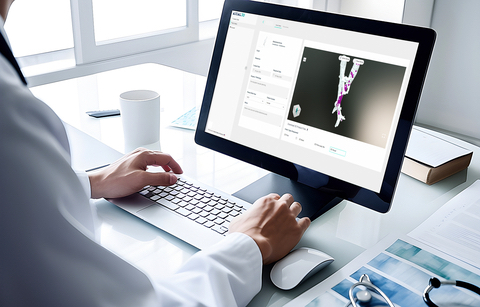
Axial3D, a leader in medical segmentation and 3D printing solutions, has achieved a critical step that will help the medical industry inch closer to its goal of making 3D printed devices widely available to improve patient outcomes. The company has received FDA clearance for its automated, AI-driven cloud-based segmentation software platform used to accelerate 3D printing of custom tools and solutions for orthopedic trauma, orthopedic, maxillofacial, and cardiovascular applications.
The 510(k) cleared software employs AI and the scalability of the cloud to automate the conversion of patients’ DICOM images from CT and MRI scans into accurate 3D visualizations and 3D print-ready files, 3D mesh files, and even 3D printed anatomical models made with Stratasys print technology.
By automating the traditionally arduous and time-consuming process associated with manual or even semi-manual segmentation, Axial3D opens the door for healthcare providers and medical device makers to handle more patient-specific applications in shorter time frames and with significantly less capital expenditures. The software enables more patient data to be processed, accelerating the development of 3D printed patient-specific programs for creating surgical plans, models, and surgical guides.
“With Axial3D INSIGHT, they can move from today’s world, which is a serialized manufacturing workflow, to a patient-specific workflow, allowing them to greatly enhance the standard of care for patients and the development they can bring to their medical products,” says Daniel Crawford, the founder and chief strategy office at Axial3D.
Stratasys invested $10 million in Axial3D in late 2022 and fostered a partnership to bring a joint solution to market for both healthcare providers and medical device makers. A range of Stratasys printers and materials have been validated and FDA 510(k) cleared with Axial3D INSIGHT to produce anatomic models for pre-operative surgical planning and for diagnostic use across multiple specialties. Stratasys estimates the opportunity for medical 3D printing at approximately $2.8 billion.
In this webinar, Axial3D’s Daniel Crawford joins a panel discussion on the state of 3D printing in medicine.


Beth Stackpole is a contributing editor to Digital Engineering. Send e-mail about this article to [email protected].
Follow DE






About Us · Contact Us · Editorial Team · Advertising · Privacy Policy · Subscriber Services · © 2026 Digital Engineering 24/7 · Peerless Media