Helping design and engineering professionals discover, evaluate and specify technologies and processes that shorten the design cycle and enable success.



Digital Engineering April 2026
In the latest issue of Digital Engineering, we take a look at the latest innovations in design for additive manufacturing, including the use of natural language inputs, social media cosplayers, and AI integration. The issue also includes a feature…

January Special Focus Issue: Design for Additive
In this Special Focus Issue of Digital Engineering, learn about the latest advancements in design for additive manufacturing, including new software tools, additive in automotive, custom medical devices, and more.
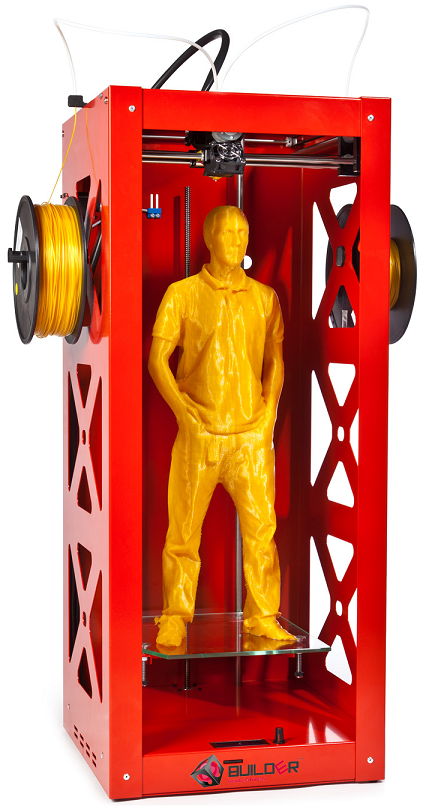
Builder, a Dutch additive manufacturing (AM) system manufacturer, has bought into the idea that size does matter in, we might say, a big way. The company’s newest 3D printer, the Big Builder, while technically a desktop model, offers what may be the largest Z-axis build envelope ever offered on the desktop.
The company’s first offering, called simply the Builder, is your run-of-the-mill variety material extrusion printer, with RepRap roots, and a larger than average build envelope of 385 x 370 x 400 mm (15.15 x 14.5 x 15.7 in.). That, apparently, wasn’t enough build space for its customer base, who demanded more.
The Big Builder increases overall build volume with an envelope measuring in at 220 x 210 x 665 mm (8.6 x 8.26 x 26.18 in.). Total volume is around 30 liters. Other printing specs include a resolution of 0.05 mm - 0.35 mm, a dual-feed extruder to speed up those large prints, and a powder-coated steel frame. The new system runs on 1.75 mm PLA and is priced at €2,495 (a little over $3,400).
It seems to me what Builder has done is to attempt to create a large volume AM system with a small footprint by simply turning the printer on its end. That does indeed allow it to fit more tidily in tight spaces, but also comes with some potential drawbacks.
The first possibility for disaster is a lack of support material. Anything you want to build that measures over 20 inches tall is going to need to be very precisely designed to ensure it doesn’t just collapse during the build. Using the same PLA to build supports as goes into the rest of the finished object means longer post-build processing, including sanding and refinishing to hide spots where plastic has been snapped off.
Another problem is build time. Material extrusion printers aren’t what you’d call speedy. It will take a very long time to build any object large enough to require a 26-inch Z-axis. The longer a print goes on, the more likely something is to go wrong as well. Printing out your own 26-inch Washington Monument replica is going to require near constant supervision to make sure the print doesn’t develop problems halfway through.
Below you’ll find a video from Builder about how the company designs and constructs its AM systems.
Source: Builder


John Newman is a Digital Engineering contributor who focuses on 3D printing. Contact him via [email protected] and read his posts on Rapid Ready Technology.
Follow DE
Join over 90,000 engineering professionals who get fresh engineering news as soon as it is published.






About Us · Contact Us · Editorial Team · Advertising · Privacy Policy · Subscriber Services · © 2026 Digital Engineering 24/7 · Peerless Media