Helping design and engineering professionals discover, evaluate and specify technologies and processes that shorten the design cycle and enable success.



May 2026 Special Focus: Artificial Intelligence in Design and Simulation
In this Special Focus Issue, learn about the latest developments in the integration of artificial intelligence into engineering workflows.

April 2026 Special Focus Issue: Generative Design
In this Special Focus Issue, Digital Engineering takes a look at how generative design solutions can be used across different types of design problems and with a variety of manufacturing approaches to accelerate design space exploration, and…
Cadence has expanded its collaboration with NVIDIA to accelerate Cadence’s Design for AI and AI for Design strategy, the company announced at NVIDIA GTC this week. “The fusion of agentic AI and physics-based design is transforming how the world’s most advanced chips are engineered,” said Anirudh Devgan, president and CEO of Cadence. “Through our expanded collaboration with NVIDIA, we’re bringing together Cadence’s expertise in agentic IC design and physics-driven optimization with NVIDIA’s accelerated computing to advance a new era of AI-driven chip innovation. Together, we’re enabling customers to design more intelligent, efficient silicon that will power the next generation of computing and AI infrastructure.”
“AI is driving the largest infrastructure buildout in history—spurring the creation of new chips, systems, and AI factories around the world,” said Jensen Huang, founder and CEO of NVIDIA. “Together, NVIDIA and Cadence have created the Cadence Millennium M2000—a revolutionary AI supercomputer built to tackle the immense scale and complexity of designing the world’s next generation of infrastructure.”
Cadence has expanded its design solutions accelerated with NVIDIA Grace CPUs and NVIDIA Blackwell GPUs—and as a turnkey deployment on the Cadence Millennium M2000 Supercomputer—delivering up to 80X greater throughput and up to 20X lower power consumption. This expanded offering now spans analysis, optimization and design, with key solvers deeply optimized with NVIDIA CUDA-X, the company said. One example is the Cadence Clarity 3D Solver demonstrating that a Millennium M2000 system configured with 8X NVIDIA RTX Pro 6000 GPU servers is up to 5X faster compared to an equivalent CPU-based solution, when extracting complex and large-scale designs.
Cadence accelerated solutions that will be available in 2026 include:
The Cadence Allegro X Design Platform and the Cadence Reality Digital Twin Platform also integrate with NVIDIA Omniverse libraries for photo-realistic visualization, critical for multi-disciplinary engineering and design. Cadence’s MSC Virtual Test Drive (VTD) is being integrated with NVIDIA Cosmos and NVIDIA Omniverse NuRec for advancing the state of the art in physical AI.
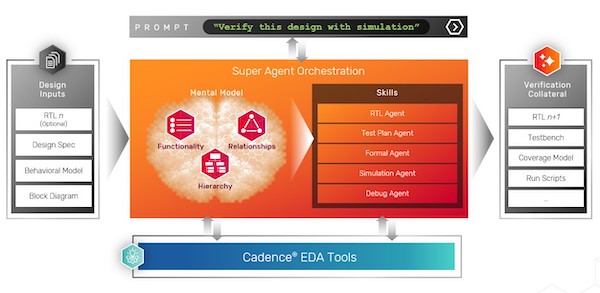
According to the company, Cadence and NVIDIA are also collaborating on future agentic AI innovations in custom and analog design and building deep research and long-running agents for engineering NVIDIA NemoClaw, an open source stack that simplifies running OpenClaw always-on assistants, more safely, with a single command. As part of the NVIDIA Agent Toolkit, it installs the NVIDIA OpenShell runtime—a secure environment for running autonomous agents and open source models like NVIDIA Nemotron.
Cadence also announced that several customers are using agentic AI, GPU-accelerated solutions and the Millennium M2000 Supercomputer to tackle design challenges the company says "are not achievable with traditional approaches." Those include:
Honda is using Cadence Fidelity CFD Software, accelerated on the Millennium M2000 GB200 NVL72 system, to pursue time-accurate, full turbofan engine simulation—a grand challenge in computational fluid dynamics (CFD) previously impractical for routine design use. "This capability opens the door to a more exploratory design methodology—one where our engineers can evaluate tradeoffs earlier and innovate with greater confidence as we develop the next generation of high-performance gas turbine engines," said Keiji Otsu, CEO, Honda R&D.
Micron is integrating GPU-accelerated Cadence design technologies and Cadence's agentic AI solution directly into its HBM memory design flow to accelerate iteration and maintain accuracy at leading-edge scale. “As our HBM and next-generation memory designs grow in scale and complexity, reducing the cycle time for our most demanding verification and simulation steps has become essential,” said Sanjay Mehrotra, Chairman, president and CEO, Micron. “Through our expanded collaboration with Cadence, we’re integrating GPU-accelerated design technologies—powered by NVIDIA computing—and building agentic AI directly into our development environment.”
Larsen & Toubro Semiconductor is using the Cadence Spectre X Simulator, accelerated up to 5X with NVIDIA GPUs, to shorten design cycles for next-generation AI and data center chips as the company advances India's sovereign semiconductor ambitions. "Faster design iteration and verification directly translate into competitive advantage and time to market for the highly customized AI silicon we're building," said Sandeep Kumar, CEO, Larsen & Toubro Semiconductor. "GPU-accelerated performance from Cadence’s Spectre X Simulator gives our teams the throughput to confidently move complex, AI-ready chips into production faster."
You can read more about Cadence and agentic AI in this blog.
Sources: Press materials received from the company and additional information gleaned from the company’s website.


DE's editors contribute news and new product announcements to Digital Engineering. Press releases may be sent to them via [email protected].
Follow DE
Join over 90,000 engineering professionals who get fresh engineering news as soon as it is published.






About Us · Contact Us · Editorial Team · Advertising · Privacy Policy · Subscriber Services · © 2026 Digital Engineering 24/7 · Peerless Media