Helping design and engineering professionals discover, evaluate and specify technologies and processes that shorten the design cycle and enable success.



May 2026 Special Focus: Artificial Intelligence in Design and Simulation
In this Special Focus Issue, learn about the latest developments in the integration of artificial intelligence into engineering workflows.

April 2026 Special Focus Issue: Generative Design
In this Special Focus Issue, Digital Engineering takes a look at how generative design solutions can be used across different types of design problems and with a variety of manufacturing approaches to accelerate design space exploration, and…
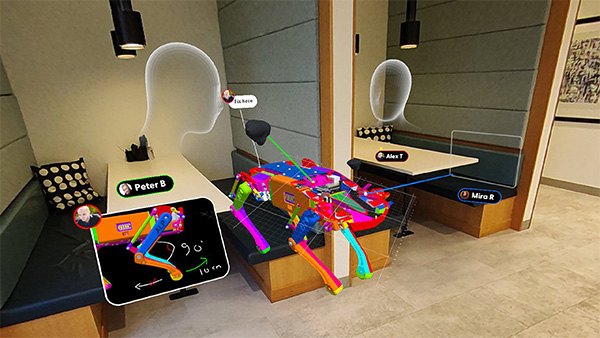
Early this month, Campfire 3D launched a collaboration app for Meta Quest, the consumer-friendly VR headset from the social media firm Meta (Facebook).
"Quest 3 brings a fundamentally new collaboration experience with full-color passthrough. Compared to previous VR devices, users feel connected to their environment, their content, and their team. Whether you're presenting concepts in a design review, or explaining a complex assembly procedure, the Campfire experience on Quest 3 is the next best thing to interacting in-person with physical items themselves," said Jay Wright, Campfire Co-Founder & CEO.
The company's name, Campfire, comes from the idea of early human collaborations and community building around the campfire, said Wright. "Humans communicate best when gathered around things," he said, in a briefing with DE 24/7.
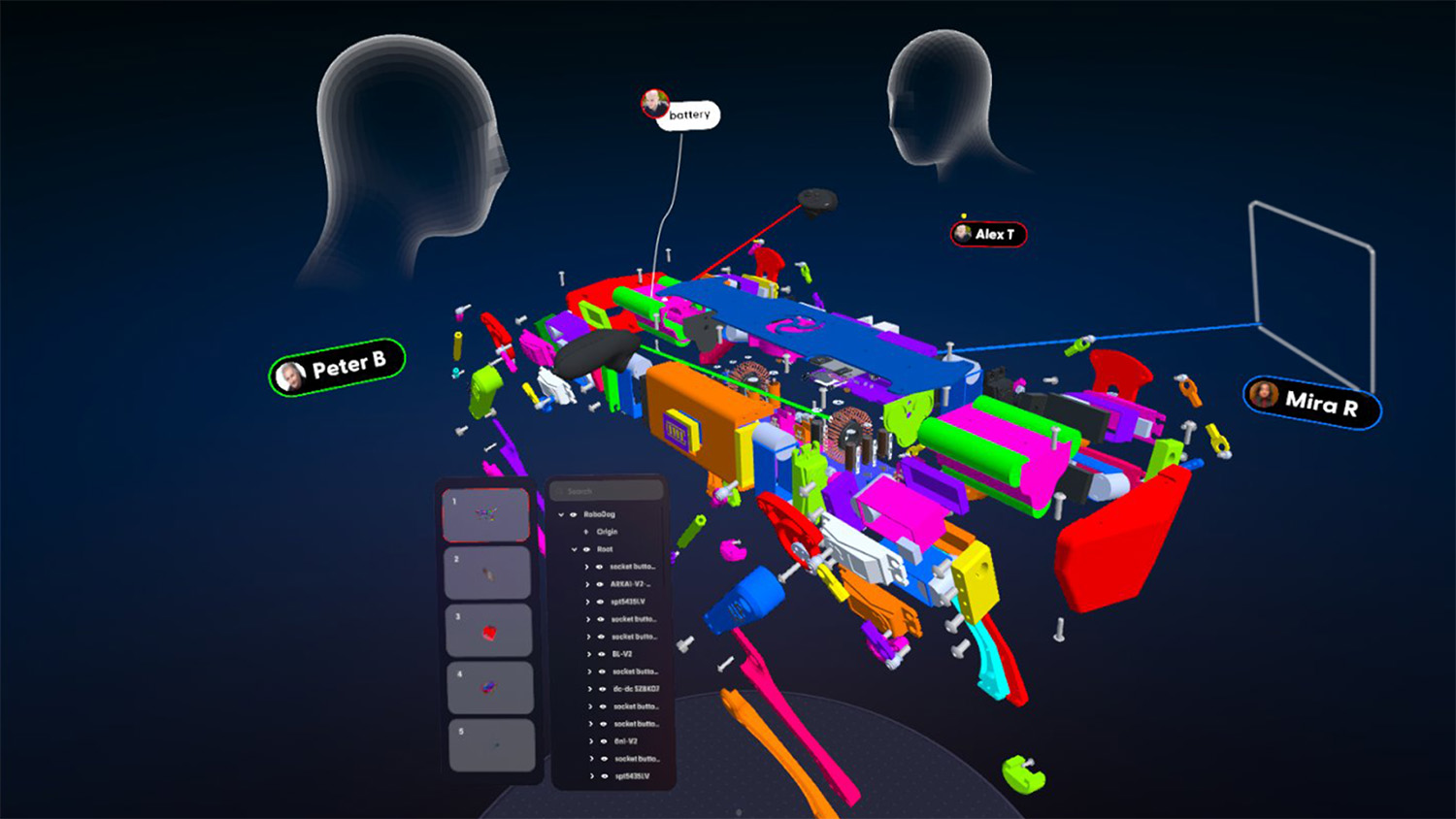
In this case, the thing--the centerpiece of collaboration--would be a 3D model visible to all participants, no matter their device of choice.
Wright explained, "The models are imported as tessellated models and hosted in the cloud. Once loaded into the Campfire 3D app, the 3D model is cached in the device's memory." He also added, "We're not trying to replace CAD."
For VR, Wright said Campfire has identified three major usages: delivering technical presentations, training materials, and work instructions. These tasks represent downstream use of CAD data, but don't overlap with typical CAD design works.
"While VR has found a home in large enterprises, it hasn’t done the same in collaboration," Wright noted. He hopes that, by bringing VR to Meta Quest, he can appeal to a much wider user base. "Professionals with about $500 in discretionary spending money"--that's who he has in mind. He's also thinking of the bring-your-own-device-to-work trend, which suggests the more affordable consumer-grade VR devices might sneak into the professional arena.
While professional-grade VR gadgets can cost $1,000 or more, Meta Quest 3 costs only about $500. Even Meta Quest Pro is still competitively priced at $999.
One key aspect of Campfire 3D's collaboration app is its AI-driven virtual assistant, named Spark. "Spark exemplifies the potential for future AI-driven assistants capable of answering questions verbally while demonstrating physical actions spatially," according to Campfire 3D's announcement.
"When we showed Spark to the customers, they often asked, Can we use Spark to provide software training to our employees?" recalled Wright.
In its current incarnation, Spark's interactivity is limited to delivering preprogrammed speeches and sequences, not too different from prerecorded videos. But Wright envisions enabling ChatGPT-style natural language processing and even APIs for the customers to train Spark with their own proprietary data, as a way to develop work instructions and training materials tailored with their own in-house policies and practices.
"If someone has asked me about AI integration 18 months ago, I would have said maybe. But now, there is a path. We have our guiding North Star," said Wright.


Kenneth Wong is Digital Engineering's resident blogger and senior editor. Email him at [email protected] or share your thoughts or suggestions at digitaleng.news/facebook.
Follow DE
Join over 90,000 engineering professionals who get fresh engineering news as soon as it is published.






About Us · Contact Us · Editorial Team · Advertising · Privacy Policy · Subscriber Services · © 2026 Digital Engineering 24/7 · Peerless Media