Helping design and engineering professionals discover, evaluate and specify technologies and processes that shorten the design cycle and enable success.


Alert!
Digital Engineering ceased publication on July 1, 2026. This website remains available as an archive of engineering content.
For inquiries or information, please email [email protected].


Digital Engineering April 2026
In the latest issue of Digital Engineering, we take a look at the latest innovations in design for additive manufacturing, including the use of natural language inputs, social media cosplayers, and AI integration. The issue also includes a feature…

January Special Focus Issue: Design for Additive
In this Special Focus Issue of Digital Engineering, learn about the latest advancements in design for additive manufacturing, including new software tools, additive in automotive, custom medical devices, and more.
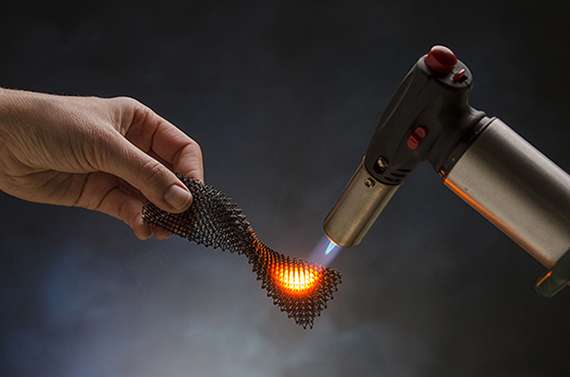
Traditionally, the challenge with 3D printing ceramics is that the materials have to have a low enough melting point so that they can be extruded and layered. That means one of the key selling points of using ceramics — their thermal properties — are undermined in the process. Sintering processes used to form parts from powders can lead to porosity, as well as limitations on the shapes that can be formed via printing and the strength of the item.
Researchers at HRL Laboratories in Malibu, CA, have come up with a process that can create printed ceramic objects that can withstand temperatures up to 2,500°F. The company's pre-ceramic resin can be printed into complex shapes via stereolithography. The objects can then be heat-treated to turn the resin into regular ceramics.
"With our new 3D printing process we can take full advantage of the many desirable properties of this silicon oxycarbide ceramic, including high hardness, strength and temperature capability as well as resistance to abrasion and corrosion," said program manager Dr. Tobias Schaedler.
The process makes it possible to create more complex shapes with ceramics that can withstand very high temperatures. That could have utility in creating parts for jet engines or hypersonic vehicles, as well as smaller, intricate components for electronic devices. According to the researchers:
Silicon oxycarbide microlattice and honeycomb cellular materials fabricated with this approach exhibit higher strength than ceramic foams of similar density. Additive manufacturing of such materials is of interest for propulsion components, thermal protection systems, porous burners, microelectromechanical systems, and electronic device packaging.
The team published their work in the January edition of Science. You can learn more about in the video below.
Source: Gizmodo


Brian Albright is the editorial director of Digital Engineering.
Contact him at [email protected].






About Us · Contact Us · Editorial Team · Advertising · Privacy Policy · Subscriber Services · © 2026 Digital Engineering 24/7 · Peerless Media