Helping design and engineering professionals discover, evaluate and specify technologies and processes that shorten the design cycle and enable success.


Alert!
Digital Engineering ceased publication on July 1, 2026. This website remains available as an archive of engineering content.
For inquiries or information, please email [email protected].
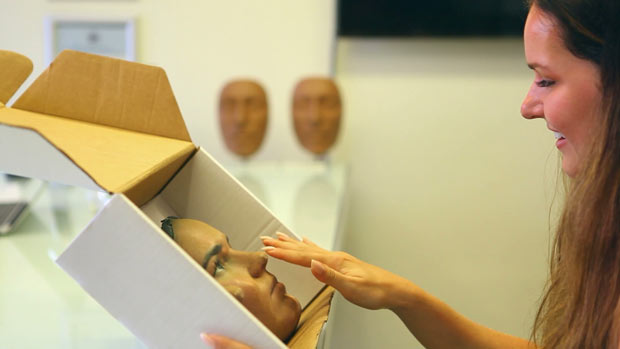
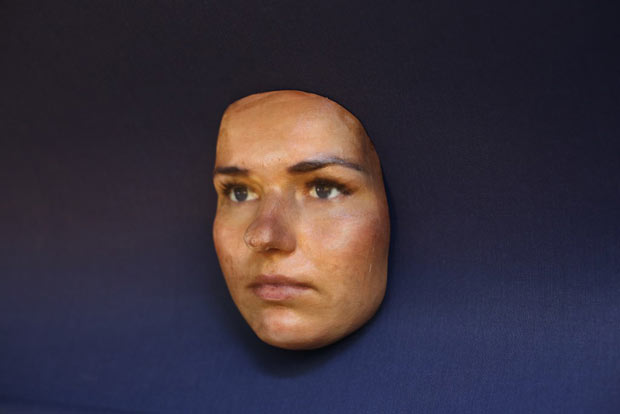 One of Dr. Avsar’s masks, created with 3D scanning and one of Mcor’s systems. Image courtesy of Mcor Technologies.
Originally, Dr. Avşar hand-sculpted the masks of his patients’ faces. But the monochromatic sculptures were time-consuming to create and modify and not as realistic as he needed to accurately convey to his patients the changes that would occur in surgery.
After seeing a demo of 3D scanning and 3D printing, Dr. Avşar recognized the benefits of these two complementary technologies in producing more realistic physical 3D models of his patients’ faces faster than the handcrafting technique.
Dr. Avşar initially used a powder-based 3D printer for this application, but switched to an Mcor full-color 3D printer because of Mcor’s superior color capability, lowest operating costs and environmentally-friendly process.
“We always prefer to use eco-friendly, stable and economic 3D printers,” said Dr. Avşar. “Also, the colors produced on the Mcor 3D printer are far better then those produced on other 3D printers.”
During a patient’s initial office visit, Dr. Avşar creates a 3D scan of their face with an Artec handheld 3D scanner. Next, he uses Autodesk’s 3ds Max 3D modeling software to prepare the digital 3D model generated by the scan for 3D printing. He also modifies the scan data to create the post-surgery image of the patient’s face.
Both digital 3D images are then sent to the Mcor 3D printer to produce the life-size photorealistic-color masks of the patient’s face, right in Dr. Avşar’s office. Dr. Avşar and his patient review and discuss the 3D printed masks and make modifications, as needed, to the post-surgery mask for further review. Once Dr. Avşar and his patient agree on the scope of the surgical modifications, they proceed with the surgery.
Dr. Avşar says: “It is what the patients want. Before this, it wasn’t possible for us to show patients exactly what their face would look like following surgery. Enabling them to see and feel the realistic three-dimensional mask of their face gives patients a far greater understanding of the surgical results they can expect. This technology is powerful for patients in everyday practice.”
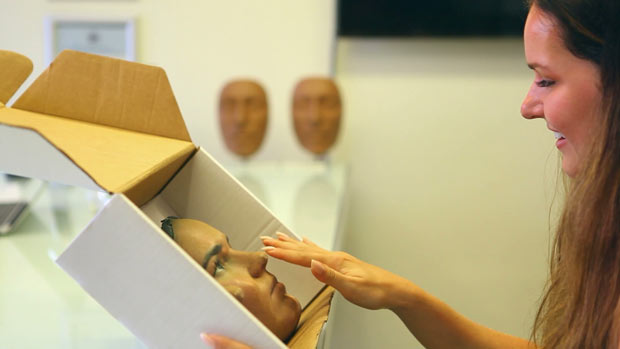 For his patients, Dr. Avsar uses 3D printing to help them visualize any facial changes during surgery. Image courtesy of Mcor Technologies.
Dr. Avşar produces approximately 20 full-color 3D printed models per month. He believes he is the only aesthetic plastic surgeon in the world currently utilizing the 3D scan-to-3D print process in this way and it is quickly beginning to pay off.
He believes that this process is applicable to patients requiring any type of surgical body modification and that it will only continue to expand as more surgeons integrate full-color 3D printing into their own practices.
More Info






About Us · Contact Us · Editorial Team · Advertising · Privacy Policy · Subscriber Services · © 2026 Digital Engineering 24/7 · Peerless Media