Helping design and engineering professionals discover, evaluate and specify technologies and processes that shorten the design cycle and enable success.


Sponsored
|
Dear Desktop Engineering Reader:
COMSOL recently released version 4.3 of its COMSOL Multiphysics analysis environment for chemical, electrical, fluid, mechanical, and structural simulations. Dot 3 sounds like a bug fix spiced with a couple of new functions, right? So, let me be clear: COMSOL Multiphysics 4.3 is a major release. No matter what you analyze and no matter whether you’re an engineer, researcher, scientist, or teacher, COMSOL has an easy-to-use, high-powered analysis toolset for you. It’s quite something. Here are a few reasons why I recommend you check out COMSOL Multiphysics 4.3.
First and foremost, Version 4.3 introduces three new discipline-specific add-on modules to the core analysis kernel. These modules bring tailored interfaces and functionality for analyzing nonlinear structural materials, pipe flows, and corrosion. Side point: These extension modules mean that COMSOL now offers 30 products ranging from modules for unique multiple physics phenomena such as acoustics, batteries, geomechanics, plasma, and RF to CAD import, materials, and bi-directional CAD associativity modules.
The new Nonlinear Structural Materials Module expands the mechanical capabilities of COMSOL’s Structural Mechanics and MEMS modules with elastoplastic, viscoplastic, creep, and hyperelastic material models. The new Pipe Flow Module lets you efficiently simulate 1D fluid flows, heat and mass transfers, hydraulic transients, and acoustics such as you encounter designing and optimizing pipe and channel networks in turbines, building ventilation systems, chemical or material manufacturing processes, and in the oil and gas applications.
The new Corrosion Module really caught my eye. You can use its specialized user interfaces to model the electrochemical processes that can lead to structural corrosion under certain conditions and see what you might do to mitigate the effects of corrosive processes or protect your structure from them. With it, you can model galvanic, pitting, and crevice corrosion as well as cathodic and anodic protection.
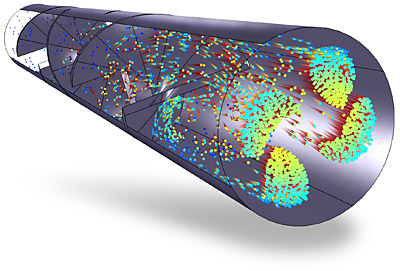
Enhancements also span the entire COMSOL product line. Meshing is now faster and more powerful, the AC/DC Module has a new interface for modeling 3D rotating machinery, the CFD Module offers new features for mass transport simulations influenced by turbulent mixing, and the Particle Tracing Module adds particle-particle interaction and Brownian forces to its list of capabilities.
That’s just a sampling of what’s new in COMSOL Multiphysics 4.3. To learn about how you can leverage this system, first call out for lunch. Then, from your desk, hit the link over there, dine, and discover. You'll find a massive but well organized web site on all that’s new in version 4.3. (Hint: The checkmarks have links to more details on a feature.) When you’re done, call the boss and tell him you’ll need pastries in the morning because your colleagues will want to check out what you learned about COMSOL Multiphysics 4.3.
Thanks, Pal. -- Lockwood
Anthony J. Lockwood
Editor at Large, Desktop Engineering


Anthony J. Lockwood is Digital Engineering's founding editor. He is now retired. Contact him via [email protected].
Follow DE
Join over 90,000 engineering professionals who get fresh engineering news as soon as it is published.






About Us · Contact Us · Editorial Team · Advertising · Privacy Policy · Subscriber Services · © 2026 Digital Engineering 24/7 · Peerless Media