Helping design and engineering professionals discover, evaluate and specify technologies and processes that shorten the design cycle and enable success.


Alert!
Digital Engineering ceased publication on July 1, 2026. This website remains available as an archive of engineering content.
For inquiries or information, please email [email protected].

Digital Engineering April 2026
In the latest issue of Digital Engineering, we take a look at the latest innovations in design for additive manufacturing, including the use of natural language inputs, social media cosplayers, and AI integration. The issue also includes a feature…

January Special Focus Issue: Design for Additive
In this Special Focus Issue of Digital Engineering, learn about the latest advancements in design for additive manufacturing, including new software tools, additive in automotive, custom medical devices, and more.
 All sorts of promises hang in the air when it comes to the world of technology hype. You might recall that by 1990 we'd all be working in the "paperless office." One of my favorite sure things was a cryogenic "microwave" that would enable you to flash freeze your garden vegetables for winter storage.
The world of engineering hardware is no less vulnerable to starry-eyed dreams, and I was convinced for years that a 3D printer that slipped into your office like a coffee pot was out of the question because of costs and unit size. Then, of course, the Dimension brand at Stratasys came out with the uPrint. And, not for the first time, I ate some crow because the uPrint is the real deal when it comes to having your own 3D printer. And, just to rub my nose in it, Stratasys says that they've sold more than a 1,000 uPrints since it was announced.
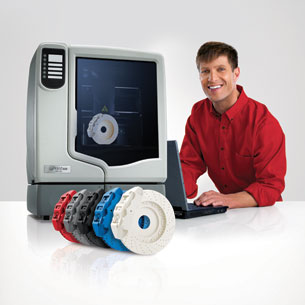 The uPrint is a small-footprint 3D printer that can fit on your desk. It comes with the software you need to manipulate models for 3D printing. It produces 8 in. x 6 in. x 6 in. concept models and functional prototypes in ivory-colored ABSplus plastic using the same FDM (fused deposition modeling) technology used by the big production units from Stratasys. And the uPrint starts at $14,900. Since uPrint has networking capabilities, that price means that any engineering workgroup can have at least one of these babies at their disposal.
A few weeks ago, Stratasys rolled out an enhanced version of the uPrint called the uPrint Plus. Slightly more expensive at $19,900, this unit offers such new features as a larger build envelope (8 in. x 8 in. x 6 in.) and the ability to print models in eight ABSplus material colors—red, blue, olive, black, dark gray, nectarine, fluorescent yellow, and ivory. That's a good enhancement. It makes it easier for you to differentiate components and intrigue your clients with a concept design that looks more like the end product.
uPrint Plus also has two support-material enhancements that they tell me reduce material consumption and modeling time. The first is a software enhancement that reduces material usage by 40 percent, cutting costs. The second is an improved soluble support material that dissolves quickly.
Today's Check It Out is a quick read that'll give you the lowdown on both the uPrint and the uPrint Plus 3D printers. After checking it out, go to the Dimension website and request a sample part and see the real deal in personal 3D printing for yourself.
Thanks, Pal. — LockwoodAnthony J. Lockwood
Editor at Large, Desktop Engineering


Anthony J. Lockwood is Digital Engineering's founding editor. He is now retired. Contact him via [email protected].
Follow DE






About Us · Contact Us · Editorial Team · Advertising · Privacy Policy · Subscriber Services · © 2026 Digital Engineering 24/7 · Peerless Media