Helping design and engineering professionals discover, evaluate and specify technologies and processes that shorten the design cycle and enable success.



Digital Engineering April 2026
In the latest issue of Digital Engineering, we take a look at the latest innovations in design for additive manufacturing, including the use of natural language inputs, social media cosplayers, and AI integration. The issue also includes a feature…

January Special Focus Issue: Design for Additive
In this Special Focus Issue of Digital Engineering, learn about the latest advancements in design for additive manufacturing, including new software tools, additive in automotive, custom medical devices, and more.
The end result of adding AM to dental practices could eventually lead to a reduction in overall costs, but those savings have yet to be passed on to all patients. If you are a poor college student without access to dental insurance, it can be difficult to get the care required. Unless you do the work yourself.
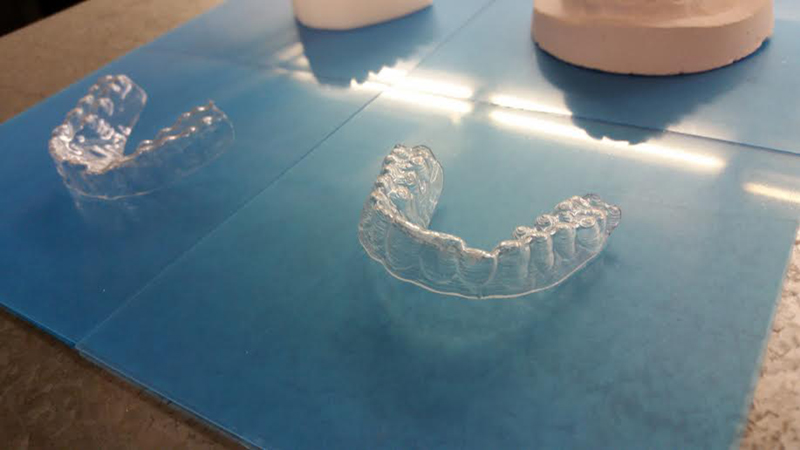 A pair of Dudley's DIY orthodontic aligners. Courtesy of amosdudley.com.
Amos Dudley had briefly worn braces as a teenager, but hadn’t kept up with them long enough for them to correctly position his teeth. After looking at some dental pictures online, Dudley saw what he thought looked like familiar striations in orthodontic aligners (clear plastic retainers that perform the same function as braces). A bit of research confirmed his suspicions, and he decided to build his own set of aligners.
Following a delve into orthodontic literature, Dudley created a mold of his teeth using alginate powder and a 3D printed impression tray. He then filled in the mold with Permastone, creating a reproduction of his teeth. Next he made a 3D scan of the model and adjusted the position of his teeth, creating 12 distinct stages of correction.
Each stage was printed out as its own manifold model on a Stratasys Dimension 1200es. Using the corrective models, Dudley purchased some dental plastic on eBay and poured himself a set of aligners. The end results made him smile.
“As far as I know, I’m the first person to have tried DIY-ing plastic aligners,” wrote Dudley. “They’re much more comfortable than braces, and fit my teeth quite well. I was pleased to find, when I put the first one on, that it only seemed to put any noticeable pressure on the teeth that I planned to move — a success! Most importantly, I feel like I can freely smile again.”
Obviously only someone with access to the proper equipment and the intelligence to understand the methods behind dental corrective practices should attempt the process. Dudley says he was able to reproduce a procedure that usually costs thousands of dollars for less than $100.
Below you’ll find a video that discusses orthodontic aligners.
Source: amosdudley.com


John Newman is a Digital Engineering contributor who focuses on 3D printing. Contact him via [email protected] and read his posts on Rapid Ready Technology.
Follow DE
Join over 90,000 engineering professionals who get fresh engineering news as soon as it is published.






About Us · Contact Us · Editorial Team · Advertising · Privacy Policy · Subscriber Services · © 2026 Digital Engineering 24/7 · Peerless Media