Helping design and engineering professionals discover, evaluate and specify technologies and processes that shorten the design cycle and enable success.


Alert!
Digital Engineering ceased publication on July 1, 2026. This website remains available as an archive of engineering content.
For inquiries or information, please email [email protected].

Digital Engineering April 2026
In the latest issue of Digital Engineering, we take a look at the latest innovations in design for additive manufacturing, including the use of natural language inputs, social media cosplayers, and AI integration. The issue also includes a feature…

January Special Focus Issue: Design for Additive
In this Special Focus Issue of Digital Engineering, learn about the latest advancements in design for additive manufacturing, including new software tools, additive in automotive, custom medical devices, and more.
 The extreme conditions of an event like the Dakar Rally have led to developments like titaniumrapid casting by CRP Technology. |
Rapid casting combines rapid prototyping, which is used to manufacture a disposable pattern, and investment casting technology. The pattern is made using SLS (selective laser sintering) prototyping systems. The pattern then undergoes wax infiltration via immersion and capillary action to increase its strength. It’s then immersed in a ceramic bath. The lost pattern is removed via dewaxing with flash firing or in an autoclave. The ceramic shell is subsequently sintered, and the alloy is cast with inductor or voltaic arc.
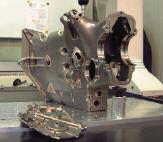 This Minardi Racing Team gearbox for aFormula 1 car was cast in titanium. |
Rapid casting with laser-sintered patterns allows complete freedom in shape conception. This reduces undercut and toolpath problems encountered during CNC machining. The end result is a reproduction of the RP pattern with tolerances and surface finishes of a quality comparable to fully machined parts.
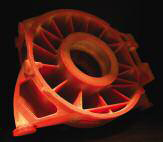 This wax-infiltrated disposable pattern wascreated via laser sintering by CRP. |
An Italian company, CRP, in conjunction with DTM Corporation previous to DTM’s acquisition by 3D Systems, developed the CastForm material frequently used for rapid casting patterns. CastForm reduces the amount of ash produced when the ceramic shell is flushed. To meet the needs of CRP’s Formula 1 racing customers, the two companies set out to develop a new material for use in titanium alloy casting.
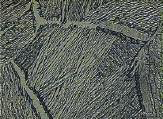 This micrography image of the titanium illustrates the alpha-beta structure in the grain center and the typical annealed alphastructure at the grain border. |
CRP uses the Ti-6Al6V alloy, which contains 6 percent aluminum and 4 percent vanadium to provide an excellent combination of stress resistance and toughness, with optimal wear resistance.
Titanium casting has high reactivity, so chemical milling is required to remove the alpha case created when the metal touches the ceramic shell. HIP (hot isostatic pressure) applied in an inert atmosphere (argon) is also needed to eliminate micro-porosity and shortage of material inside the casting. TIG weld repair in an inert atmosphere can also be used to fill in porosity or HIP hollows. Shot peening reduces stress and increases fatigue resistance.
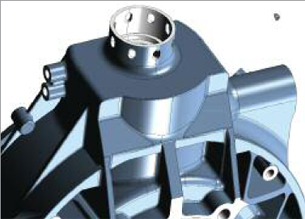 Upright design of a Mitsubishi Pajero/Montero Evolutions rally carbefore any design alterations. |
CRP’s first titanium parts were front and rear uprights made for Formula 1 team Minardi. The upright is the connecting part of the wheel where the hub transmits the engine rotational power to the tires. The suspension brackets, the front steering bracket, the rear convergence tie-rod, and the brake calipers are connected to the uprights.
The main properties Minardi wanted in its new uprights were lightness, stiffness, and reliability. Uprights were generally manufactured in a process that involved forming and cutting steel sheets. Welding, heat treatment, CNC machining, and painting were also involved. Using this process, engineers weren’t able to optimize the uprights, so they were heavier than they should have been. And because the uprights were typically welded, their life expectancy was shorter than it could or should have been.
CRP also developed a titanium gearbox for Minardi. The requirements were similar to those of the uprights, but the complexity and size of the piece were greater. By using titanium, CRP reduced the weight of the gearbox by 25 percent when compared to an existing one of cast magnesium.
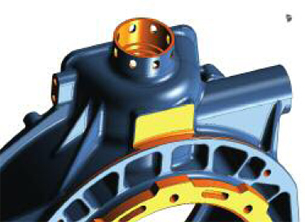 The Mitsubishi Pajero/Montero upright design after optimizing thedesign for weight and stiffness. |
More recently, CRP designed a racing wheel upright for the 2007 Mitsubishi Pajero/Montero Evolutions Rally Raid car. That upright holds the wheel hub bearing and is formed with various mountings and brackets for suspension attachment (wishbones and damper) and various analysis sensors.
CRP is reworking the design to get uniform wall thickness all around to improve casting quality and save weight. A new distribution of the ribs will provide better response to the mechanical requirements caused by stress.
The cap-type structure is a direct response to structural calculation made on the model. This new morphology results in more uniform stress distribution and obvious weight savings.
More Info:
3D Systems
Rock Hill, SC
3dsystems.com
CRP Technology
Modena, Italy
crptechnology.com
Sara Ferris has been covering the CAD industry since 1995. She was formerly editor-in-chief of Cadalyst magazine. You can e-mail comments about this article to her at [email protected].


DE's editors contribute news and new product announcements to Digital Engineering. Press releases may be sent to them via [email protected].
Follow DE






About Us · Contact Us · Editorial Team · Advertising · Privacy Policy · Subscriber Services · © 2026 Digital Engineering 24/7 · Peerless Media