Helping design and engineering professionals discover, evaluate and specify technologies and processes that shorten the design cycle and enable success.



Digital Engineering April 2026
In the latest issue of Digital Engineering, we take a look at the latest innovations in design for additive manufacturing, including the use of natural language inputs, social media cosplayers, and AI integration. The issue also includes a feature…

January Special Focus Issue: Design for Additive
In this Special Focus Issue of Digital Engineering, learn about the latest advancements in design for additive manufacturing, including new software tools, additive in automotive, custom medical devices, and more.
A researcher, Andrew Iams, was using an electron microscope, examining a new aluminum alloy at the atomic scale. He was looking to find the key to its strength, when he observed that the atoms were arranged in an unusual pattern. He found quasicrystals in this aluminum alloy, and he and his peers at the National Institute of Standards and Technology (NIST) found that these quasicrystals also make it stronger.
Their findings are published in the Journal of Alloys and Compounds.
The alloy formed under the conditions of metal 3D printing. Understanding this aluminum on the atomic scale will enable a new category of 3D-printed parts such as airplane components, heat exchangers and car chassis, according to NIST, while also enabling research on new aluminum alloys that use quasicrystals for strength.
Quasicrystals are similar ordinary crystals but have some distinct differences. A traditional crystal is any solid made of atoms or molecules in repeating patterns, according to NIST.
There are just 230 possible ways for atoms to form repeating crystal patterns. Quasicrystals don’t fit into any of those patterns. Their shape lets them form a pattern that fills the space, but never repeats.
Dan Shechtman, a materials scientist at Technion-Israel Institute of Technology, discovered quasicrystals while on sabbatical at NIST in the 1980s. Through careful research, Shechtman proved beyond a doubt that this new type of crystal existed, advancing the science of crystallography.
Working in the same building as Shechtman decades later, Andrew Iams found his own quasicrystals in 3D-printed aluminum.
In 2017, a team at HRL Laboratories, based in California, and UC Santa Barbara discovered a high-strength aluminum alloy that could be 3D printed. They found that adding zirconium to the aluminum powder prevented the 3D-printed parts from cracking, leading to a strong alloy.
The NIST researchers set out to understand this new, commercially available 3D-printed aluminum-zirconium alloy on the atomic scale.
In metals, perfect crystals are weak. The regular patterns of perfect crystals make it easier for the atoms to slip past each other, according to NIST. When that happens, the metal bends, stretches or breaks. Quasicrystals break up the regular pattern of the aluminum crystals, causing defects that make the metal stronger, NIST adds.
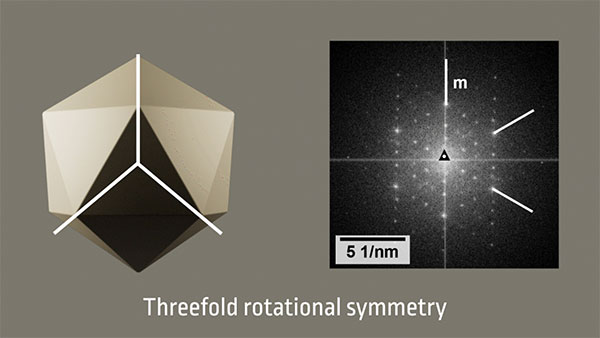
When Iams looked at the crystals from just the right angle, he saw that they had fivefold rotational symmetry. That means there are five ways to rotate the crystal around an axis so that it looks the same.
“Fivefold symmetry is very rare," Iams says. "That was the telltale sign that we might have a quasicrystal. But we couldn’t completely convince ourselves until we got the measurements right.” To confirm they had a quasicrystal, Iams had to carefully rotate the crystal under the microscope and show that it also had threefold symmetry and twofold symmetry from two different angles.
Sources: Press materials received from the company and additional information gleaned from the company’s website.


DE's editors contribute news and new product announcements to Digital Engineering. Press releases may be sent to them via [email protected].
Follow DE
Join over 90,000 engineering professionals who get fresh engineering news as soon as it is published.






About Us · Contact Us · Editorial Team · Advertising · Privacy Policy · Subscriber Services · © 2026 Digital Engineering 24/7 · Peerless Media