Helping design and engineering professionals discover, evaluate and specify technologies and processes that shorten the design cycle and enable success.



May 2026 Special Focus: Artificial Intelligence in Design and Simulation
In this Special Focus Issue, learn about the latest developments in the integration of artificial intelligence into engineering workflows.

April 2026 Special Focus Issue: Generative Design
In this Special Focus Issue, Digital Engineering takes a look at how generative design solutions can be used across different types of design problems and with a variety of manufacturing approaches to accelerate design space exploration, and…
In May, GrabCAD and Stratasys (now the same company), announced a GrabCAD challenge to design the most practical possible 3D printed shell for CubeSats. The CubeSat Challenge was opened to anyone interested in designing for additive manufacturing, with prize support offered by Stratasys. Winners of the challenge were recently announced.
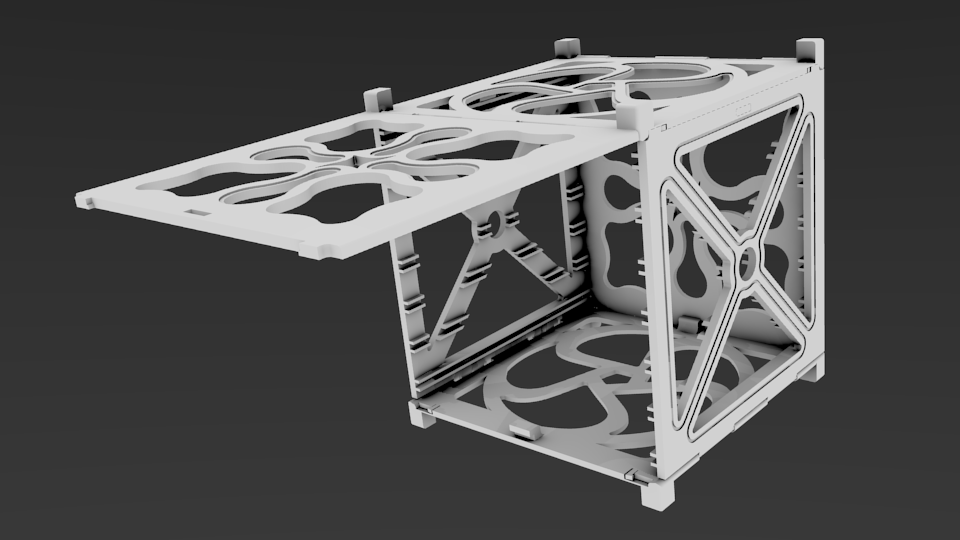
 The winning CubeSat design, named the FoldSat, offers an estimated 40% savings in production time. Courtesy of Stratasys.
The challenge drew over 200 respondents, many of whom were apparently already familiar with some of the design principles that makes additive manufacturing (AM) a growing presence in the aerospace field. One such advantage is the complexity of design afforded by AM, which allows for part consolidation.
“Engineers were able to reduce satellite structures from up to 50 parts down to two or three parts by using additive manufacturing,” said Scott Sevcik, business development manager for aerospace and defense at Stratasys. “There were a number of very creative approaches to redesigning the satellite structure, and it was great to see several of the entries consolidate the build down to two or as few as one part. That highlights one of the most significant benefits of 3D printing a structure.”
Such a large reduction in part count can offer significant advantages to production. It can reduce the cost of assembly labor by cutting time required to build a part. Fewer parts means reduced chance of assembly error, or a delay caused by a shortage of a single part. Along with the other benefits, reducing the number of parts also shortens the supply chain.
The overall winner of the CubeSat Challenge was Paolo Minetola from Italy. Minetola produced a design he named the “FoldSat” consisting of two parts and meant to be produced by Fused Deposition Modeling. Each part of the design consists of three faces. The faces fold up into half a square and are joined to the second half through simple snap mechanisms.
The interior of the design contains rails to assist with mounting electronics, and once assembled, a single side of the finished CubeSat can be swung open to allow access to the interior.
You can learn more about the other winners here.
Below you’ll find a video outlining the first interplanetary space mission to include CubeSats.
Source: Stratasys


John Newman is a Digital Engineering contributor who focuses on 3D printing. Contact him via [email protected] and read his posts on Rapid Ready Technology.
Follow DE
Join over 90,000 engineering professionals who get fresh engineering news as soon as it is published.






About Us · Contact Us · Editorial Team · Advertising · Privacy Policy · Subscriber Services · © 2026 Digital Engineering 24/7 · Peerless Media