Helping design and engineering professionals discover, evaluate and specify technologies and processes that shorten the design cycle and enable success.


Alert!
Digital Engineering ceased publication on July 1, 2026. This website remains available as an archive of engineering content.
For inquiries or information, please email [email protected].

May 2026 Special Focus: Artificial Intelligence in Design and Simulation
In this Special Focus Issue, learn about the latest developments in the integration of artificial intelligence into engineering workflows.

Design & Simulation Software Guide 2025
In this Special Issue, Digital Engineering presents its second annual guide to design and simulation software vendors.
For many businesses that rely heavily on computer-aided engineering (CAE) and rendering software programs, putting up with workstations that slow down or come to a standstill is part of the frustrating day-to-day reality, according to the results of a survey DE recently ran on behalf of IBM Platform Computing.

Among more than 1,000 participants, 88% revealed they're using compute-intensive CAE and visualization applications. At the same time, 39% indicated they're running them exclusively on workstations. The disparity suggests a large number of these businesses simply accepted the workstations' sluggishness — or complete inaccessibility, in the worst cases — as a fact of life.
The easiest fix to the productivity hindrance is to offload the workstation-crippling simulation and visualization tasks to a dedicated cluster, equipped with far more computing cores than individual machines typically offer. So why aren't many businesses doing that? The reluctance to deploy clusters may have to do with the perceived high cost, dedicated IT resources required (both human and hardware), and uncertainty about ease of use. To address these, I spoke with Nick Werstiuk, IBM Platform Computing's product line executive.
Based on the survey responses, Werstiuk singled out several factors as the reasons many businesses delay or avoid cluster deployment. He observed, "Many CAE users lack knowledge about clusters as infrastructures to run their applications. Organizations tend to have tight IT budget constraints, so they may just make do with workstations. Finally, a major concern is that they often lack the skill and knowledge to manage these clusters."
Even if a business decides to bite the bullet and acquire the necessary cluster, it may trim additional cost by choosing open source cluster maintenance software. Werstiuk cautioned, "Open source generally requires [users] to pull together a variety of software, which they must integrate or support on their own. The expertise you need to integrate or pull together these solutions is something you need to consider. "
A lack of knowledge may also lead some first-time cluster adopters to choose Windows HPC, a cluster management solution closely related to the Windows OS that dominates the engineering software market. Werstiuk noted, "That offers robust support for Windows-based hardware and applications, but not for Linux-based applications. A lot of these CAE applications do have a large Linux footprint. Clients might want to run them on Linux-type environment."
By comparison, IBM Platform HPC offers both dedicated tech support, a single integrated cluster-management environment, and support for multiple OS, Werstiuk pointed out. "We further simplify the notion of acquiring and using clusters by releasing a set of capabilities around the IBM Application Ready Solutions, which integrates pre-tested IBM hardware with IBM Platform HPC Management software and ISV applications from ANSYS, Accelrys, Schlumberger, and more," he added.
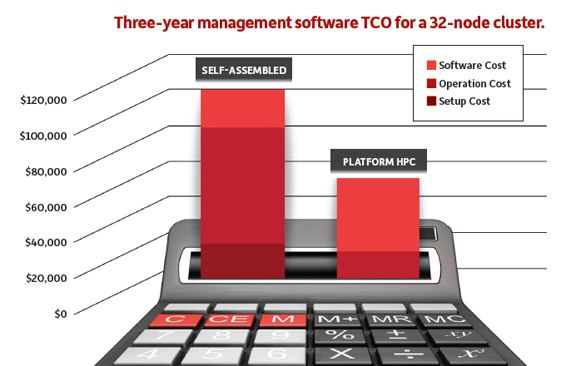
If you're looking for insights into the cost of cluster deployment — not just the initial hardware and setup cost but the cost of owning and maintaining it over time — you may use IBM's online HPC total cost of ownership (TCO) calculator to get some estimates. Even though IBM HPC initially costs more than open-source solutions, the TCO calculator shows that, over time, a cluster from IBM Platform Computing costs significantly less than self-assembled clusters managed with open-source software.
For the IBM Platform Computing-sponsored white paper titled "5 Easy Steps to a High Performance Cluster" based on the survey results, visit the download page here.
For the complete interview with IBM's Nick Werstiuk, listen to the podcast below:


Kenneth Wong is Digital Engineering's resident blogger and senior editor. Email him at [email protected] or share your thoughts or suggestions at digitaleng.news/facebook.
Follow DE






About Us · Contact Us · Editorial Team · Advertising · Privacy Policy · Subscriber Services · © 2026 Digital Engineering 24/7 · Peerless Media