Helping design and engineering professionals discover, evaluate and specify technologies and processes that shorten the design cycle and enable success.



May 2026 Special Focus: Artificial Intelligence in Design and Simulation
In this Special Focus Issue, learn about the latest developments in the integration of artificial intelligence into engineering workflows.

April 2026 Special Focus Issue: Generative Design
In this Special Focus Issue, Digital Engineering takes a look at how generative design solutions can be used across different types of design problems and with a variety of manufacturing approaches to accelerate design space exploration, and…
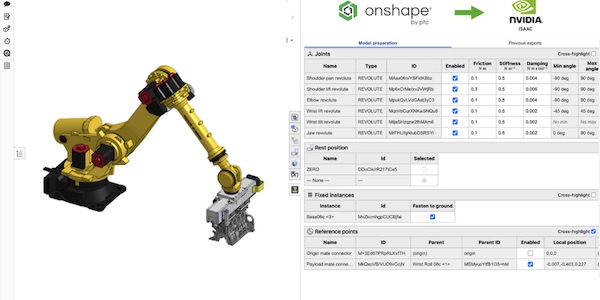
At the NVIDIA GTC event in San Jose this week, PTC announced a new robotics design-to-simulation workflow that integrates the company's Onshape CAD and product data management (PDM) solutions with the NVIDIA Isaac Sim open simulation framework.
According to PTC in traditional robotics design workflows, the data handoff between stakeholders is slow and manual, forcing teams to recreate joints, actuators, and other physical details after exporting CAD models. The Onshape–Isaac Sim workflow removes that friction by defining mechanical relationships once in Onshape and carrying them directly into Isaac Sim. When a design changes, the simulation updates automatically, helping companies such as FANUC America Corporation to move from CAD to physics‑based simulation more rapidly.
"The integration between Onshape and NVIDIA Isaac Sim will allow us to bring simulation earlier into how industrial robotic systems are designed and evaluated," said Amar Dhaliwal, General Manager - Automation Systems Group, FANUC America Corporation. "That early insight enables better design decisions, faster integration, and smoother project execution—so our customers achieve the best possible results from their automation investments."
"Robotics teams need workflows that keep pace with how fast ideas change," said David Katzman, EVP and General Manager of Onshape and Arena, PTC. "By working with NVIDIA, we're combining Onshape's strength in continuous, collaborative design with world‑class simulation to help teams build the foundation for physical AI that supports the future of robotics engineering."
The integration is enabled by a cloud-native architecture built on Amazon Web Services (AWS), which keeps design and simulation in sync throughout development.
FANUC issued a separate release outlining its collaboration with NVIDIA on physical AI and robotics. FANUC will leverage NVIDIA AI infrastructure, including NVIDIA Jetson edge modules, cloud/edge AI infrastructure, NVIDIA Isaac Sim and NVIDIA Omniverse libraries, within its extensive robot portfolio and ROBOGUIDE simulation software. According to the company, this approach empowers manufacturers to create photorealistic digital twins of their factories, train robots virtually, and deploy them with "unprecedented speed and flexibility."
“Physical AI is the next frontier in industrial automation,” said Mike Cicco, President and CEO, FANUC America. “By collaborating with NVIDIA, we’re giving manufacturers the tools to deploy intelligent robotics faster and align virtual design with real-world production.”
Sources: Press materials received from the company and additional information gleaned from the company’s website.


DE's editors contribute news and new product announcements to Digital Engineering. Press releases may be sent to them via [email protected].
Follow DE
Join over 90,000 engineering professionals who get fresh engineering news as soon as it is published.






About Us · Contact Us · Editorial Team · Advertising · Privacy Policy · Subscriber Services · © 2026 Digital Engineering 24/7 · Peerless Media