Helping design and engineering professionals discover, evaluate and specify technologies and processes that shorten the design cycle and enable success.


Alert!
Digital Engineering ceased publication on July 1, 2026. This website remains available as an archive of engineering content.
For inquiries or information, please email [email protected].

Digital Engineering April 2026
In the latest issue of Digital Engineering, we take a look at the latest innovations in design for additive manufacturing, including the use of natural language inputs, social media cosplayers, and AI integration. The issue also includes a feature…

January Special Focus Issue: Design for Additive
In this Special Focus Issue of Digital Engineering, learn about the latest advancements in design for additive manufacturing, including new software tools, additive in automotive, custom medical devices, and more.
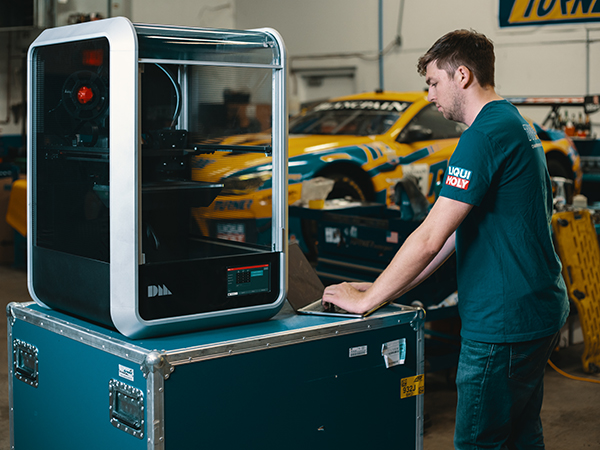
Desktop Metal has launched Fiber, a desktop 3D printer to fabricate high-resolution parts with industrial grade continuous fiber composite materials used in automated fiber placement (AFP) processes. Based on a new process called micro automated fiber placement (μAFP), users can now print parts with needed strength and stiffness, and in a broad range of materials, according to Desktop Metal.
This new platform produces parts using materials that are reportedly two times stronger than steel at 1/5 the weight. Fiber printers feature a large build envelopes for the continuous fiber desktop printer space and are designed to be arranged in print farm configurations of six or 10 printers.
“For the first time, Fiber printers combine the material properties of high performance AFP continuous fiber materials with the affordability and speed of a desktop 3D printer,” says Ric Fulop, CEO and co-founder of Desktop Metal.
Fiber is a continuous fiber desktop printer to miniaturize AFP technology, typically found in the highest end carbon fiber production processes, and combine it with Fused Filament Fabrication (FFF), according to Desktop Metal. The printer uses a robotic tool changer architecture for future expandability and is capable of storing up to four tools, including additional FFF heads for different materials or future enhancements such as automated in-process inspection.
The Fiber print platform is available in two models through a subscription service:
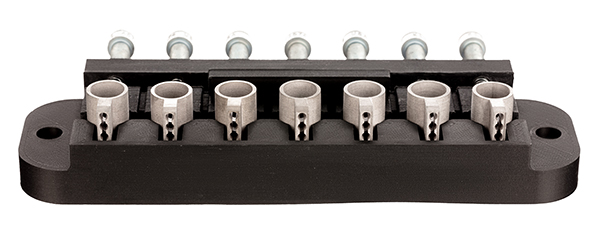
With a large build volumes offered in a continuous fiber 3D desktop printer (310x240x270 mm), Fiber HT and Fiber LT are designed to combine the benefits of 3D printing with continuous fiber materials that are qualified for high-performance applications.
Parts printed on Fiber feature targeted continuous fiber reinforcement along load paths to build a fully dense fiber core with low porosity (<1% porosity with PEEK and PEKK, and <5% with PA6).
Fiber offers engineers a large selection of composite materials for a desktop printer, starting with a chopped carbon fiber filled Nylon (PA6) that is ESD-compliant, and a chopped fiberglass filled Nylon (PA6). The materials library also includes chopped carbon fiber filled PEEK and PEKK filaments that provide mechanical properties and chemical resistance, and yield parts that can withstand continuous operation in high temperatures relative to other thermoplastics. Each of these materials can be reinforced with continuous carbon or glass fiber.
Key applications, which benefit a wide variety of industries, from manufacturing, tooling and automotive to consumer electronics, sporting goods, medical, education/research and marine, include:
The technical effort for Fiber is led by Dr. Konstantine Fetfatsidis, vice president of Composite Products for Desktop Metal, who was previously the advanced manufacturing R&D lead for Aurora Flight Sciences, a Boeing company.
“As a long-time user of multi-million dollar AFP technology for various development-to-production aerostructures programs, I am excited to bring AFP technology to the manufacturing floor for smaller, more complex parts,” says Fetfatsidis. “This new print technology finally brings the material properties of AFP composites to small parts under 20 pounds, which would typically require expensive tooling, extensive manual labor, multiple consumables, and multi-step, long process cycles.”
Fiber printers are available to order here, as well as through the company’s reseller network. Printers are scheduled to ship in Spring 2020.
Sources: Press materials received from the company and additional information gleaned from the company’s website.


Desktop Metal was started to address a problem—how to make metal 3D printing accessible for engineering teams. In 2013, CEO Ric Fulop began collaborating with world-leading experts in materials science, engineering, and 3D printing. Their work…

DE's editors contribute news and new product announcements to Digital Engineering. Press releases may be sent to them via [email protected].
Follow DE






About Us · Contact Us · Editorial Team · Advertising · Privacy Policy · Subscriber Services · © 2026 Digital Engineering 24/7 · Peerless Media