Helping design and engineering professionals discover, evaluate and specify technologies and processes that shorten the design cycle and enable success.



Digital Engineering April 2026
In the latest issue of Digital Engineering, we take a look at the latest innovations in design for additive manufacturing, including the use of natural language inputs, social media cosplayers, and AI integration. The issue also includes a feature…

January Special Focus Issue: Design for Additive
In this Special Focus Issue of Digital Engineering, learn about the latest advancements in design for additive manufacturing, including new software tools, additive in automotive, custom medical devices, and more.
In addition, AM offers advantages in flexible design that are much easier to achieve than with other manufacturing processes. These advantages have already led to a simple prosthetic hand design and the envelope keeps getting pushed forward with each new iteration of prosthetic development. UK robotics inventor, Joel Gibbard, has launched the Open Hand Project, which aims to bring low cost robotic prosthetics to the public.
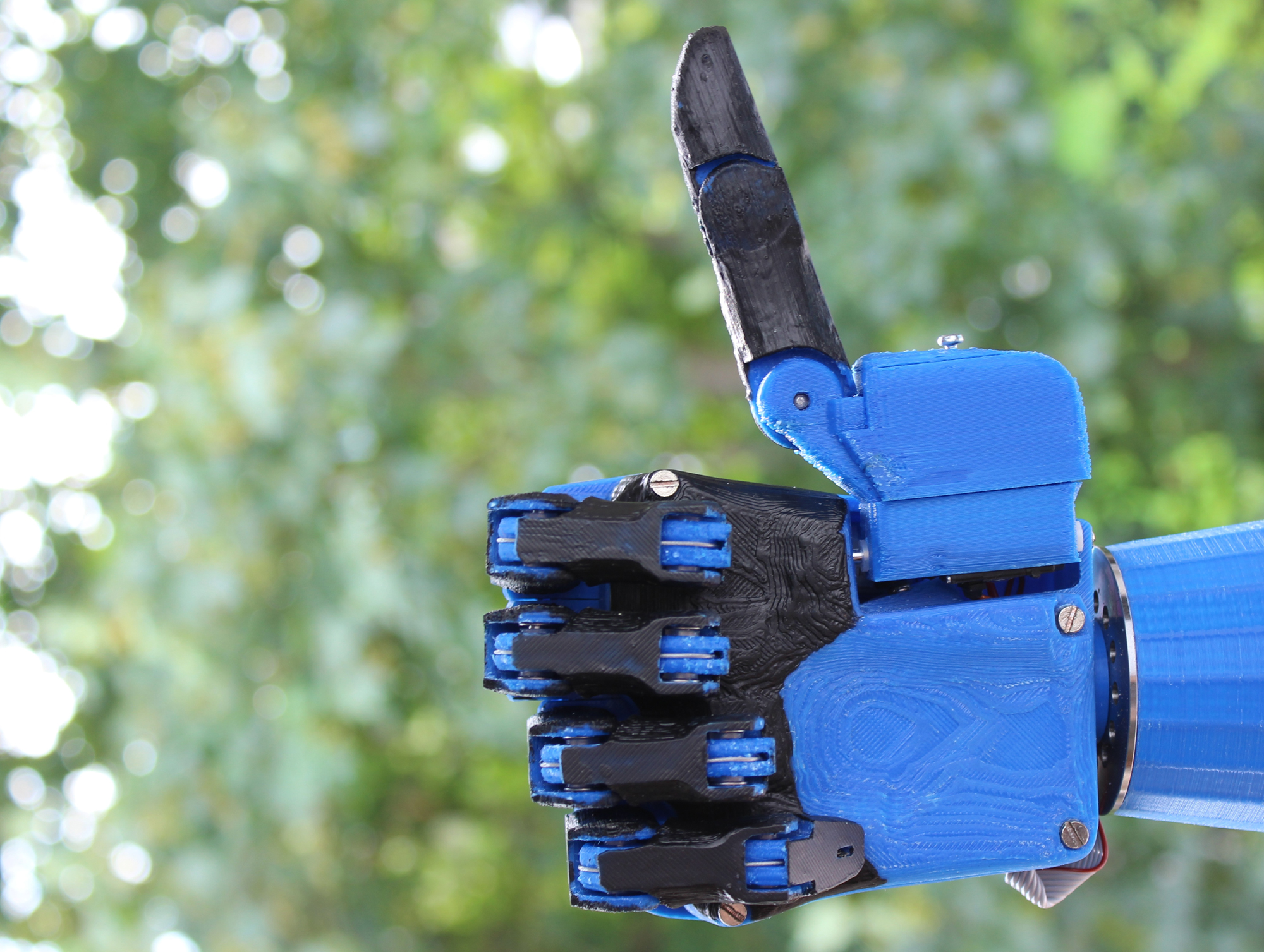
Gibbard’s design, named the Dextrus, uses 3D printed parts, electric motors and steel cables to reproduce the action of the human hand. To assist with gripping, the fingers of the hand are covered in rubber. Gibbard expounds upon the virtues of the Dextrus on his Indiegogo project page, saying:
The hand can be connected to an existing prosthesis using a standard connector to give an amputee another option. It uses stick-on electrodes to read signals from their remaining muscles, which can control the hand, telling it to open or close.The fingers are individually powered and each one can sense when an object is impeding its movement. This gives it the ability to grasp objects gently and means the fingers can really wrap around unusual shapes to grip them firmly.
The power to 3D print the majority of the large, moving pieces of the Dextrus means Gibbard can save on costs. Instead of a multi-thousand dollar price tag, the new prosthetic can be obtained for the relatively modest sum of £700 (just under $1,100). When you consider many families spend more on that for a complete entertainment center, the price looks plenty reasonable for the benefits offered.
Gibbard has been testing out his design with a chef that lost his right hand to meningitis, and has used his feedback to improve the model. Funds from the Indiegogo campaign will go toward PCB and electronic designs required for modest production runs of the Dextrus, and a “modest salary” for the inventor to keep him in the workshop for the coming year.
Below you’ll find a video about the Open Hand Project.
Source: Indiegogo


John Newman is a Digital Engineering contributor who focuses on 3D printing. Contact him via [email protected] and read his posts on Rapid Ready Technology.
Follow DE
Join over 90,000 engineering professionals who get fresh engineering news as soon as it is published.






About Us · Contact Us · Editorial Team · Advertising · Privacy Policy · Subscriber Services · © 2026 Digital Engineering 24/7 · Peerless Media