Helping design and engineering professionals discover, evaluate and specify technologies and processes that shorten the design cycle and enable success.



May 2026 Special Focus: Artificial Intelligence in Design and Simulation
In this Special Focus Issue, learn about the latest developments in the integration of artificial intelligence into engineering workflows.

April 2026 Special Focus Issue: Generative Design
In this Special Focus Issue, Digital Engineering takes a look at how generative design solutions can be used across different types of design problems and with a variety of manufacturing approaches to accelerate design space exploration, and…

You won't tolerate a thumb-twiddling idler on your staff, so why would you put up with idle computing cores? Well, perhaps you don't have a choice -- that is, not until software makers begin writing (or rewriting) their code to support multi-threaded processing.
If the professional grade machine you operate is a recent purchase (say, within the last two years), it's probably powered by a multicore processor. But if the software you're running is not coded for parallel computing -- solving different problems in parallel on more than one computing core -- you're not fully taking advantage of all the horsepower in your machine.
This, of course, doesn't make a difference if you're composing a word document or browsing the web. But if you're running FEA analysis or rendering a photo-realistic image, the ability to enlist all the cores in your machine could mean saving anywhere from 15 minutes to half a day.
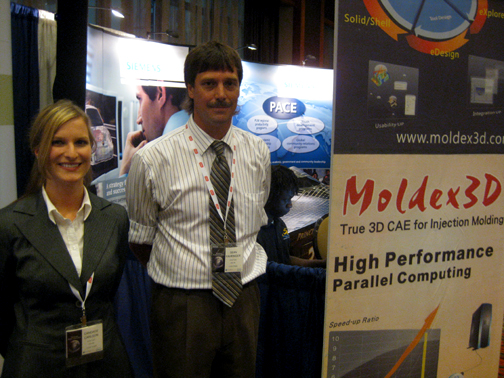
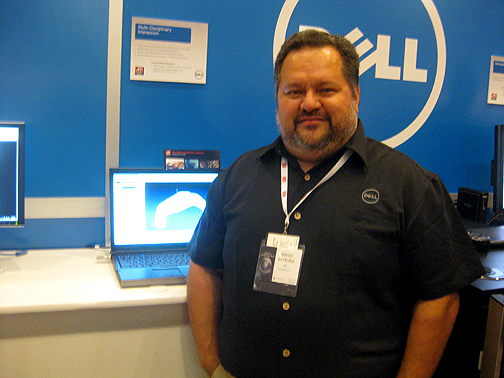
Recently, at Siemens PLM Connection 2010 (June 27-July 1, Dallas, Texas), I asked Diego Esteves, a systems engineer and consultant at Dell, and Sean Fahringer, a technical engineer at CoreTech, to discuss parallel computing.
Fahringer said, "The concept of parallel computing is, taking a large block of work and subsequently dividing it to be processed on the CPU cores available in a modern computer, in such a way so that each CPU core does its own section of that block ... each CPU core working on a much smaller section of that big, larger scope of the calculations in the math, so the benefit regards to its throughout is tremendous."
This approach is especially suited for mold-flow simulation, a specialty of CoreTech's Moldex3D software, because "The greater the degree of accuracy you strive for, it generally comes at the penalty of calculation time. The increase density of meshes increase the calculation time exponentially ... All things being equal, with regards to RAM and read/write access to the disk on computer, in an environment comparing single-core computers to multicore computers, the difference in improvement is exponential."
Esteves, who was demonstrating the Dell Precision M6500 mobile workstation, noted, "Today, on the CAD side, [parallel-computing support] is very much a limitation of the software. Software vendors have a little bit of catching up to do. A lot of the capabilities aren't [suitable for] multi-threading, but one of the things vendors can possibly do immediately is to take advantage of the auto-parallel feature in the compilers, so without changing the code, the compilers will seek places in the code that can be auto-paralleled."
My recorded conversations with Dell's Esteves and CoreTech's Fahringer are posted below:
For more on parallel computing in computer-aided engineering, look for my article on HSMWorks in July issue of Desktop Engineering.



Kenneth Wong is Digital Engineering's resident blogger and senior editor. Email him at [email protected] or share your thoughts or suggestions at digitaleng.news/facebook.
Follow DE
Join over 90,000 engineering professionals who get fresh engineering news as soon as it is published.






About Us · Contact Us · Editorial Team · Advertising · Privacy Policy · Subscriber Services · © 2026 Digital Engineering 24/7 · Peerless Media