Helping design and engineering professionals discover, evaluate and specify technologies and processes that shorten the design cycle and enable success.


Alert!
Digital Engineering ceased publication on July 1, 2026. This website remains available as an archive of engineering content.
For inquiries or information, please email [email protected].

May 2026 Special Focus: Artificial Intelligence in Design and Simulation
In this Special Focus Issue, learn about the latest developments in the integration of artificial intelligence into engineering workflows.

Design & Simulation Software Guide 2025
In this Special Issue, Digital Engineering presents its second annual guide to design and simulation software vendors.
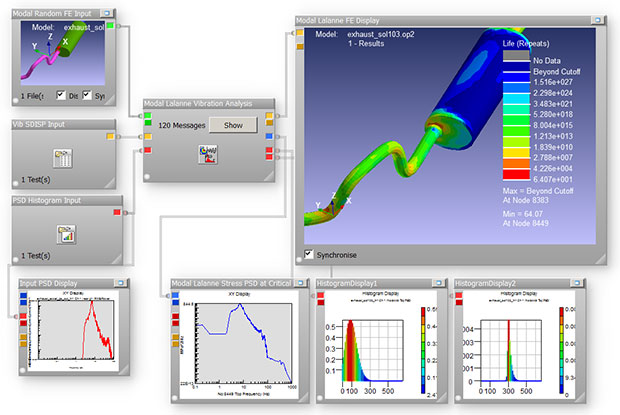 This nCode DesignLife image depicts the dynamic loading of an exhaust system by an acceleration profile. Here, DesignLife 11.0 uses the frequency response results from a finite element solution and the PSD (power spectral density) of loading to calculate the PSD of stress at every location in the finite element model. Image courtesy of HBM nCode.
HBM nCode has released version 11.0 of its nCode suite of durability engineering, test and analysis software. Version 11.0, according to the company, adds speed improvements for processing large amounts of data rapidly and additional methods for designing and validating components subjected to vibration excitation.
The nCode suite is made up of GlyphWorks for graphical data processing, nCode DesignLife for fatigue analysis applications and nCode Automation for managing data and automating analysis. nCode DesignLife, HBM nCode says, offers a complete, one-package fatigue solution from high cycle to low cycle, simple to multiaxial strain life and from crack initiation to crack growth. The company adds that it has made “significant improvements” to the Jiang plasticity model and the automatic analysis selection methods in this release.
For version 11.0, HBM nCode says that it enhanced the nCode DesignLife vibration fatigue solver in several areas of functionality, including new types of loadings, conditions and calculations. Added methods include multiple simultaneous PSDs (power spectral densities), Sine on Random and Sine Dwell loading, which, the company says, enables improved simulation of real-world conditions and offers benefits for engine and powertrain applications. DesignLife also supports modal superposition for larger models, more frequency steps, an expanded frequency range as well as better fidelity of results and faster analysis, according to the company.
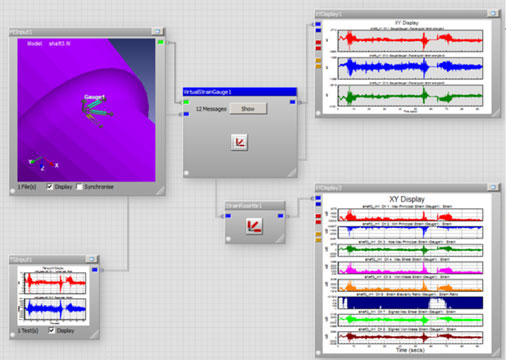
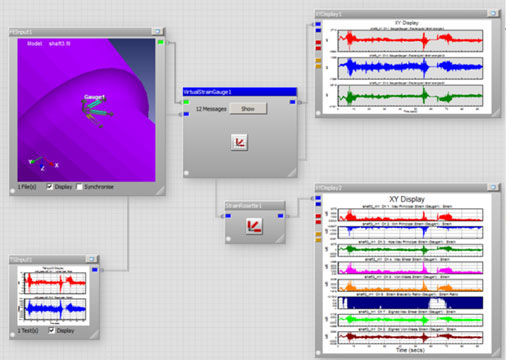 The Stress Gauge Analysis engine in nCode DesignLife 11.0 identifies suitable strain gauge locations for a load reconstruction process. Additionally, the gauge selection procedure can generate metrics that can help users select the appropriate number of gauges to use. Image courtesy of HBM nCode.
For virtual load generation, the Strain Gauge Analysis engine in nCode DesignLife provides virtual strain gauges. These gauges can be used to reconstruct loads from measured strains and to calculate input loads. The Strain Gauge Analysis engine in version 11.0 helps identify suitable strain gauge locations for a load reconstruction process, and the gauge selection procedure can generate metrics that assist in selecting the appropriate number of gauges to use.
Frequency analysis in version 11.0 sees new pre-defined processes for auto-correlation and cross-correlation of input data with various lags/scaling options. Convolution between input data and an impulse/filter kernel response can be performed. Other new features include a new waterfall analysis method, zoom analysis and the ability to generate Campbell plots.
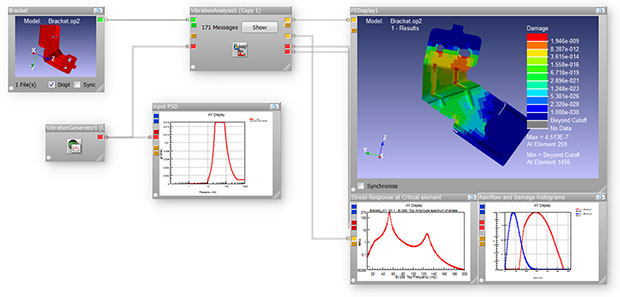 In version 11.0, the nCode DesignLife vibration fatigue solver sees such improvements as new types of loading, conditions, calculations and additional methods, including Sine on Random. Image courtesy of HBM nCode.
“nCode 11.0 focuses on new capabilities for vibration fatigue and frequency analysis, allowing engineers to avoid unnecessary overdesign and prevent operational failures,” said Paul Roberts, product manager at HBM nCode, in a press statement. “Additionally, significant improvements have been made to the overall execution speed of processing test data; for example, an aerospace customer has reduced analysis time of huge data sets with complex flows by 30%.”
In addition to the nCode suite of applications, the company also offers nCode CDS (Complete Durability System), which it describes as a cost-effective licensing method that offers flexible access to the full range of desktop products through licensing “CDS units.”
For more information about version 11.0 of the nCode suite of durability engineering, test and analysis software, visit HBM nCode.
Learn more about vibration and fatigue analysis in nCode 11.0.
Download the HBM nCode DesignLife 11.0 brochure.
Watch the “What’s New in nCode version 11.0” on-demand webinar.
Check out the HBM nCode library of upcoming and archived webinars.
Sources: Press materials received from the company and additional information gleaned from the company's website.


Anthony J. Lockwood is Digital Engineering's founding editor. He is now retired. Contact him via [email protected].
Follow DE
Join over 90,000 engineering professionals who get fresh engineering news as soon as it is published.






About Us · Contact Us · Editorial Team · Advertising · Privacy Policy · Subscriber Services · © 2026 Digital Engineering 24/7 · Peerless Media