Helping design and engineering professionals discover, evaluate and specify technologies and processes that shorten the design cycle and enable success.


Alert!
Digital Engineering ceased publication on July 1, 2026. This website remains available as an archive of engineering content.
For inquiries or information, please email [email protected].

Digital Engineering April 2026
In the latest issue of Digital Engineering, we take a look at the latest innovations in design for additive manufacturing, including the use of natural language inputs, social media cosplayers, and AI integration. The issue also includes a feature…

January Special Focus Issue: Design for Additive
In this Special Focus Issue of Digital Engineering, learn about the latest advancements in design for additive manufacturing, including new software tools, additive in automotive, custom medical devices, and more.
 Dear DE Reader:
Investment casting over wax patterns is among the oldest manufacturing processes. Remember King Tut? At his funeral some 3,000 years ago, royal attendants adorned his remains with investment casted doodads, idols and jewelry. They used beeswax for patterning. There's plenty of evidence that investment casting was a hit process a millennia before Tut.
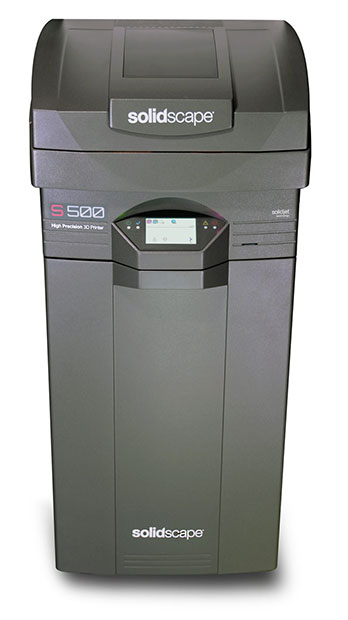
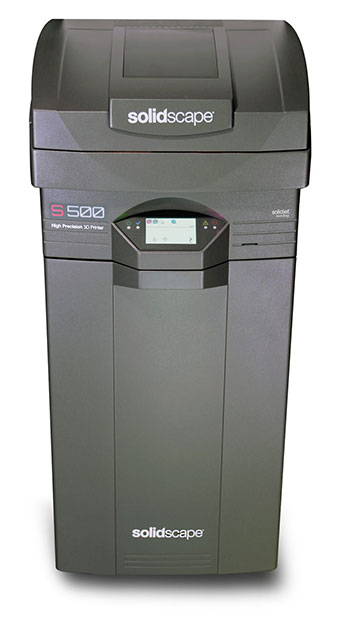 Shown here on its base platform, the new S500 3D printer for investment casting and rapid prototyping of complex geometries can produce wax patterns for direct casting in most metals and alloys. Image courtesy of Solidscape Inc.
Investment casting remains an industrial staple because it works so well. Sculpting patterns out of beeswax, however, has given way to CAD design, modern materials and 3D printing. Today's Editor's Pick of the Week looks at some new technology for this venerable process.
Solidscape recently announced its new S500 3D printer for high-precision investment casting and rapid prototyping. Actually, it was a dual announcement. They also launched new modeling and support materials that work well with the S500; more on them in a bit.
The S500 3D printer can produce wax patterns ready to be cast in most metals and alloys. Solidscape says that the S500 is designed to make the 3D printing of directly castable parts and the creation of custom molds from wax patterns repeatable and scalable. A key here is some new technology that builds support structures of solid wax. One particularly neat feature of the S500 is that it's a one-touch operator. It even has the ability to format your CAD files for 3D printing automatically.
OK, those materials. The Midas material is for modeling. It's formulated for casting metals like stainless steel, nickel and various alloys. It has a clean burnout without thermal expansion. The Melt-I support material provides the wherewithal for creating intricate patterns by reducing stress points on things like delicate details. It's non-toxic and dissolvable.
Now, put the materials and the S500 together. What this means for you is that you can design then 3D print wax patterns with complex geometries, undercuts, overhangs, thin walls and interlocking parts. As well, you should expect to get accurate results repeatedly. Solidscape says you should also be able to avoid burnout schedules and special equipment for a lot of work you need done. It also could save you a few weeks of production time compared to milling.
All in all, the S500 wax 3D printer and the new casting and support materials sound like nothing to tut-tut at. You can learn more about them from today's Editor's Pick of the Week write-up. The end links will take you to more granular details.
Thanks, Pal. – Lockwood
Anthony J. Lockwood
Editor at Large, DE


Anthony J. Lockwood is Digital Engineering's founding editor. He is now retired. Contact him via [email protected].
Follow DE






About Us · Contact Us · Editorial Team · Advertising · Privacy Policy · Subscriber Services · © 2026 Digital Engineering 24/7 · Peerless Media