Helping design and engineering professionals discover, evaluate and specify technologies and processes that shorten the design cycle and enable success.


Sponsored
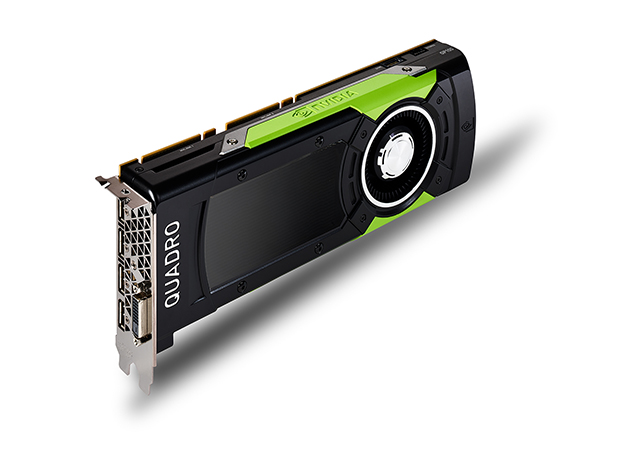


Artie Doyle's "The Adventure of the Abbey Grange" opens with Sherlock Holmes rousting sleeping Watson with urgent words: “The game's afoot ... Into your clothes and come!" Today's Editor's Pick of the Week is no game. But if you need supercomputing-class graphics processing horsepower on your workstation, come, read and hold on to your hat.
At SOLIDWORKS World, NVIDIA rolled out its new range of Quadro GPUs (graphics processing units). They're built around NVIDIA's high-performance Pascal microarchitecture and with designers, engineers and researchers in mind. These GPUs are now shipping to distributors and OEMs (original equipment manufacturers). And the top model in particular, the Quadro GP100, could change your understanding of what “workstation” means.
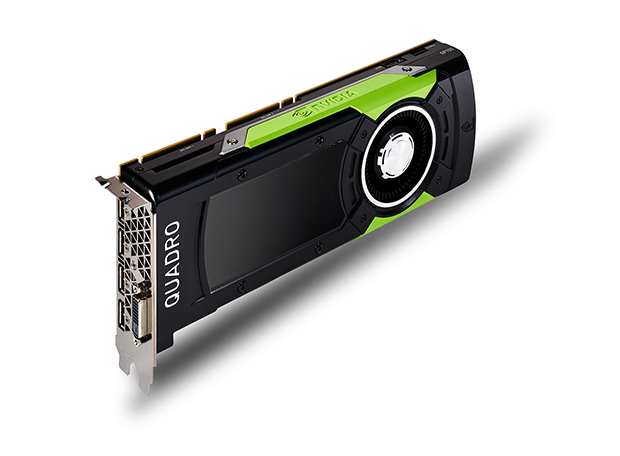 NVIDIA says that its new 16GB Quadro GP100 GPU (graphics processing unit) unifies compute and design, effectively transforming the average engineering desktop workstation with the power of a supercomputer. Image courtesy of NVIDIA Corp.
The Quadro GP100 basically brings HPC (high-performance computing) graphics horsepower to desktop workstations. It offers double-precision performance with 16GB of second-generation high-bandwidth memory (HBM2) and a 717GB per second memory bandwidth. The Quadro GP100 provides more than 20 TFLOPS of 16-bit floating-point precision computing. Single-precision (FP32) performance is 10 TFLOPS.
What does that mean for you? For one, you can run simulations while designing and get realistic multiphysics simulations quickly. Two, rendering should pop. Three, since it is VR (virtual reality) ready, you could integrate VR into your design and simulation workflows and be really cool. Four, you could use your workstation as a deep learning development platform.
You can also merge a pair of Quadro GP100 GPUs with NVIDIA's NVLink high-bandwidth, energy-efficient interconnect technology to scale to 32GB of HBM2 memory. That is, you could build a large-scale visual computing solution on a single engineering workstation.
The possibilities go on. But you can get an idea of what the Quadro GP100 could mean for design, CAE, rendering, artificial intelligence, VR and so forth, from a link at the end of today's main write-up to some benchmark results of a Quadro GP100 running Dassault Systèmes SIMULIA’s Abaqus/Standard FEA solver.
Speaking of Dassault, watch for NVIDIA to announce a May date for a joint webinar with Dassault and an engineering consultancy that'll introduce the Quadro GP100 to designers, analysts and anyone needing serious graphics processing. The webinar will look at modern design processes and offer real-world use cases enabled by Dassault 3DEXPERIENCE, its SIMULA CAE solutions and the Quadro GP100.
You can learn more about the Quadro GP100 from today's Pick of the Week write-up. Make sure to read those benchmark results. This could be your game changer.
Thanks, Pal. – Lockwood
Anthony J. Lockwood
Editor at Large, DE


Anthony J. Lockwood is Digital Engineering's founding editor. He is now retired. Contact him via [email protected].
Follow DE
Join over 90,000 engineering professionals who get fresh engineering news as soon as it is published.






About Us · Contact Us · Editorial Team · Advertising · Privacy Policy · Subscriber Services · © 2026 Digital Engineering 24/7 · Peerless Media