Helping design and engineering professionals discover, evaluate and specify technologies and processes that shorten the design cycle and enable success.


Alert!
Digital Engineering ceased publication on July 1, 2026. This website remains available as an archive of engineering content.
For inquiries or information, please email [email protected].

Cut Retrieval-Augmented Generation (RAG) Hallucinations by 50%
Most teams hit the same wall with enterprise AI: LLMs that hallucinate, pipelines that don’t scale, and infrastructure that’s harder to design than the models themselves.

What Is Intelligent BOM Management? A Guide to Smarter Product Development
Learn how intelligent Bill of Materials (BOM) management helps teams collaborate, reduce errors, and bring innovative products to market faster with cloud-based PLM tools.
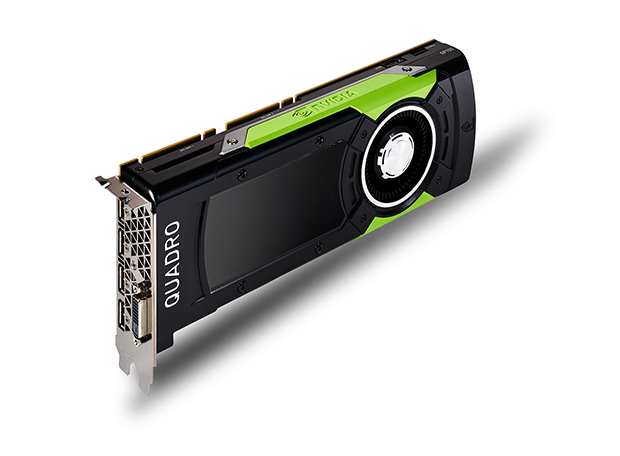 NVIDIA says that its new 16GB Quadro GP100 GPU (graphics processing unit) unifies compute and design, effectively transforming the average engineering desktop workstation with the power of a supercomputer. Image courtesy of NVIDIA Corp.
“Professional workflows are now infused with artificial intelligence, virtual reality and photorealism, creating new challenges for our most demanding users,” Bob Pette, vice president of Professional Visualization at NVIDIA, said in a press statement. “Our new Quadro lineup provides the graphics and compute performance required to address these challenges. And, by unifying compute and design, the Quadro GP100 transforms the average desktop workstation with the power of a supercomputer.”
Based on NVIDIA's Pascal architecture, the new Quadro GP100 GPU, which sits atop the Quadro lineup, offers up to twice the performance of the previous generation based on SPECviewperf 12 benchmark results and ultra-fast memory, the company says.
According to NVIDIA, the Quadro GP100, which is sized to fit engineering desktop workstations, unifies simulation, HPC (high-performance computing), rendering and design. It combines double-precision performance with 16GB of second-generation high-bandwidth memory (HBM2) that, NVIDIA says, enables users to conduct simulations during the design process and gather realistic multiphysics simulations faster. Memory bandwidth is 717GB per second.
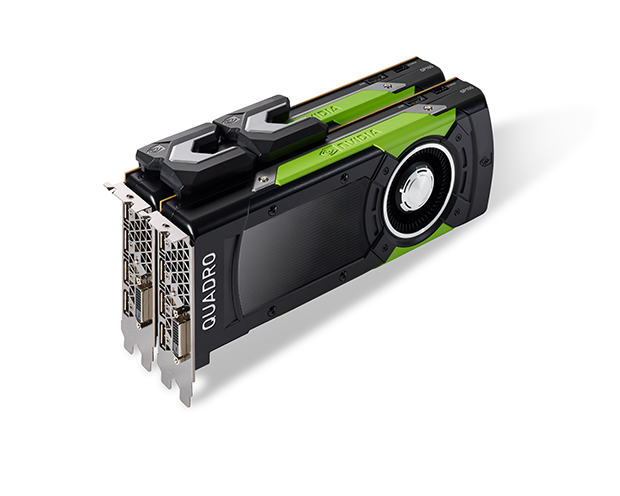 NVIDIA's NVLink interconnect enables data sharing between a workstation's CPU and a GPU (graphics processing unit) as well as between GPUs at rates from 5 to 12 times faster than a traditional PCIe Gen3 interconnect. Here, an NVLink combines two Quadro GP100 GPUs, which scales a single workstation to 32GB of second generation high-bandwidth memory. Image courtesy of NVIDIA Corp.
Users also can combine two Quadro GP100 GPUs with NVIDIA's NVLink high-bandwidth, energy-efficient interconnect technology and scale to 32GB of HBM2 memory to create a massive visual computing solution on a single workstation, according to the company. The company adds that with the Quadro GP100 users can visualize data in high resolution and HDR (high-dynamic range) color on up to four 5K displays.
The Quadro GP100 provides more than 20 TFLOPS of 16-bit floating-point precision computing. [Single-precision (FP32) performance is 10 TFLOPS; running in half precision (FP16) mode doubles the throughput to 20 TFLOPS.] This, says NVIDIA, makes it suitable as a development platform to enable deep learning in either a Windows and Linux environment. The Quadro GP100, as well as its sibling GPU, the P4000, are VR Ready and can be used to incorporate virtual reality into design and simulation workflows. Pascal-based Quadro GPUs, NVIDIA adds, can render photorealistic images more than 18 times faster than a CPU.
The entire NVIDIA Quadro Pascal lineup supports the latest NVIDIA CUDA 8 compute platform for building GPU-accelerated applications. The company says that this support provides developers access to new Pascal features in developer tools as well as performance enhancements and new libraries such as the nvGraph (NVIDIA Graphics) library of parallel algorithms for high-performance analytics.
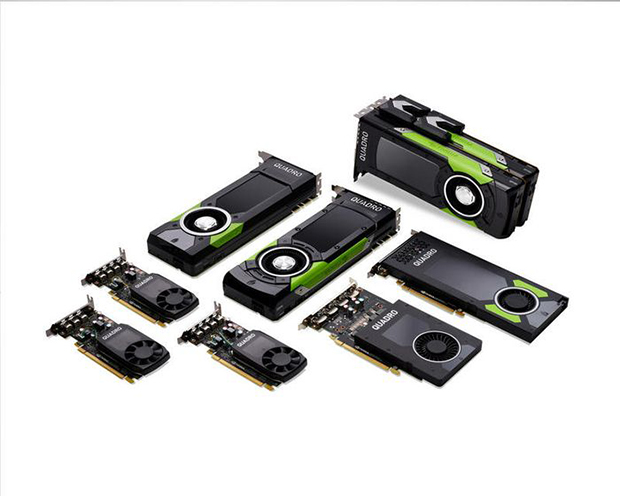 The complete NVIDIA Quadro Pascal lineup of graphics processing units. Image courtesy of NVIDIA Corp.
NVIDIA says that its new generation of Quadro Pascal-based GPUs—the GP100, P4000, P2000, P1000, P600 and P400—completes its entire NVIDIA Quadro Pascal lineup, which includes the previously announced P6000, P5000 and mobile GPUs.
NVIDIA reports that its Quadro GP100 GPU as well as its new generation NVIDIA Quadro products will be available shortly from engineering and design workstation manufacturers like Dell, HP, Lenovo and Fujitsu as well as authorized distribution partners such as PNY Technologies.
NVIDIA has also informed DE that it will soon open registration for a May webinar co-presented with Dassault Systèmes and the engineering consulting firm TEN TECH LLC. The webinar will feature Dassault's SIMULA brand of CAE solutions, including the Abaqus FEA (finite element analysis) solver, a key CAE component of Dassault's 3DEXPERIENCE software platform for design workflows. The webinar will explore real-world use cases enabled by the combination of Dassault's 3DEXPERIENCE, SIMULIA CAE tools and the Quadro GP100 GPU.
For more information on the Quadro GP100 and the new Quadro lineup, visit NVIDIA.
Learn more about Quadro GPUs for Design and Manufacturing.
Learn more about the NVLink interconnect.
See benchmark results of Dassault Systèmes SIMULIA’s Abaqus/Standard FEA solver running on the Quadro GP100.
See why DE's editors selected NVIDIA's new GP100 and Pascal-Based Quadro GPUs as their Pick of the Week.
Sources: Press materials received from the company and additional information gleaned from the company's website.


Anthony J. Lockwood is Digital Engineering's founding editor. He is now retired. Contact him via [email protected].
Follow DE
Join over 90,000 engineering professionals who get fresh engineering news as soon as it is published.






About Us · Contact Us · Editorial Team · Advertising · Privacy Policy · Subscriber Services · © 2026 Digital Engineering 24/7 · Peerless Media