Helping design and engineering professionals discover, evaluate and specify technologies and processes that shorten the design cycle and enable success.



May 2026 Special Focus: Artificial Intelligence in Design and Simulation
In this Special Focus Issue, learn about the latest developments in the integration of artificial intelligence into engineering workflows.

April 2026 Special Focus Issue: Generative Design
In this Special Focus Issue, Digital Engineering takes a look at how generative design solutions can be used across different types of design problems and with a variety of manufacturing approaches to accelerate design space exploration, and…
Women make up only 13% of the engineering workforce. That’s a pretty alarming statistic, and to change it, there is an active effort underway to foster interest in engineering among young female students, including DiscoverE’s recent Introduce a Girl to Engineering Day, celebrated on February 21.
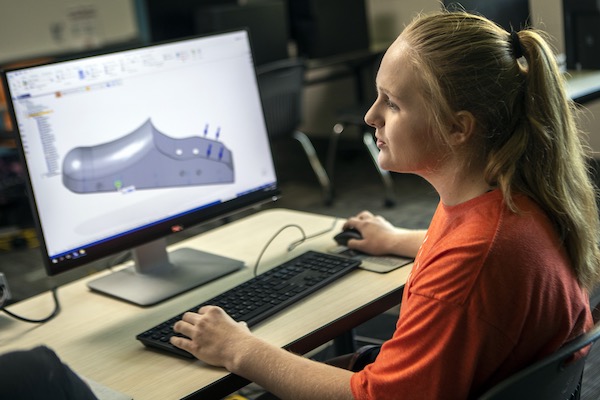
Timed to last week’s event, Siemens PLM Software showcased its own rendition of a rising female engineering star: Ashley Kimbel, a senior at Grissom High School in Huntsville, AL, who tapped the firm’s Solid Edge 3D design platform to create a lighter weight prosthetic foot for a U.S. marine wounded in Afghanistan.
Kimbel, 17, has her sights set on a career as a surgeon, but has immersed herself in various hands-on engineering initiatives at her school, including the Green Power auto racing program and projects in advanced manufacturing. Between all of the hands-on project work, and with encouragement from her parents, both engineers, Kimbel has covered some pretty impressive ground, including carbon fiber design, 3D printing and a professional certification in Siemens PLM Software's Solid Edge.
Kimbel is among a still relatively small pool of female students embracing science, technology, engineering and math (STEM). A study released by Microsoft, in partnership with KRC Research, found that despite the priority K-12 schools are placing on promoting STEM, efforts to expand interest among girls has not been universally successful. Lack of role models and support from parents is part of the problem, the study found. Girls lose interest in the field as time goes on. According to the study, 31% of girls thought jobs involving coding were not for them by middle school while the percentage jumps to 40% by high school.
Part of the remedy, the study concluded, is to create a more engaging and relatable STEM curriculum, including the types of hands-on projects that attracted Kimbel. When Devon Bane, a volunteer in her high school’s engineering programs, approached Kimbel about redesigning a prosthetic for his brother Kendall, she jumped at the chance to stretch her wings to solve a real-life biomedical engineering problem.
“I’ve always wanted to do something in the medical field, and this was the perfect combination of medicine and engineering,” she says.
Bane, who uses a heavy-duty foot to enjoy such activities as snow boarding and mountain biking, found he would tire easily due to the weight of the prosthetic. He was interested in the project to help the students immerse themselves in real-world engineering practices, including designing from a set of specifications, and to reap the benefits of a lighter weight prosthetic. “Something that would keep the fit and function, attach to my leg, be the same height, but would lower weight and allow me to do the activities I love without tiring out,” he explains.
For a year, Kimbel worked on the prosthetic replacement, tapping Solid Edge’s built-in 3D modeling, simulation and new generative design features to shave weight from the prosthetic. When Kimbel didn’t have a clear idea of what to do with the top portion design, she input specific parameters, including maximum strength and minimum weight, and let the software’s generative design features come up with possible iterations.
“The software came up with five or six results, helping us zero in on potential ideas faster,” she explains. Her goal: To reduce the 2.5-lb. prosthetic foot to around 1.7 lbs., she says.
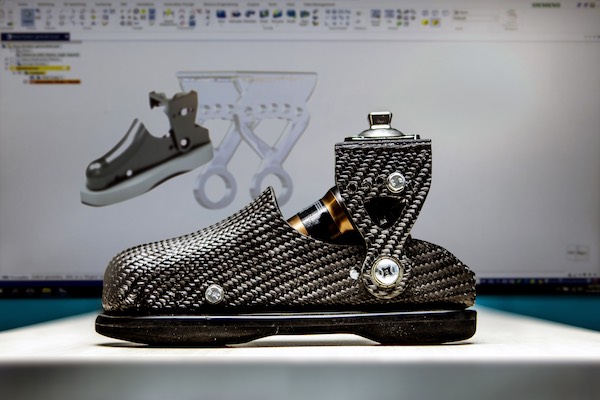
Generative design tools in Solid Edge helped model portions of the prosthetic foot to achieve specific lightweighting characteristics. Image Courtesy of Siemens PLM Software.
One year later, Kimbel revealed her lightweight prosthetic foot design to Bane and even landed a spot on the "Today" show to discuss her design success—and her passion for pursuing a career in STEM. Next year, she is heading off to the University of Alabama in Birmingham, to take the next step in her engineering studies.
Del Costy, Siemens PLM Software’s senior vice president and managing director, Americas, says he hopes Kimbel’s story will spark other students’ interest in pursuing engineering.
“They started with design requirements, went through the iterative process, validated concepts, got user feedback—it’s what happened here with this high school student and war veteran and it’s quite a story,” Costy says. “It’s important that we keep doing this and getting the tools into students’ hands as early as possible.”


Simcenter™ software, from Siemens Digital Industries Software, uniquely combines system simulation, 3D CAE and test to help you predict performance across all critical attributes earlier and throughout the entire product lifecycle. By combining…

Making the Case for Artificial Intelligence and Machine Learning in Engineering
In this paper, Siemens Digital Industries Software and Digital Engineering will provide an overview of how AI/ML-enabled software can improve design workflows, while also addressing common questions and concerns around implementing this technology in an engineering organization.

Beth Stackpole is a contributing editor to Digital Engineering. Send e-mail about this article to [email protected].
Follow DE
Join over 90,000 engineering professionals who get fresh engineering news as soon as it is published.






About Us · Contact Us · Editorial Team · Advertising · Privacy Policy · Subscriber Services · © 2026 Digital Engineering 24/7 · Peerless Media