Helping design and engineering professionals discover, evaluate and specify technologies and processes that shorten the design cycle and enable success.


Alert!
Digital Engineering ceased publication on July 1, 2026. This website remains available as an archive of engineering content.
For inquiries or information, please email [email protected].

May 2026 Special Focus: Artificial Intelligence in Design and Simulation
In this Special Focus Issue, learn about the latest developments in the integration of artificial intelligence into engineering workflows.

Design & Simulation Software Guide 2025
In this Special Issue, Digital Engineering presents its second annual guide to design and simulation software vendors.
EOS and Ansys are collaborating to provide an enhanced, streamlined workflow for developing AM parts. The new workflow teams EOS' metal systems for additive manufacturing with Ansys simulation solutions—equipping AM engineers to develop precise parts, improve productivity, slash production time and deliver new products faster, the companies report.
The new collaboration advances interoperability between EOS and Ansys technologies. As a member of the EOS Developer Network, Ansys will enhance user AM processes via Ansys simulations and expedite printing by sending jobs directly to EOS' 3D printing systems. Additionally, to enhance simulation fidelity, Ansys simulations integrate EOS-specific data by leveraging EOS' open-source application program interfaces.
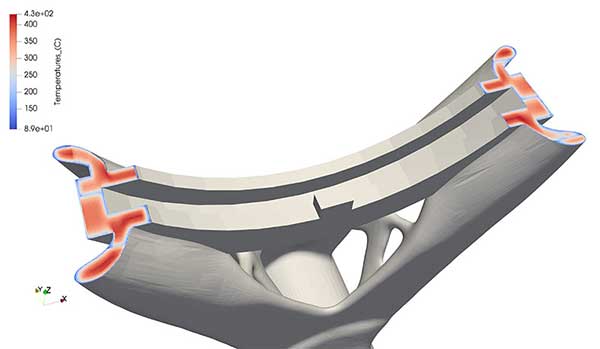
This integration will help improve part geometries by predicting and compensating for distortion and other issues to reduce build failure and upgrade manufacturing processes to increase productivity. It will also improve material property selection by forecasting how design changes will affect the microstructure of parts. With the new workflow, users designed complex print jobs up to 20% faster and simple jobs up to 50-60% faster than previous methods, according to the companies.
"EOS and Ansys are transforming how companies worldwide design parts, enhance products and create leading-edge inventions," says Martin Steuer, senior vice president, Division Software at EOS. "Combining Ansys simulations with EOS 3D printing technology creates a seamless workflow that enables our mutual customers to reduce spending, increase reliability, boost efficiency and deliver products to market much earlier than the competition."
"Leveraging EOS scan vectors, Ansys simulations calculate and predict issues such as porosity, residual stress, thermal distortion and help users avoid potential blade crashes. This collaboration provides new levels of insight to users, making it easier for them to build complex parts more precisely," says Shane Emswiler, senior vice president at Ansys. "Uncovering these issues early using simulation empowers engineers to select the correct parameters and understand if a part can be built as-is or must be redesigned—ultimately greatly minimizing the number of builds by substantially reducing trial-and-error failures, resulting in reduced material waste and substantial cost savings."
Sources: Press materials received from the company and additional information gleaned from the company’s website.

EOS enables their customers to produce innovative and high quality products based on industrial 3D printing technologies. EOS is a global technology and quality leader for high-end solutions in the field of additive manufacturing (AM). Founded in…

Industry Focus: Designing for Industrial Machinery and Heavy Equipment
The articles compiled in this special digital issue focus on how vendors are reacting to the need to digitize the factory floor and connect it all the way back through the enterprise to front-end product design and development.

DE's editors contribute news and new product announcements to Digital Engineering. Press releases may be sent to them via [email protected].
Follow DE
Join over 90,000 engineering professionals who get fresh engineering news as soon as it is published.






About Us · Contact Us · Editorial Team · Advertising · Privacy Policy · Subscriber Services · © 2026 Digital Engineering 24/7 · Peerless Media