Helping design and engineering professionals discover, evaluate and specify technologies and processes that shorten the design cycle and enable success.


Alert!
Digital Engineering ceased publication on July 1, 2026. This website remains available as an archive of engineering content.
For inquiries or information, please email [email protected].

Digital Engineering April 2026
In the latest issue of Digital Engineering, we take a look at the latest innovations in design for additive manufacturing, including the use of natural language inputs, social media cosplayers, and AI integration. The issue also includes a feature…

January Special Focus Issue: Design for Additive
In this Special Focus Issue of Digital Engineering, learn about the latest advancements in design for additive manufacturing, including new software tools, additive in automotive, custom medical devices, and more.
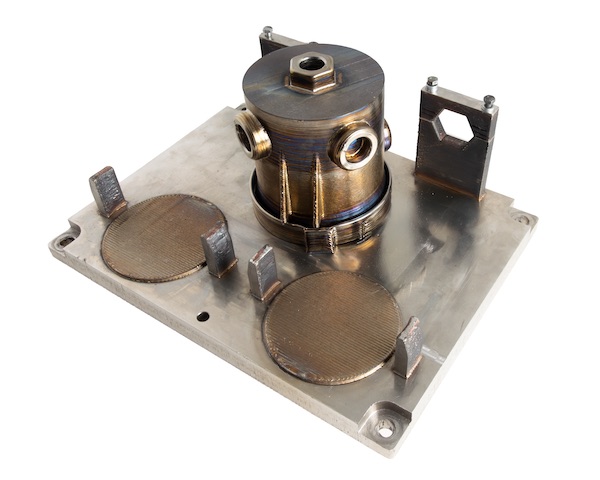
An ExxonMobil refinery in Baton Rouge, LA, has improved the design and performance of an anti-wicking device using Meltio's M600 laser metal deposition (LMD) sytem to print the part in titanium. The resulting redesign reduced costs by 42% and lead times by 90%.
The existing anti-wicking device, designed to prevent oil from wicking up thermocouple wires into the instrument cabinet, suffered from significant design and operational limitations. It was traditionally built using subtractive manufacturing methods. The company was able to redesign the device and print it in titanium, which achieved structural improvements and cost savings.
“Before wire-ded we never thought about having parts in titanium because it was very expensive, but after moving to Meltio’s technology we discovered it’s quite affordable,” said an ExxonMobile representative in a press release.
The company decided to move from the original material to a more efficient and effective one. After considering and testing several options, Titanium 64 was chosen: It is a lighter and cheaper material compared to the original, and a material already parameterized with Meltio’s technology. However, adapting these heavy-duty components for additive manufacturing presented distinct metallurgical and operational hurdles.
Atmospheric requirements: The chosen material, Titanium 64, requires a strictly inert environment to achieve optimal microstructural properties. Generating this atmosphere demands approximately one and a half hours of machine time to remove oxygen prior to printing.
Thermal constraints: Titanium requires a minimum layer time of seven minutes to avoid overheating, making standard single-part production inefficient due to excessive idle times.
Deposition defects: Initial printing trials of the main body revealed surface oxidation caused by localized thermal accumulation, alongside material overbuilding on lateral clamping wings. Furthermore, rapid travel movements during printing physically shifted the unanchored main body, causing the laser to lose focus.
“Titanium has historically been a material limited by its high machining and manufacturing costs. Metal filament additive manufacturing opens the door to democratizing its industrial use, making applications that were previously unfeasible economically viable," said Luis Sanchez, managing director at Meltio.
Refinery equipment has to survive extreme conditions and constant vibration. By redesigning the component and locking it firmly in place during the printing process, ExxonMobil and Meltio created a solid, leak proof titanium barrier that easily meets the strict reliability standards.
To maximize chamber inertization efficiency, engineers additively manufactured a custom fixture using SS-316Lsi deposited onto an SS304 base plate. This tooling enabled the batch production of four components simultaneously, naturally increasing inter-layer dwell times and eliminating surface oxidation issues.
The main body was redesigned with a 75-degree overhang limit. To avoid complex support structures, the team implemented a non-planar printing approach. Using the M600 probing functions, the machine executed a Z-axis touch-off at the lowest substrate point, depositing features directly onto the curved surface. The lid was also redesigned to incorporate hollow perimeters specifically designed to hold a silicone sealant.
Material overgrowth was successfully mitigated by significantly decreasing laser power and print speed in specific localized regions. To prevent workspace displacement during non-extrusion travel moves, robust mechanical clamping was added to both sides of the fixture, locking the components rigidly into their coordinate systems.
In addition to cost savings, production lead time decreased drastically from an estimated 4 to 6 weeks down to exactly 58.8 hours.
“This successful industrial use case highlights something very significant for the industry: metal additive manufacturing is no longer a laboratory technology, but a real industrial tool for critical sectors such as energy, petrochemicals, and defense," Sanchez said. "The ability to manufacture complex titanium components while reducing costs, lead times, and logistical dependence is a complete game-changer.”
Sources: Press materials received from the company and additional information gleaned from the company’s website.


DE's editors contribute news and new product announcements to Digital Engineering. Press releases may be sent to them via [email protected].
Follow DE






About Us · Contact Us · Editorial Team · Advertising · Privacy Policy · Subscriber Services · © 2026 Digital Engineering 24/7 · Peerless Media