Helping design and engineering professionals discover, evaluate and specify technologies and processes that shorten the design cycle and enable success.


Alert!
Digital Engineering ceased publication on July 1, 2026. This website remains available as an archive of engineering content.
For inquiries or information, please email [email protected].

May 2026 Special Focus: Artificial Intelligence in Design and Simulation
In this Special Focus Issue, learn about the latest developments in the integration of artificial intelligence into engineering workflows.

Design & Simulation Software Guide 2025
In this Special Issue, Digital Engineering presents its second annual guide to design and simulation software vendors.
In addition to being a fully integrated FEA multiphysics toolbox, and interfacing with the FEniCS FEM solver and external mesh generators such as DistMesh, GiD, Gmsh, and Triangle, the major new feature of FEATool 1.8 is a fully integrated and cross-platform OpenFOAM CFD Solver GUI interface for MATLAB and GNU Octave.
The new MATLAB CFD interface for the OpenFOAM CFD solver now allows users to conveniently model both laminar and fully turbulent incompressible Navier-Stokes CFD problems all within a graphical user interface (GUI). The integrated FEATool-OpenFOAM interface features
With the added support for the OpenFOAM CFD solver and FEniCS, high-performance multiphysics, multi-simulation and CFD modeling can now be all be conveniently done within an easy-to-use and self-contained software interface.
FEATool 1.8 features a new and improved CAD and geometry engine completely written in the MATLAB m-script language for maximum efficiency and portability. The new CAD engine significantly improves performance and accuracy, especially with respect to treatment of 3D geometries. Moreover, both 2D (planar) and 3D STL CAD file import is now also fully supported, allowing for more complex geometries to be modeled in FEATool Multiphysics.
Following are some highlights:
For more info, visit Precise Simulation.
Sources: Press materials received from the company.

DE's editors contribute news and new product announcements to Digital Engineering. Press releases may be sent to them via [email protected].
Follow DE






About Us · Contact Us · Editorial Team · Advertising · Privacy Policy · Subscriber Services · © 2026 Digital Engineering 24/7 · Peerless Media
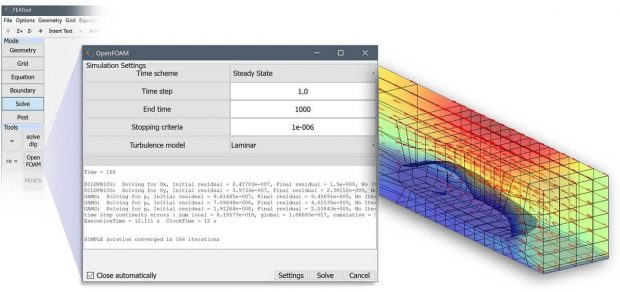 OpenFOAM. CFD solver integration. Image courtesy of Precise Simulation.