Helping design and engineering professionals discover, evaluate and specify technologies and processes that shorten the design cycle and enable success.



Digital Engineering April 2026
In the latest issue of Digital Engineering, we take a look at the latest innovations in design for additive manufacturing, including the use of natural language inputs, social media cosplayers, and AI integration. The issue also includes a feature…

January Special Focus Issue: Design for Additive
In this Special Focus Issue of Digital Engineering, learn about the latest advancements in design for additive manufacturing, including new software tools, additive in automotive, custom medical devices, and more.
It’s been just about a year since Formlabs launched its first additive manufacturing (AM) system, the Form1. The company is certain it’s learned a thing or two since then and is ready to improve on its rookie offering with the introduction of the Form1+.
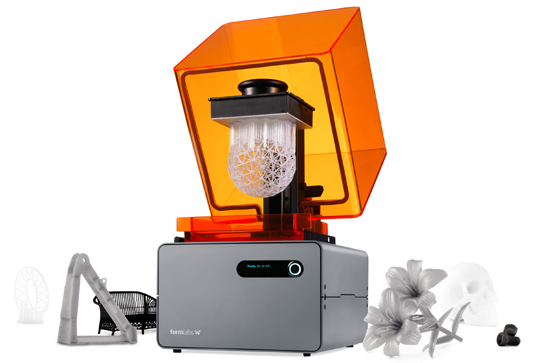 Formlabs second generation SLA 3D printer, the Form1+. Courtesy of Formlabs.
“The Form 1+ incorporates everything that we’ve learned in the past year,” said Ian Ferguson, lead engineer at Formlabs. “We’ve given every part of the machine another look, updating it for better performance and reliability: a new laser, a new control system, and upgraded precision and quality for dozens of components.”
According to Formlabs, the new system builds objects up to 50% faster than the previous model thanks to a second generation laser system the company says is four times more powerful than the original. The Form1+ comes with a one-year warranty, and is meant to be ready to print out of the box in as little as 15 minutes.
The Form1+ shares the same specs as the first generation AM system, with a layer thickness of 25 microns, and a build envelop of 125 x 125 x 165 mm (4.9 x 4.9 x 6.5 in). Print speed comes in at around 1-3 cm/hour along the Z axis. The new system will go on sale for $3,299 (same as the original), and owners of the first generation system can upgrade for $749.
Formlabs also announced new shipping rates and increased support for European customers, along with a new black resin. Both black and standard clear resins are priced at $149 per liter.
Below you’ll find a video from Formlabs introducing the Form1+.
Source: Formlabs


John Newman is a Digital Engineering contributor who focuses on 3D printing. Contact him via [email protected] and read his posts on Rapid Ready Technology.
Follow DE
Join over 90,000 engineering professionals who get fresh engineering news as soon as it is published.






About Us · Contact Us · Editorial Team · Advertising · Privacy Policy · Subscriber Services · © 2026 Digital Engineering 24/7 · Peerless Media